

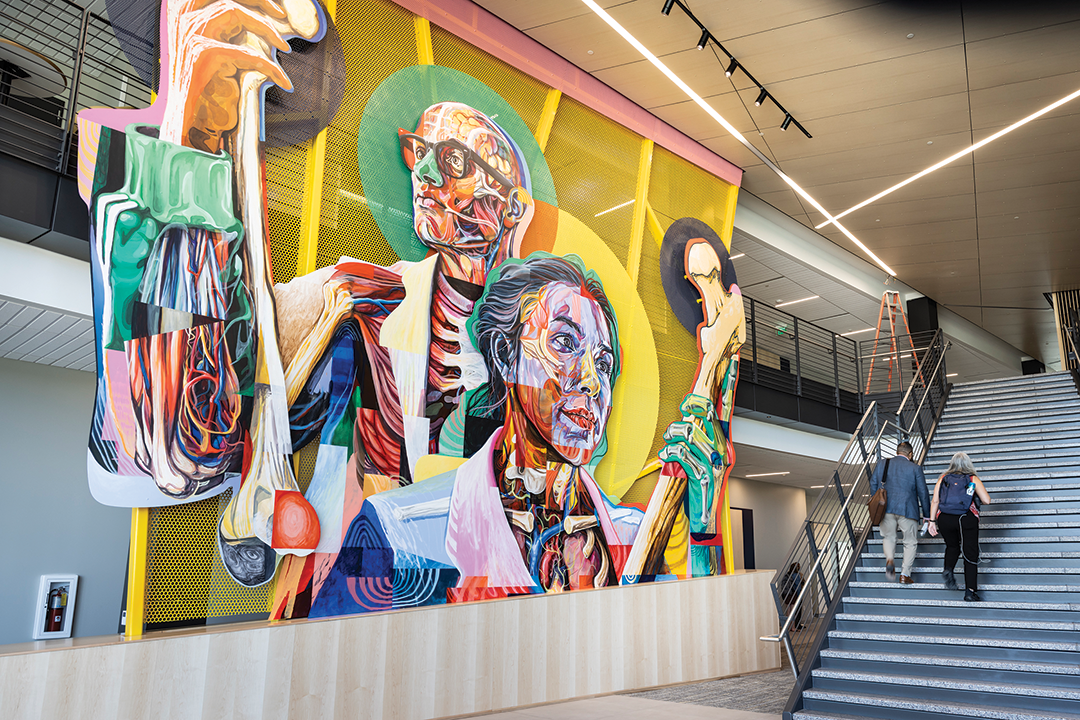
Last year, Colorado had enough doctors to meet only 45 percent of the demand for primary care, according to the Kaiser Family Foundation. That statistic reflects a growing trend across the nation that has worried many healthcare workers.
Margo Karsten, an executive with Banner Health, was one of them. In 2021, she called University of Northern Colorado President Andy Feinstein and told him there weren’t enough doctors to replace her hospitals’ aging workforce. Three years later, Feinstein and other higher education leaders convinced state lawmakers to allocate the funding they needed to educate more Colorado students in life sciences. In all, the state gave $247 million to build or expand programs at four universities.
Over half of that funding—about $178 million—went to two universities in Northern Colorado. This summer and fall, the University of Northern Colorado and Colorado State University opened new facilities with the promise that more health professionals will work in the region to care for people and animals.
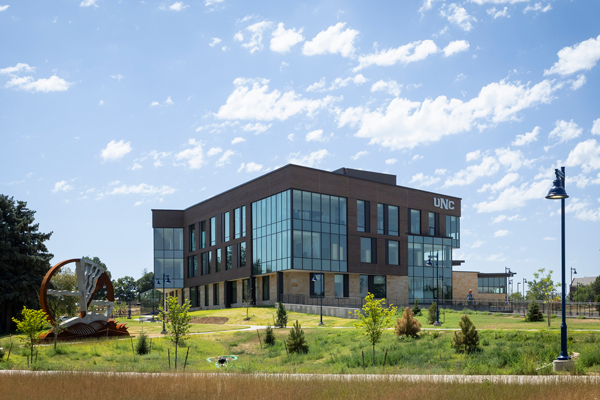
Photo courtesy of the University of Northern Colorado.
UNC College of Osteopathic Medicine
The College of Osteopathic Medicine at UNC in Greeley welcomed its first class of 80 students over the last few months. Colorado has two other medical programs—the University of Colorado Anschutz School of Medicine in Aurora and Rocky Vista University in Parker—but they cannot produce enough new doctors to meet the current and future demand, Feinstein wrote in a letter in 2023, when the project was first proposed. According to the university, 61 out of Colorado’s 64 counties have shortages of primary care doctors.
Feinstein, who ended his tenure with UNC on Aug. 1, said in the letter that the creation of the college was a response to the community “calling on UNC to act.”
“We find ourselves positioned to meet another critical challenge that will shape the health, strength and growth of Greeley, Weld County and the state for many years to come,” he wrote.
The resulting $200 million, 110,000-square-foot facility drew $128 million in state funds from the 2024 legislation and $34 million from private donors to become a reality, says Beth Longenecker, founding dean of the new college at UNC. The state also allocated $42 million in reserves that UNC is required to hold in escrow as part of the accreditation process, Longenecker says.

Photo courtesy of the University of Northern Colorado.
Once it is operating at capacity, the osteopathic college will train about 155 medical students every year to become fully licensed physicians who compete for the same residency programs as Doctors of Medicine (MDs), but with a few unique points of focus, Longenecker says.
Doctors of Osteopathic Medicine (DOs) treat their patients with the philosophy that the body, mind and spirit are one interconnected unit that requires equal care to have good health, Longenecker says. The “spirit” element can come in the form of religious faith, inner hope or emotional wellbeing, according to the American Association of Colleges of Osteopathic Medicine, and DOs are specifically trained to engage with and listen to their patients. DOs also offer extra therapeutic treatments for the musculoskeletal system, which they see as fundamental for motion and healing.
DOs have successfully practiced medicine for over 150 years, Longenecker says. In fact, more than a quarter of primary care doctors—about 28 percent—are DOs, she says.
Among doctors trained in osteopathic medicine, most go on to practice primary care, Longenecker says. That’s what made UNC’s College of Osteopathic Medicine ideal for Colorado, where the projected shortage of doctors is largely in primary care.
On the UNC campus, the osteopathic college stands in place of Bishop-Lehr Hall, formerly a lab school for UNC’s College of Education that was razed after sitting empty for 15 years, Longenecker says. A wall memorializing the education lab now accompanies the new building.
Inside, the learning spaces reflect a focus on clinical practice rather than lectures, Longenecker says. Students work with high-tech mannequins or actors who pretend to be patients, and classrooms are designed for students to sit in groups and interact with their instructors. There are also several labs, including one dedicated to osteopathic manual treatment, which uses pressure, stretching and movement to ease pain and help the body heal.
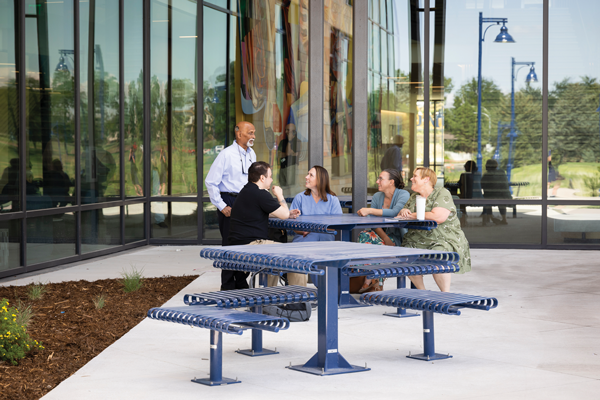
Photo courtesy of the University of Northern Colorado.
The new college is already solidifying its place in the Northern Colorado community, Longenecker says. Banner Health has committed to hosting more than 60 percent of UNC’s medical student rotations within the next few years, and the school is developing a partnership with Sunrise Community Health clinics, she says. UNC is also exploring how the new facility can be accessed by its other students, such as those in its existing nursing program, and students at Aims Community College who are training to provide emergency medical services.
Over the next 20 years, the College of Osteopathic Medicine is expected to create more than 760 new jobs in Weld County, bringing a $500 million economic impact to the region, according to an analysis provided by the university. UNC alone plans to hire 70 people in the coming years to support the growth of the college, Longenecker says.
As dean, Longenecker is particularly proud of the individuals who make up the college’s inaugural medical class. Similar to the rest of the UNC student body, the class of hopeful doctors includes a number of first-generation college students and many who come from “educationally disadvantaged” places, she says, meaning they live in areas where high schools receive less government funding. To review student applications, UNC equally weighed school performance and character, she says.
“Fifty percent is your academics, and 50 percent is what you bring to the table as a human being: your commitment to community, your commitment to research or your commitment to leadership,” she says. “We managed to really knock that one out of the park.”
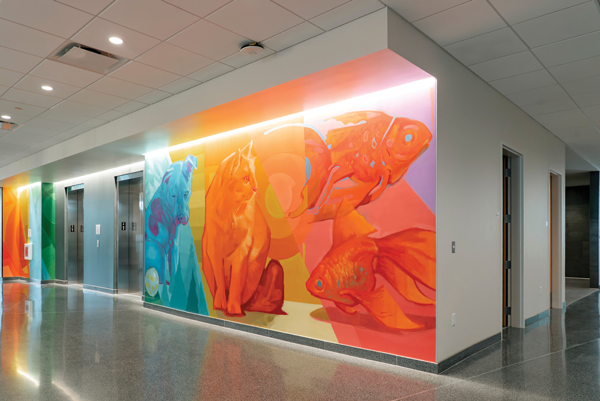
Photo courtesy of CSU Photography.
CSU Veterinary Hospital and Education Complex
Colorado State University’s bid for a new space to educate veterinary students and treat animals also stemmed from a shortage of veterinarians in the state, especially in rural areas. The resulting $234 million project at CSU’s South Campus in Fort Collins opened its doors to students in August.
From 2021 to 2026, the number of Colorado counties that were classified as veterinary service shortage areas increased from eight to 14, according to the U.S. Department of Agriculture. Most of them, including Weld County, severely lack private practice veterinarians who can work with livestock producers in rural areas.
The new Veterinary Hospital and Education Complex (VHEC) will allow CSU to expand its class size for the Doctor of Veterinary Medicine program by about 30 students, which is a 20 percent increase, says Matthew Johnston, a professor with CSU’s Veterinary Teaching Hospital. This fall’s class has 168 students, up from 138, and the full veterinary program has grown from 600 to 720 students, according to materials provided by the university. Out of the 168 seats, about 57 are reserved for Colorado residents, Johnston says.
Johnston was involved in the creation of the VHEC from its inception. Originally, the facility emerged amid efforts to modernize CSU’s veterinary curriculum, he says. He was tasked in 2018 with learning how CSU could update its veterinary program and keep its place as one of the top veterinary schools in the nation. His research quickly directed the school toward a reduction in traditional classroom work and an increase in hands-on learning.
An eight-year project ensued to build the VHEC, a 213,000-square-foot space where veterinary students learn by providing care to animals. Previously, CSU’s veterinary program owned just two labs—one for anatomy and one for microscopy—and three lecture halls, Johnston says.

Rachel Yager. Photo courtesy of CSU Photography.
“That’s just not enough to do all the active learning, group work and creative thinking that we need,” he says.
To fund the project, the 2024 state legislation provided $50 million, and donors contributed approximately $12 million, says Rachel Yager, a spokesperson for CSU’s veterinary school. University contributions covered about $172 million, she says.
Students can practice real medicine in their studies at the VHEC thanks to two dozen new exam rooms and an expanded primary care suite that will more than triple students’ time doing hands-on practice, Johnston says. The added space is particularly important, given that 70 percent of CSU’s vet graduates end up in primary care jobs, he says.
The VHEC also features a new livestock hospital, a small animal isolation unit for animals with highly contagious diseases, an innovation space with 3D printing and silicone modeling and a simulation area where students can practice common veterinary situations. The complex also includes upgraded spaces for emergency, critical and urgent care as well as a pharmacy, according to project materials provided by the university.
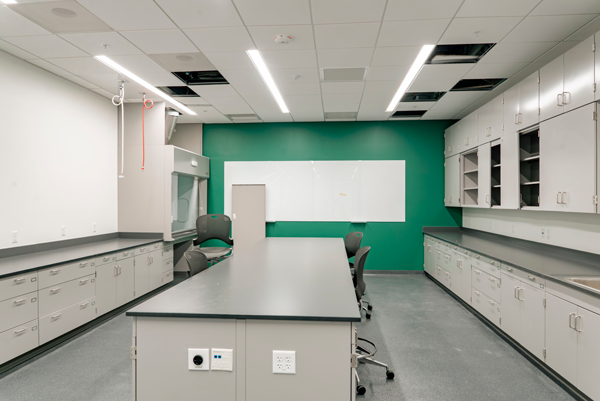
Photo courtesy of CSU Photography.
Students in Front Range Community College’s veterinary technician track will also have access to the facilities, Johnston says, as will hundreds of other CSU students who are enrolled in the Master’s in Veterinary Clinical Care program or undergraduate biomedical studies.
For the surrounding Northern Colorado community, the expansion means that CSU will have more resources to care for local animals and bolster its reputation as a magnet for veterinary students. The veterinary health system currently cares for 42,000 animals and performs 500,000 diagnostic tests per year, according to the university.
The added capacity and features at the facility have undoubtedly raised awareness of CSU’s capabilities in veterinary medicine, Johnston says, and they will allow the school to tout a program that is on the cutting edge of the practice.
“This really puts us as the most progressive veterinary school in the world,” he says.