


Emily Robinson struggled for years with addiction to meth, heroin and alcohol, but things finally started to look up when she moved to Colorado in 2019. At age 26, she’d just finished a 28-day inpatient program in Texas and was referred to a facility in Denver. When she was ready to transition out of that facility and into a sober living house, she faced a new problem: Her dog, Albie, couldn’t stay there with her.
Robinson was told she had two weeks to find somewhere else to put Albie. The news was heartbreaking: He was the only thing providing her comfort and a sense of familiarity. She couldn’t bear the thought of letting her loving hound mix go.
“I knew I needed to be in that supportive environment, and I realized that if it came down to it, I’d have to give him up for adoption,” she says. “That would’ve been really hard to move past as someone in early recovery.”
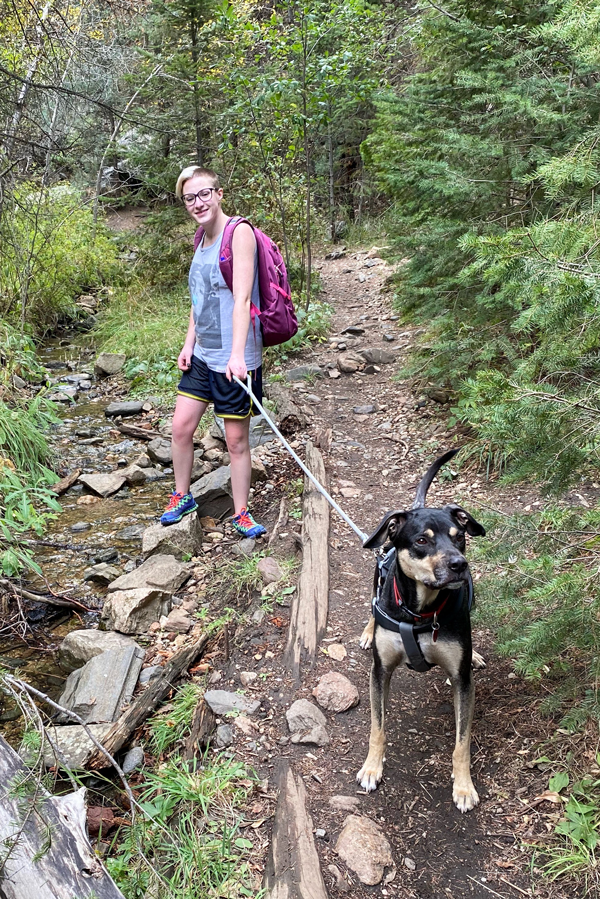
Emily and Albie
Robinson didn’t have the money to board Albie, and she didn’t know anyone in Denver who could help, so she frantically searched for places that might take him in. Then she found Until They’re Home, a nonprofit that secures temporary homes for pets of people in crisis.
Keeping pets out of shelters
Molly Obert co-founded the organization after working with animal shelters as a dog behaviorist. She noticed that many people surrendered their pets for reasons that were solvable and that the stressful shelter environment generally made those problems worse. As a result, more animals were being euthanized.
“There would be a person who had a dog with separation anxiety, and their landlord would say, ‘If this dog can’t be in a crate, they’ve got to go,’” Obert says. “With meds, a crate and a little bit of training, that dog could probably stay in the home.”
Frustrated, Obert started taking those pets into her home and found a few other fosters who could help keep them out of the shelter. Some of the animals had behavioral challenges, but many of them just needed a place to stay while their owner was in the hospital, at a homeless resource center, in a treatment facility or escaping domestic violence.
As more pets came to Obert, so did more people who were willing to take them in. She formed a small team, including a volunteer and foster coordinator as well as a cat expert. Until They’re Home now manages dozens of volunteers and nearly 100 fosters from Colorado Springs to Laramie, Wyo.
“We help people who would otherwise have to surrender their animals to the shelter,” Obert says. “They’re providing a loving environment for their animals, and if they just had a little bit of support, they could keep them.”
The coordination is a constant challenge, Obert says, as some fosters can take in pets for weeks or months, while others can only help out on weekdays or weekends. With about 30 active fosters at a time, her team plays a never-ending game of Tetris to make sure each animal is placed in a safe home that fulfills its needs. Until They’re Home is licensed with PACFA (Colorado’s Pet Animal Care and Facilities Act program), and their fosters are thoroughly vetted.
“We always have plans A, B, C and D,” Obert says, taking into consideration the fosters’ own dogs, cats and kids as well as their availability and experience level before placing an animal in their care. “Having two-to-three fosters lined up for one dog is the best way to do it. My home is always plan C, and plan D might be a boarding facility—if I have funds for that.”
Inconsistent funding means Obert can only accept seven percent of pet owners looking for a foster home. She equips each foster with pet food and supplies and covers the cost of veterinary care and occasional boarding, all of which quickly add up. But she’d rather make sure those animals are well taken care of than spread her resources too thin.
“I have to say no, otherwise I would end up with 100 animals at my home,” she says. “That’s not sustainable for anybody.”
Eliminating barriers
It’s rare when owners can’t take their pet back after their fostering term is up. Obert limits it to four months and prioritizes applicants who have a caseworker to help them get into treatment or find stable housing. Those environments generally don’t allow pets, and she doesn’t want their animals to prevent them from finding a way to turn their lives around.
That was the case for Kristen Baltrum’s sister, Annie, who experienced homelessness with her dog, Millie. When Annie sought help at a resource center, she was told that she could come in, but her dog couldn’t. So she turned her back on those services and continued living on the streets with Millie. She died by suicide seven months later.
“I believe that if she’d gotten into the shelter with her dog, she would have gotten access to the services she needed,” Baltrum says.
In response, Baltrum founded the Longmont-based nonprofit, Annie & Millie’s Place, to provide resources for people experiencing homelessness so they can stay with their pets. She works with Obert to find fosters for those animals while their owners secure housing.
Both occasionally face backlash from people who think the homeless shouldn’t have pets, a notion Baltrum once shared. Now she counters with a book recommendation: “My Dog Always Eats First” by Leslie Irvine, a retired sociology professor at the University of Colorado Boulder.
Irvine studied the human-animal bond between those experiencing homelessness and their pets. She found that they are not only loyal to one another, but that the animals are well cared for.
“Millie said yes to Annie every time. She was up for traveling, sleeping outside and going for walks. If I was Annie, I wouldn’t want to say no to Millie,” Baltrum says. “What I don’t understand is why that bond that provides purpose, protection, unconditional love and companionship needs to be a barrier to safe, secure housing and the help people need most.”
While Annie’s story is tragic, others don’t have to be. Robinson, now 32, has stayed sober and currently manages a coffee shop in Denver. After she and Albie were reunited, they lived in a house with a yard, where they spent a lot of time together before he passed.
“The silver lining was that I was in a place where I could take the very best care of him,” she says. “The way he had taken care of me.”
______________________________________________________
Judgment-free Rehoming
Much of the funding for Until They’re Home’s fostering program comes from adoption fees. Obert’s PACFA license allows her to adopt out animals when their owner or a shelter requests it—something she does without judgment because she knows that sometimes animals do need to be rehomed.
“I don’t want a dog in a home where the humans don’t want him there,” she says. “I don’t care what the reason is. It could be that he scratched their couch or chewed up their cushions. I want that dog to be in a home where he can chew up everything he wants and still be loved and adored.”
______________________________________________________

Until They’re Home is hosting one of their two annual fundraisers, the Unleashed Rock Fest for Rescues, at 7 p.m. Oct. 17 at the Aggie Theatre. See the Dead Pioneers, I Am the Owl, Plasma Canvas and Wicked Vixen perform live while benefiting animals in need.