
Hundreds of millions of years ago, Colorado lay beneath a shallow sea known as the Western Interior Seaway. Small, shelled invertebrates—ancestors of modern clams and snails—thrived here, forming the bottom of a food chain that would eventually support massive prehistoric reptiles.
As the region dried and shifted, the land uplifted to form the Rocky Mountains. Ridges emerged along what we now know as Devil’s Backbone Open Space, Horsetooth Reservoir and the Boulder Flatirons, exposing layers of rock that help paleontologists unearth the creatures who once lived here. You can discover them too, if you know what to look for.
Back to the Cretaceous Period
The most common fossils found in Northern and north-central Colorado date back 66 to 145 million years to the Cretaceous period. According to Ray Tschillard, founding director of the Poudre Learning Center in Greeley and a retired geo-educator, the soft shale and sandstone formed in that underwater environment were ideal for preserving traces of ancient life, from insect tunnels and footprints to bones.

Weld County Gaston Design fossil finishing of Pops.
A local celebrity dino
Weld County’s official dinosaur, Pops, was discovered by a University of Colorado professor in 1982. He’d received permission from the lessee of a ranch near Briggsdale and the Pawnee National Grassland to hunt for small fossils on the property. While walking back to his car, he noticed a bone sticking out of the ground.
“It turned out to be this remarkable skull that was almost completely intact,” says Natalie Toth, chief fossil preparator at the Denver Museum of Nature and Science.
Nearly half of the skull was recovered, along with parts of the Triceratops’ ribs, tail bones and back bone, a rarity likely due to the undisturbed location.
While Triceratops fossils are relatively common in Colorado, Pops stands out. It’s older than most known Triceratops by one to two million years. The skull was found in what’s known as the Laramie Formation, dating back 68 to 70 million years, while most are 66 to 68 million years old. Pops lived a long life, too. Arthritic joints in Pops’ tail bones suggest it lived to old age.
The owners of the ranch donated Pops to Weld County on the condition that it remain forever displayed in a county building for the community to enjoy. The original resides in the Weld County Administration Building in Greeley, while a cast is often taken to schools and community events.
“Pops has been a point of pride ever since it was named Weld’s official fossil, almost as soon as it was found,” says Jennifer Finch, public information officer for Weld County. “Sometimes communities are built around a common experience, and Pops accomplished that. Parents remember the excitement of it being discovered, and now they bring their kids to see it.”

Mapelli family donating Pops to the Weld County Centennial Center in 1986.
Rare remains
Most people have never heard of Torosaurus, as only a few dozen of these Cretaceous-age dinosaurs have been discovered worldwide. The horned, frill-necked dinosaurs roamed the region at the same time as their slightly larger relatives, the Triceratops.
“Colorado is really unique in that we have this Cretaceous dinosaur that’s not very common, and three of them were found right here in the Denver area,” Toth says.
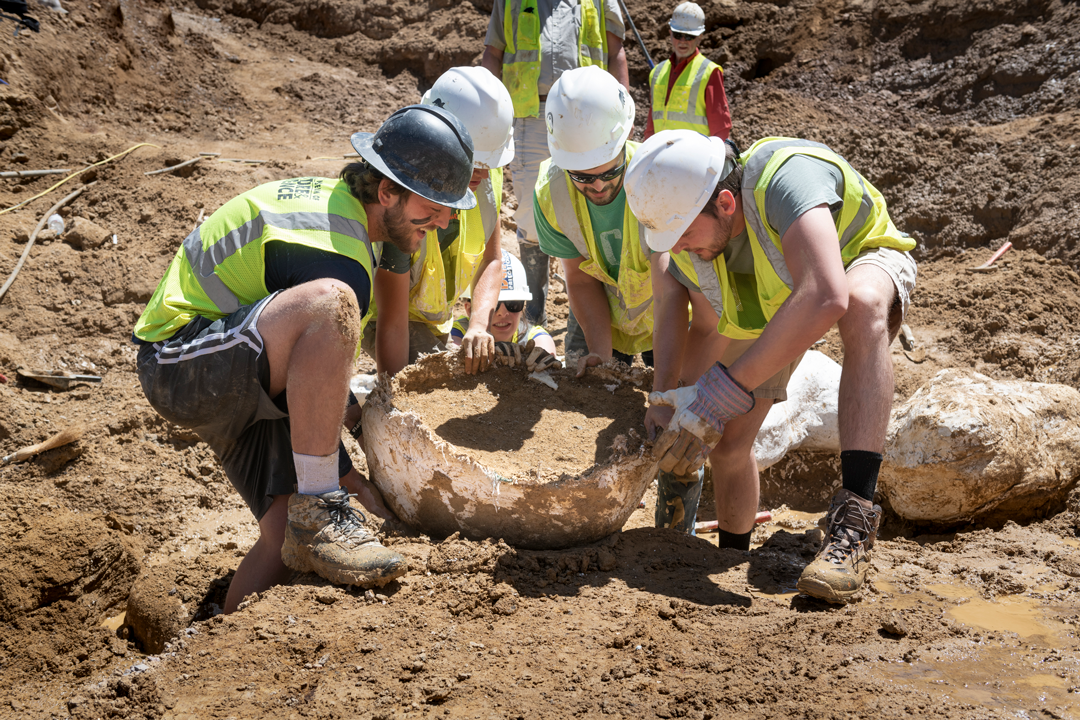
The first discovery came in 2017 at a Thornton construction site, where a shoulder blade and horn led to a nearly complete skull. Two more were uncovered in Highlands Ranch in 2019 after construction crews again struck bone. It took museum crews eight weeks to fully excavate the site.
According to Toth, not only are these skulls rare, but they’re among the most complete ever found.
The king was here, too
Evidence suggests Tyrannosaurus rex once roamed Colorado as well.
During Denver’s expansion in the 1990s, construction crews uncovered T. rex teeth, a thigh bone and part of a tail. Additional teeth have since been found across the region, including one discovered by a young boy hiking near Broomfield in 2021, who spotted a shiny object with a serrated edge, documented the location and contacted the museum.
“We’ve found lots of parts of this giant meat-eating dinosaur,” Toth says, “and evidence of the animals, like Torosaurus, that it would have preyed on.”
Not just dinosaurs
In the western town of Rangely, an ongoing field project is helping scientists piece together an entire prehistoric ecosystem.
“There’s an incredible package of Cretaceous rocks that capture a moment in time around 73 million years ago,” Toth says.
During a recent field session, her team uncovered fossils of fish, turtles, crocodiles, mammals, dinosaurs and plants. The goal is to connect gaps in the fossil record across the Rocky Mountain region.
“There are well-studied fossil systems to the north, around Montana, and to the south, near New Mexico, but very little in between,” she says. “This could help fill in that missing piece of the puzzle.”
The Jurassic Period
Jurassic-era fossils are less common in Northern Colorado, but they do exist.
Near Horsetooth Reservoir, a roughly 150-million-year-old apex predator, Allosaurus, was discovered during dam work in the early 2000s. Often described as the T. rex of its time, it walked on two legs and hunted large herbivores such as Camarasaurus.
Evidence of Camarasaurus has also been found in the area, according to Toth, including large vertebrae from the long-necked, 50-foot herbivore.

Stomping grounds at Dinosaur Ridge in Jefferson County.
The tracks of giants
One of the world’s top fossil sites lies at Dinosaur Ridge, just outside of Red Rocks Park & Amphitheatre. A hotbed of discovery since the late 1800s, the area’s Morrison Formation was once home to everything from Cretaceous creatures to Jurassic giants.
Exploration in the region began in the 1870s, when paleontologist and local professor Arthur Lakes led a series of excavations based on exposed surface findings that revealed a plethora of Jurassic fossils.
Among the findings were 150-million-year-old Apatosaurus, Diplodocus and Allosaurus bones, and, in 1876, the first-ever Stegosaurus remains—the dinosaur designated Colorado’s state fossil in 1982.
Then, in 1937, road construction near Red Rocks led to the unearthing of hundreds of fossilized tracks. While tracks aren’t as easily identifiable as bones, Amanda Rea, director of camp and collections at Dinosaur Ridge, says they’re believed to belong to Cretaceous, herbivorous, duckbilled dinosaurs from the ornithopod family. Carnivorous prints, including prehistoric crocodiles, were found as well.
In 1995, Dinosaur Ridge was established along a one-mile stretch of the Morrison Formation. Today, the site houses more than 300 fossil tracks, the location where the first Stegosaurus was found, a visitor center and interpretive trail.
“The cool thing about Dinosaur Ridge is you can walk through such a huge span of geological time,” Rea says. “Start in the Jurassic and end in the Cretaceous all within a one-mile stretch.”
The ridge most recently made history in 2016, when the first raptor track in Colorado and only the second in North America were discovered there.
Myths and local legends
Some fossil discoveries inspired stories still told today.
In Masonville, records from 1990 describe the discovery of large bones dubbed the “Masonville Monster,” later identified as Allosaurus remains and turned over to the University of Colorado for excavation.
“There were a lot of fun stories about the Masonville Monster at the time,” says Lesley Struc, local history archive curator for the Fort Collins Museum of Discovery. “A professor was quoted as saying it could have swallowed a 1,400-pound Hereford cow.”
In 1941, another discovery near Horsetooth Reservoir caused a stir: a large fin fossil that many believed to belong to a sea serpent.
It was later identified as part of a 42-foot Plesiosaur, a marine reptile that lived alongside dinosaurs. Today, a life-size cast hangs at the museum in Fort Collins, and the original fossil is housed at the Denver museum.
Traveling forward in time
More recent fossils tell their own story. On the plains near Pawnee Buttes, fossils from the Cenozoic era paint a picture of Colorado 20 to 40 million years ago. Instead of towering dinosaurs, the landscape was home to early horses and camels no bigger than modern dogs.
“These weren’t the camels or horses we think of today,” Tschillard says. “They were smaller and more adapted to the forested environments that existed before the grasslands took over.”

An Ice Age discovery
Fort Collins’ Fossil Creek area was named for the prehistoric fossilized marine shells found there. When the city began planning Fossil Creek Park in 2002, they carried that theme into the design with shell-shaped entrance signs and ball fields, plus a woolly mammoth sculpture and fossil-themed playground.
Upon excavation, crews were surprised by a buried fossil site containing mammoth ribs and pieces of vertebrae, along with small rodents and tooth fragments from an unidentified mammal from 14,000 to 30,000 years ago, at the end of the Ice Age.
“There was this distinct, gray layer of soil that a flood had washed into the area at some point, and in it, maybe 15 feet down, were all these bones,” says Roger Sherman, who designed the park along with his team at BHA Design. “They were only 20 to 30 feet from the site the mammoth statue was set to go.”
A team from Colorado State University excavated the site. Today, the mammoth statue and fossil play area at the park commemorate the discovery, while the bones remain in CSU’s care in the archaeological repository.
Evidence that mammoths and humans coexisted
The discovery of mammoths at Fossil Creek Park was exciting, but not the first in the area. Jason LaBelle, an anthropology professor at Colorado State University, says mammoth bones have been found all over Northern Colorado, including near Horsetooth Reservoir, Soapstone Natural Area, Cameron Pass and the North Fork of the Cache la Poudre River.
One of the most significant discoveries locally was the Dent site along the South Platte River near Milliken. The site made headlines when it was discovered in 1932, not only because of the remains of 15 or more mammoths, but because of what was found in their bones: spear points. These human-made tools provided early clues to a much-debated scientific question.
“This was one of the earliest examples ever found that humans and mammoths co-existed for a brief time,” says LaBelle. “There’s a big debate over whether humans played a role in mammoths’ extinction, and the site was super significant both locally and internationally in helping understand their relationship.”
Mastodons, too
Though they’re not as common as mammoths, the Ziegler Reservoir Fossil Site discovered near Snowmass Village in 2010 proves that mastodons also roamed Colorado. Forty-two mastodons, along with mammoths, bison and other mammals, were found as well as preserved plant matter. While similar, mastodons and mammoths can be distinguished by their teeth patterns: Mastodons ate leaves from trees while mammoths grazed on grass.
Finding fossils in NOCO
The most common fossils in Northern Colorado aren’t massive bones; they’re much older and easier to find.
“Oftentimes people come across little swirly shells, things that look like tiny ice cream cones,” Toth says. “Some of these are up to 500 million years old.”
Those fossils are often found in shale-rich areas, like Carter Lake, Horsetooth Reservoir and Devil’s Backbone, where ancient seabeds have been lifted and exposed.
“It’s like trying to find a pea under a stack of mattresses,” Tschillard says. “In flat areas, fossils are buried deep. But where the land has been pushed up, we can see right into those layers.”

© Denver Museum of Nature & Science. Photo by Rick Wicker.
Tips for fossil hunting
Note that collecting fossils is prohibited on city and county land, such as around Carter Lake and Horsetooth Reservoir. If you find something, leave it where it is.
Refer to geological maps to find areas with exposed rock layers as well as road maps for access and public land maps from the Bureau of Land Management (BLM) or U.S. Forest Service to identify public land. Pawnee National Grassland and the BLM Northwest District near Rangely are popular areas for fossil collection.
Consider visiting a local museum or trade show to start getting acquainted with fossils. The Weld County Rock & Mineral Society’s annual event in June often features fossils. “Touch them, ask questions and learn what you’re looking for,” Struc says.
Check exposed shale and sandstone formations as well as ridged areas where layers of rock stand up like the pages of a book.
Look for anomalies, like shapes or textures that stand out from the surrounding rock.
Search for molds or impressions, not just bones and shells.
Know that rules for collecting fossils vary on public land, but most areas have one thing in common: “If you find bones, leave them in place,” Toth says. “Take a photo, mark the location and contact a local museum.”
In general, common invertebrate and plant fossils may be collected within reason and for personal use only on BLM and national forest land. Hand tools are permitted but must cause little to no ground disturbance. According to Toth, fossils found often include:
Ammonites: similar to today’s nautilus, dating back to the Jurassic and Cretaceous Periods.
Baculites: Cretaceous squid with cone-shaped shells on their heads.
Gastropods: spanning pre-dinosaur to post-dinosaur eras with a distinct, swirly, cone-shaped shell.
Trilobites: existing during the Paleozoic era (252 to 521 million years ago) and resembling horseshoe crabs with their oval shape and three-lobed bodies.
Fossilized plants: conifer branches, ferns and petrified wood from the Mesozoic era, also known as the “age of the dinosaurs,” and beyond.