
Move over, “millennial gray.” This year marks a return to personalized, authentic spaces as homeowners grow weary of the drab and predictable aesthetic that has defined interior design in recent years.
From textured fabrics to rooms awash in warm neutrals, this season’s design trends invite you to linger and enjoy the comforts of home. Use these ideas as inspiration—but ultimately, it’s all up to you.
Earth tones
More homeowners are gravitating toward a natural look and leaning into earthy tones, says Sarah Bashore, owner of Hixon Interiors in Fort Collins. She’s seeing richer colors, including warmer blues and greens, making an appearance everywhere, from high-end kitchen appliances to couches. Softer neutrals, like ivory, cream and taupe with yellow, red or brown undertones, often complement them.
“That cooler gray palette, where it’s all gray and white, we’re done with that, and we’re moving forward,” Bashore says.
Pam Sunderman, owner of Pam Sunderman Design in Timnath, notes that while more colors are emerging, the overall look is still muted. Think of the colors found in nature, like chocolate brown, terracotta and sage green.
“It’s not so bright,” Sunderman says, “just very natural, earthy palettes.”
Some of her favorite colors this year are Farrow & Ball’s Mouse’s Back, described as “a lovely brownish green,” and Sherwin-Williams’ Natural Choice, a creamy off-white with warm undertones.
“I like to mix really rich colors with really soft neutrals,” Sunderman says. “Warm white mixed with really saturated, deep, earthy colors.”

Pam Sunderman Design. Photo by Kathy Peden Photography.
Natural elements
Nature has also permeated this year’s design trends, with natural elements such as wool, linen, silk and leather bringing texture and contrast to home interiors. Sunderman sees those elements as a way to bring character into a room.
“When I’m putting designs together for my clients, I’m always encouraging them to use natural stone countertops and handmade tiles, like Zellige, where it’s not perfect. It’s a handmade product, or it’s [from] Mother Nature,” she says.
That means embracing the beauty of imperfections and appreciating the unique character of artisan wares wrought from clay, stone and other natural elements. Sunderman seeks to integrate a mix of textures, including glass, metals and fabrics, to create a sense of balance throughout the home.
For one recent project, she found that adding a potted tree to a corner created a harmonious contrast with the surrounding artwork.
“Plants do so much to soften a space,” she says. “Art is great, but you’ve got to break that up with other items. So, putting a tall tree in that corner was exactly what that space needed.”
Bashore says textures can accent a room much in the way color does. She often uses woven rope in furniture as well as metals, like brass and gold, to add a pop of texture to a space. Lighter woods, rather than painted finishes, can also offer a simple, modern aesthetic while bringing in elements of nature, she says.
Bold wallpaper
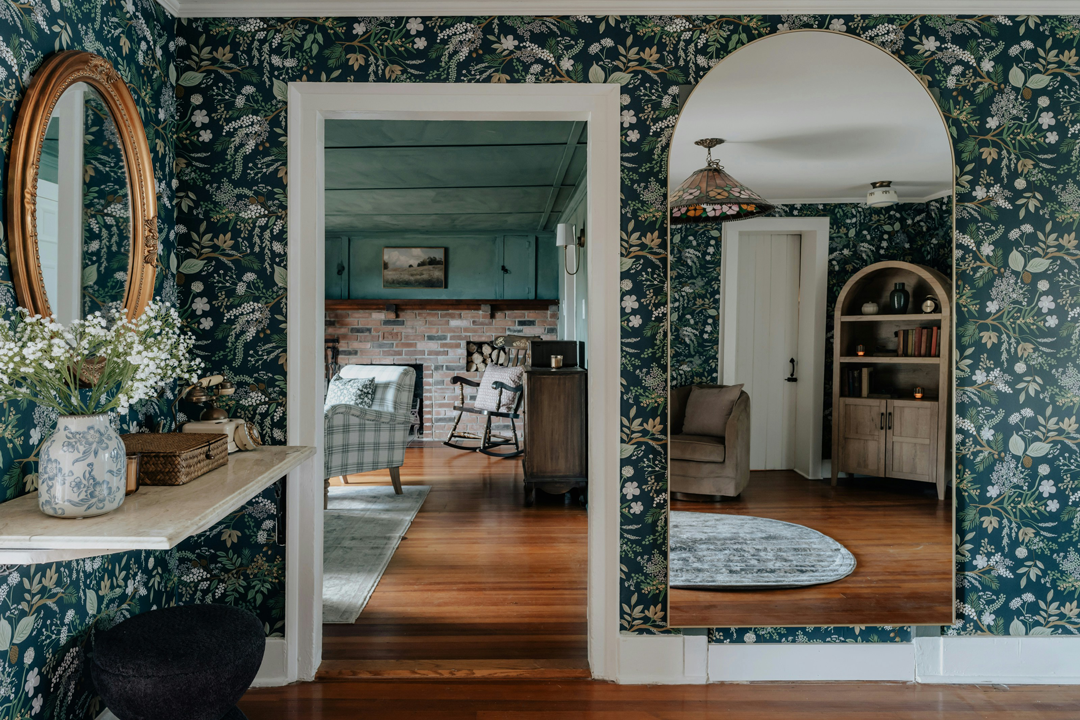
Wallpaper and murals are other popular ways to add contrast and personality to a space. Bashore enjoys designs that incorporate metallic elements to bring “a three-dimensional feel to a two-dimensional surface.”
“As [homeowners] get visitors, people will be drawn to those spaces and want to touch it and wonder, ‘What is this?’ versus just a painted wall in the same color that nobody thinks twice about,” she says.
Sunderman gravitates toward murals with landscape scenes that span the length of a wall, rather than a repeating wallpaper pattern. Many of those mural designs lean toward muted and natural tones as well.
She adds that wallpaper choices aren’t limited to the four walls of a room. She sees more clients embracing the ceiling as a “fifth wall,” at times adding wallpaper to just the ceiling and nowhere else.

Hixon Interiors. Photo by Tim O’Hara.
Not quite maximalism
Sunderman is seeing a shift away from minimalism, but that doesn’t exactly mean maximalism is back in full swing.
“I like to call it ‘midi-malism,’ where it’s not as cold and stark as minimalism,” she says. “It’s not as saturated as maximalism, but it is bringing in personal character.”
She hesitates to call it a trend, saying the instinct to add authentic touches to a space is a reflection of what she has always seen in good design. That can mean incorporating sentimental pieces, antiques or meaningful art into a room. Sunderman sees those choices being driven by the fact that people are spending more time at home, which has created a growing desire for comfort.
Basement finishes
Bashore has noticed a pull toward more personalized, comfortable spaces too. In her business, that has translated into a push to maximize the utility of basements.
“[People are] staying where they’re at, and they’re realizing that they’ve been sitting on a gold mine,” she says.
She’s seeing clients reenvision their basements as personal spaces and additional entertainment areas that are perfect for cooling off in the heat of summer. For one client, she recently designed a basement speakeasy.
“We didn’t just do the typical bookcase that moves,” she says. “This was more of a paneled wall, and it happened to have a part of it that surprisingly opened up.”
Instead of taking on renovations aimed at selling a property, Bashore says many clients are discovering the value of investing in their own comfort and enjoyment. As design trends embrace custom built over mass produced and personality over carbon copy, she and Sunderman say 2026 is the year to think about what home really means.
“There is definitely a popularity right now in really making a space your own, and rather than instant gratification—everything bought at the store all at once—it’s much more curated,” Sunderman says. “Every home is different because every homeowner is different.”