
Nick Herman had a good life as the director of a Denver tech company, a husband and a father to a newborn son. But he also had what he and his friends call “the sickness,” an utter and complete obsession with fly fishing. He was so infected, so to speak, that he left his career to pursue it full time.
“I was out fly fishing with my cousin, and I was catching fish and catching fish…and he was like, ‘Dude, you really need to do something with this,” Herman says. “I was like, ‘Well, what can I do?'”
Herman and his wife both had retail experience, so they decided to open a fly shop, Arbor Anglers, in Golden in 2015. It went so well that they opened another shop in Lafayette a couple of years later. By 2024, they had sold both shops, moved up to Northern Colorado and opened Mountain Fly Shop in downtown Fort Collins. A main motivation was to be closer to Estes Park, where Herman’s grandfather taught him how to fish at age 6.
“As I got into the college years, fly fishing became the only thing I cared about,” he says. “It’s the thrill of the chase, knowing that no matter how long you do this, you’re never going to be the best, and that drives you crazy.”

Nick Herman. Photos by Jäkob Burleson.
On the fly
You don’t have to have “the sickness” to see the appeal of fly fishing. People are drawn to it for a number of reasons, from getting out in nature and spending time with loved ones to studying the environment and practicing different techniques. Many approach the river both as students and stewards of the land.
Those motivations often correlate with where people are in their lives, Herman says. He sees the younger crowd engaged in more friendly competition, trying to catch the biggest or the most fish out of their group. Many anglers in their 30s, 40s and 50s are so focused on kids and family that they’re just looking for some peace and quiet, he says. Older folks tend to develop an interest in conservation or catching fish a certain way.
“Some of the retired guys are even fishing without hooks,” Herman says. “They don’t care about getting the fish to the net; they just want to know if the fly they tied can trick the fish.”
Herman finds himself in the category of parents needing a break, but “the sickness” means he loves everything else too. He likes that he can be his goofy self on the river and make memories with friends and family, though he also turns to fly fishing for moments of solace.
“As someone who has struggled with anxiety and depression, when I’m out there, that just doesn’t exist,” he says. “It can exist all the way until you put your foot in the water, and then it’s gone.”

Grant Houx, owner of St. Peter’s Fly Shop, and his wife, Julia.
That feeling is shared by many anglers, including Grant Houx, owner of St. Peter’s Fly Shop in Fort Collins. He says it’s often not about what you catch, but the experience of being on the water.
“It’s like partial meditation,” he says. “I hear that all the time: People come into the shop and say, ‘I’m out there in these gorgeous places, repeating a process and challenging myself.’ Most places don’t have cell service, so you’re unplugged from the world and you come back refreshed.”
Like Herman, Houx grew up fishing and developed an obsession in college. He loved fly fishing so much that he became a guide and worked for several outfitters as a student at Colorado State University. Along the way, he bought a drift boat and a raft and got permits to start his own guiding business.
“That was another level of addiction, having a floating craft,” he says.
At age 24, Houx was approached by one of his employers, the owner of St. Pete’s, who asked if he was interested in buying the shop. He jumped at the opportunity, learned how to run the business and opened a second location a few years later. Now married with kids, his days on the water are spent enjoying nature and learning what he doesn’t already know.
“The sayings of ‘I just want to catch one,’ to ‘I want to catch a bunch,’ to ‘I want to catch a really big one’…there’s a natural progression, and I went through all that,” he says. “It’s a never-ending quest for knowledge.”
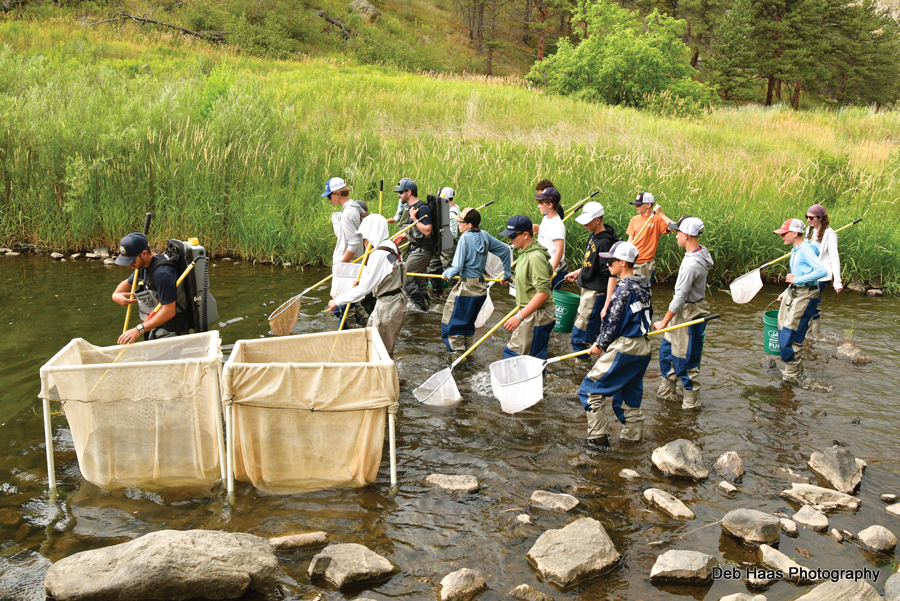
Rocky Mountain Flycasters. Photo by Deb Haas Photography.
How to trick a trout
Trout are acutely aware of their environment, which can make fly fishing a challenge. In rivers, fish face upstream to feed, so the key is to sneak up behind them. Having success requires stealth, patience and skill.
“You’re hunting these trout, and they’re pretty crafty, so don’t stomp around like a moose,” says Don Gilmore, president of Rocky Mountain Flycasters, a local chapter of Trout Unlimited. “You also have to understand the weather, time of day, time of year and what bugs are hatching. If you’re using [a type of fly] too early in the season, no matter how perfectly you cast, they just don’t care.”
Trout Unlimited is the largest cold water conservation organization in the U.S., with local volunteers focused on river restoration after wildfires and floods as well as the reintroduction of Colorado’s state fish, the greenback cutthroat trout, which is listed as a threatened species under the federal Endangered Species Act. The organization also focuses on youth education, bringing high schoolers to Rocky Mountain National Park every summer to learn about river ecology and practice fly fishing. Knowing some entomology is critical, Gilmore says.
June and July are the most dynamic bug hatching months, Houx says, with fish actively feeding on aquatic insects, like mayflies, caddis and stoneflies. Within those categories are bugs of different life stages, some below the water (nymphs) and others above it (dry flies). Terrestrials, such as grasshoppers and beetles, typically pop up around that time as well.
Anglers who use similar-looking flies will have the most success, referred to as “matching the hatch.” About 90 percent of a fish’s diet happens underwater, Herman says, so fishing with nymphs increases your odds.
If you don’t know where to start, Herman and Houx recommend stopping by a fly shop to ask questions. Most anglers will be happy to offer suggestions, and the shops post their own reports listing the bugs that get bites on any given day on different bodies of water. There is a general pattern to how bugs emerge every year, so keeping a journal of what pops up where, when and at what water temperature can be helpful for the future, Houx says.
“We also encourage anglers to bring their fly boxes in,” Herman says. “Be honest about where you’re at with it, and we can curate your flies and make sure you have the right ones.”
Many beginners find fly fishing intimidating because of the casting, which does take practice. Herman suggests beginners rig up their rod, cut the hook off the fly and go out to their backyard or a park to get a feel for it. You can even set out targets, close your eyes and try to hit them.
“If you close your eyes, you’ll feel when the rod starts to pull your hand back, and it’s like, ‘Oh, now it’s time to go forward,'” he says. “There is a tendency to try to muscle through it, but the fly rod and line do all the work for you.”
Your cast doesn’t have to be perfect for you to catch fish, he and Houx say.
“Don’t try to be Brad Pitt in ‘A River Runs Through It,'” Herman says. “There is a right and wrong way of casting, but I’m a lot less worried about that. What I’m more worried about is, ‘Can you get your fly to where you want it to go?'”
Gearing up and going out
Some people hesitate to get into fly fishing because of the upfront cost, but you can get a basic, long-lasting setup for a couple hundred bucks, Herman and Houx say. You need a fly rod set up with a reel, fly line, leader and tippet, plus a fly box with a dozen or so flies. Waders and wading boots give you more advantageous angles to cast from and are nice to have in cold water, but they aren’t always necessary.
 “Your flies, leaders and tippets, those are like your tees and golf balls,” Houx says. “But once you get your golf clubs, you don’t replace them unless you have a desire to. Your nine-foot, five-weight fly rod could be the only rod you ever buy.”
A fly fishing bag and polarized sunglasses make all the difference, both say.
“Don’t pull out your fanny pack that you use for whatever else, like running a marathon,” Herman says. “It makes for a miserable day.”
“Polarized sunglasses are the third or fourth item on my list for fly fishing,” Houx says, “not only to be able to see the fish, but also for safety. We’re throwing hooks around.”
Once you’re on the river, you’ll want to look for the right spot to fish. In the colder months, the fish go more dormant and hang out in deeper pools, Houx says, whereas in the summer, they follow the bug hatches into faster water, where there’s more food and oxygen. During high flows, they tend to push toward the river edges, and when the water is low, they’ll move toward the center.
That said, there’s an unspoken etiquette to follow on the river. Most anglers work upstream to sneak up on the fish, so it’s generally frowned upon to set up camp right above someone (anglers call it “high holing”). The Poudre River offers miles and miles of public water to fish on, so Herman recommends moving about 100 yards upstream from the person below you. That’s not really possible in tail waters, like areas below Lake Estes on the Big Thompson, he says, because there isn’t as much public water to fish. In those spots, 20 yards above and below is all you can justify holding on to.
“Try to respect the person who got there before you because they put in the effort to be there earlier,” he says. “If you’re thinking about going above someone, ask them, ‘Are you working upstream? Is there a spot where you would be OK if I jumped in up front?’ If people were more willing to have a conversation, I think we’d all have better experiences on the water.”
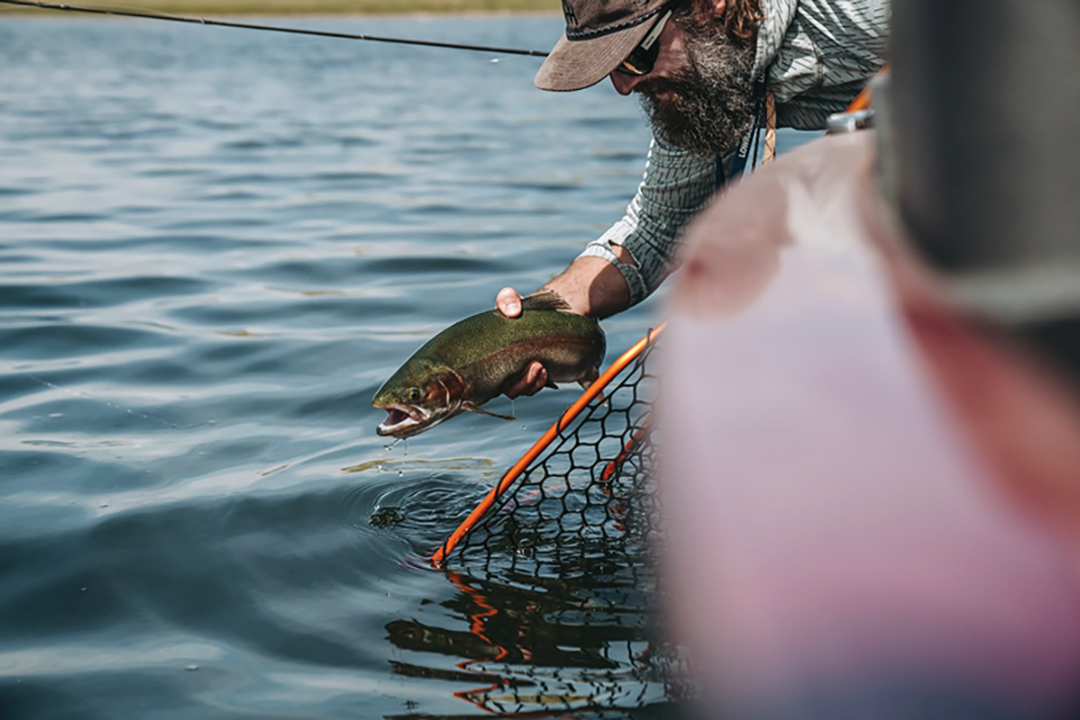
There’s also a slogan, “Keep Them Wet,” meaning anglers should keep fish wet to minimize stress and potential harm. That means wetting your hands before handling fish and taking them out of the water for no more than a few seconds.
“The idea is that we get caught up in all these photos and end up dropping fish, and the mortality rate starts to increase,” Houx says.
Certain areas of the rivers are designated as catch and release, and many sections are labeled as “artificial flies and lures only.” Following those rules helps protect the fish and keep habitats healthy.
“Our resource, to us, is number one, and I think that’s what should create the foundation of etiquette,” Houx says. “If you deplete a resource, it’s not going to be there for you to continue to enjoy.”
High Temps? Move Higher
When river flows are low and water temperatures are high (in the mid-60s), oxygen decreases significantly, causing stress on trout populations. During those times, the fish can’t survive on a catch and release basis, Herman says.
In more extreme cases, Colorado Parks and Wildlife may call for a “hoot owl,” or voluntary fishing restrictions during the afternoon and evening. While that may be more likely this year—given the low snowpack last winter and the record heat in March—at press time, it was too early to predict summer water levels. Much of the state got inches or feet of snow in early May, which has anglers cautiously optimistic.
“We’ve got to be responsible and very aware of what’s happening relative to temperature and water level,” Gilmore says. “What we’ll encourage people to do is go up to the lakes.”
Lake Estes remains one of Herman’s favorite spots: He says he’s been catching 18- to 22-inch rainbows there. Anglers can also find lots of fly fishing opportunities in Rocky Mountain National Park and Red Feather Lakes as well as places like Joe Wright Reservoir, Zimmerman Lake, Long Draw Reservoir and the American Lakes up the Poudre Canyon, he and Houx say.
“High alpine lakes are great because they give you the opportunity to hike into beautiful locations,” Houx says. “A lot of the brookies and cutthroats up there are really ambitious eaters too.”