

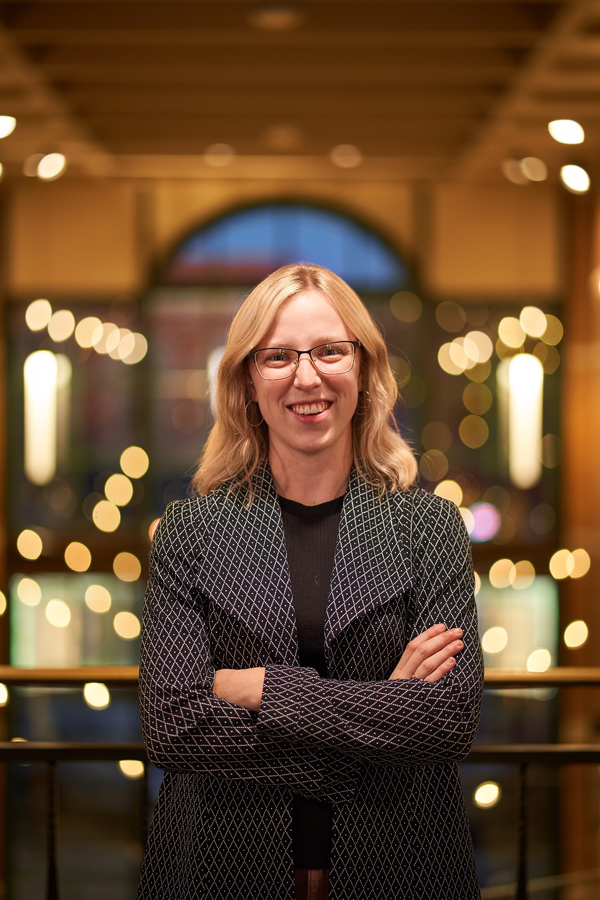
Solara Clark
Grant program administrator for FoCo Creates, owner of Solara Clark Creative
Age: 28
Location: Fort Collins
Tell us about yourself, your history and how you came to be where you are now.
I’m originally from Missouri, where I received my bachelor’s degree in music. I then came to Fort Collins to pursue a master’s degree in arts management and immediately fell in love with Northern Colorado. I have been serving in my current role of FoCo Creates grant administrator for four-and-a-half years, and I have been incredibly fortunate to support the arts and our community in such an impactful way. Outside of my day job, I own Solara Clark Creative and teach piano, clarinet and saxophone lessons in my private studio. I live in Fort Collins with my wife, two dogs and cat.
Explain your career, achievements and professional highlights.
I am proud to serve the arts and culture community of Fort Collins in the philanthropy sector. I started at the City of Fort Collins as a finance coordinator for the Arts and Culture Department, then I shifted into my current role, where I spend my days managing the FoCo Creates grant program. The program gives over $500,000 a year to local artists and nonprofit organizations in the region. In the last year, I have introduced changes to the grant program that improve accessibility, strengthen review processes and align with the best practices of grantmaking nationwide.
In what ways do you give back to the community?
I feel drawn to support the community in my role with the city, through teaching music and through photography. I often provide volunteer photography for nonprofit organizations; most recently, I photographed NOCO Humane’s Fire Hydrant 5K & Expo and Rise & Rescue fundraisers, FoCoMX, Soda Shop Movement Company’s performance of “Anatomy of a Fiasco,” the International Women’s Day proclamation, Poudre School District’s JamFest and a performance by Places Everyone, a local arts organization that I have provided a photography mentorship through. I often provide free session vouchers to nonprofits for fundraisers as well.
What do you consider your biggest accomplishment or challenge you’ve overcome, either professionally or personally?
As a music performance major in college, playing clarinet was all I dreamed of. During my senior year, I learned I had velopharyngeal insufficiency, which means the muscle controlling and separating the airway from my nose to my mouth was deformed, making it nearly impossible for me to play clarinet in the long term. My dreams were crushed. But falling into arts management ended up being the right path for me, and I wouldn’t change it.
Where do you see yourself in five years? In 10 years?
I hope to continue serving the community I have fallen so deeply in love with in bigger and better ways. I would be grateful for myself and my family to be healthy and find ways to grow in our connections to each other and the people closest to us. I hope to see my photography business grow, but I hope it always serves as a creative outlet and source of joy rather than just a source of income.
What piece(s) of advice would you give to your younger self?
I know it’s cheesy, but everything happens for a reason. If you put in the work and be confident in yourself and your skills, things will work out in exactly the right way. Work hard, but always find the passion in what you are doing.
Tell us something unique about you.
I love Western dancing. Over the last year, I have been learning country swing dancing with my wife and participating in line dancing every chance I get. We take private swing dance lessons and are hoping to start competing in the future. The dance community is so energetic, kind and welcoming.
Why is it important to you to give back through the arts?
The arts are essential to life, yet they are so often overlooked. There is no way I can give back all that the arts have given me, but I do what I can to support a sector that is my heart and soul as well as the heart and soul of my community. Professional photography is often a luxury that many cannot afford, so by offering my services to nonprofits that are close to my heart, I can provide something meaningful, unique and helpful to both them and myself.
What helped you pivot to another career path when you could no longer perform?
A whole lot of support from the people I love. My wife, family and close friends were instrumental in helping me recognize that I could still work my dream job, even if it looked a little different than I had imagined. I also owe a great deal to my previous boss and internship supervisor, Jim McDonald, who gave me an opportunity in arts administration and helped me see a future beyond performance. I knew I couldn’t dwell on what I couldn’t control, so I shifted my mindset and worked hard in a field where I could excel.