

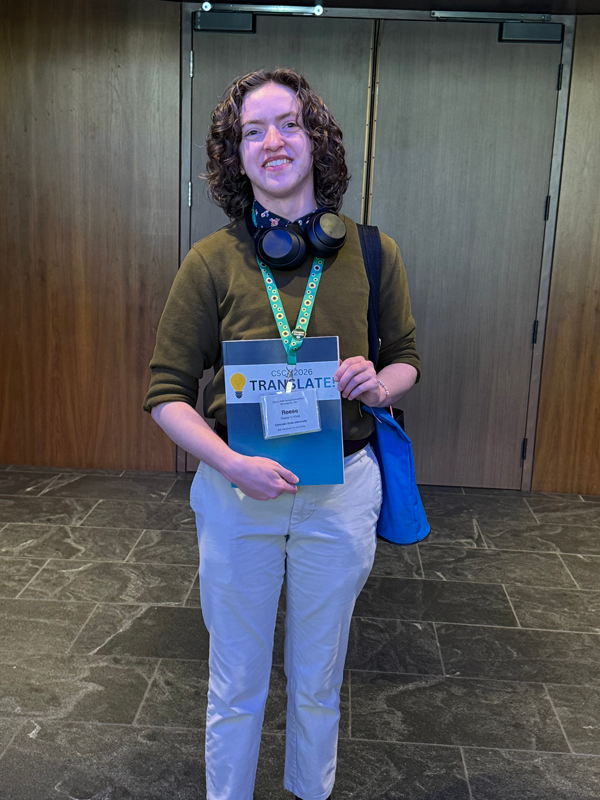
Reese Klotz
Peer advocate for The Arc of Larimer County
Age: 25
Location: Fort Collins
Tell us about yourself, your history and how you came to be where you are now.
I arrived in Colorado in 2019 as an undeclared CSU student. A class on rhetorical theory introduced me to the field of communication studies, and I quickly became enchanted with the science behind human communication. A few years later, I figured out why: I am autistic and have ADHD, and communication theory helped me understand the systems of social behavior that I had struggled to navigate for my entire life. I became determined to locate and empower neurodivergent voices, which led me to become a communication researcher and mentor with a focus on neurodivergence and self-advocacy.
Explain your career, achievements and professional highlights.
Between 2023 and 2025, I completed my master’s coursework and taught the basic public speaking course at CSU. Last August, while working toward finishing my thesis, I began working at The Arc of Larimer County, a nonprofit advocacy organization for individuals with intellectual and developmental disabilities. My role as a peer advocate primarily consists of self-advocacy skills mentorship, but I also assist with disability acceptance and inclusion trainings. I defended my thesis in March and have since happily continued my self-advocacy mentorship and education work at The Arc.
In what ways do you give back to the community?
My self-advocacy mentorship work at The Arc helps community members with intellectual and developmental disabilities build skills. Those include articulating their thoughts and needs to their support givers, making decisions and ensuring that those decisions are honored and asking for information and clarity when things are unclear. The Arc also hosts disability acceptance and inclusion trainings for local organizations and businesses that want to make their operations more accessible and affirming. Outside of my job, I enjoy volunteering with Poudre Libraries, especially during the summer reading season.
What do you consider your biggest accomplishment or challenge you’ve overcome, either professionally or personally?
My passion for self-advocacy comes from the monumental effort it took to complete my master’s degree while refusing to downplay my identity and needs as a disabled person. I am a stronger person and a more capable expert in my field because I am disabled. The challenge that I have to overcome again and again is that many non-disabled people hear the word “autistic” and suddenly need constant reassurance that I know what I’m doing.
Where do you see yourself in five years? In 10 years?
I would like to be teaching in a classroom again, ideally something communication-related at a community college or small university. I miss the consistent routine of an academic environment, but I do love working with my peers with developmental disabilities and would appreciate any opportunity to stay involved with self-advocacy mentorship. If I’m really lucky, my partner and I will teach at the same institution and become a pedantic campus power couple.
What piece(s) of advice would you give to your younger self?
If I had the chance to talk to my younger self, I would tell them two things. First, I would advise them to look up “inattentive-type ADHD” and “high-masking autism” because it would explain so much. Second, I would assure them that one day they will love themself and their life more than they could possibly fathom, and the best thing they can do in the meantime is just trust their instincts.
Tell us something unique about you.
I believe that everyone should have something that they are unapologetically a bit of a snob about, just for fun and enrichment. My snob thing is tea. I love to learn about different types of tea, where they come from, how they are brewed and what they can do for the body. I have an electric kettle with six different temperature settings just so I can make my favorite oolong and green teas correctly.
How do you advocate for yourself in life and in work?
While the standard in my organization is to use person-first language (“person with disabilities”) when describing the populations we work with, I insist that others use identity-first language (“disabled person”) when talking about me personally. Until I was given the language to explain why I think and act differently than most, I thought there was something wrong with me and that I had an obligation to fix it. Now that I know that I am disabled—not broken—I proudly embrace this part of my identity and speak openly about it in an effort to destigmatize disabled experiences.
How do you hope to inspire others with neurodivergent traits?
As an advocate, a teacher or whatever else I may become, I hope to show my neurodivergent friends and peers that there are no better experts in our needs and experiences than ourselves. Our ideas and voices deserve not only to be heard, but to be centered on the designs of the systems that are meant to empower us. There are a lot more of us out there than most people think, and when we act together, we can foster a standard of accessibility and inclusion that is the norm instead of the exception.