
Valerie Embry celebrated Juneteenth long before it became a federal holiday, as a young girl alongside first-generation industrial laborers in the Indiana Harbor area near Chicago. The day meant something to them: They had close ties to formerly enslaved people in the South.
Juneteenth commemorates June 19, the day in 1865 when enslaved people in the U.S. learned they were free. Even after it became a federal holiday in 2021, many Northern Colorado residents didn’t know its significance.
“Coming out West, I found that people out here did not know about Juneteenth,” Embry says.
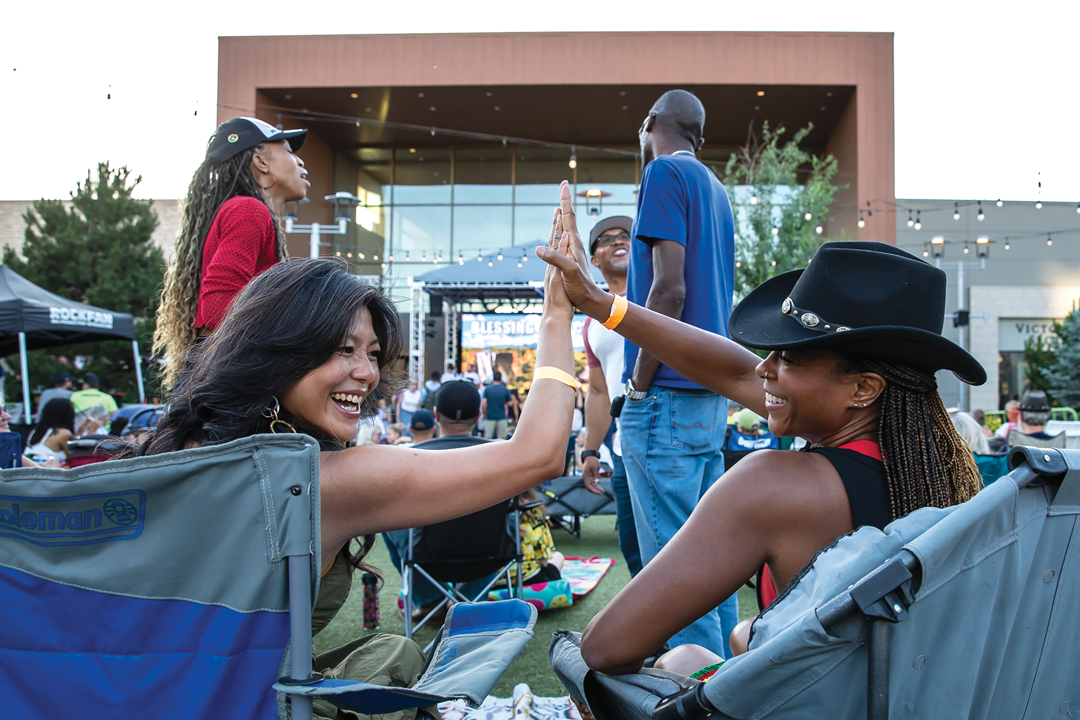
She did her best to change that. Today, Embry is one of the organizers of the Fort Collins Juneteenth festival, a fast-growing event with entertainment, vendors and history talks that takes place each year at the Foothills Mall.
While Juneteenth celebrations such as the one Embry helps organize have become more prominent in recent years, the initial patchwork of events in Fort Collins speaks to a more local reality. In Colorado, especially the north, Black communities don’t have the same deeply rooted history that made Juneteenth celebrations in other parts of the U.S. a part of their culture. Juneteenth celebrations began as small, scattered events across community centers, backyards and Black-owned businesses that ran promotions, says Embry, a musician known as “Peaches” and a longtime Fort Collins resident.

Saja Butler performing at the 2025 Fort Collins Juneteenth Celebration at Foothills Mall. Photos by Backstage Flash.
“It was a collective thought, but they were independent kinds of events,” Embry says of the holiday just 10 years ago. “It might be a barbershop saying, ‘Hey, I’m going to give $5 haircuts and have a DJ play.’ Somebody else would say, ‘Let’s do a basketball tournament.’”
In fact, cities like Fort Collins, Greeley and Loveland didn’t have large Juneteenth celebrations until 2021 and 2022, when the dispersed celebrations gave way to something more deliberate. Now Northern Colorado’s Black organizers and community leaders encourage everyone to honor the meaning of Juneteenth. The holiday’s history serves as an ongoing reminder, they say: Freedom, even when mandated by law, is not a guarantee for any marginalized community.
Local impacts
Many people believe Juneteenth to be a day that commemorates the end of slavery with the Emancipation Proclamation, but that’s not quite accurate, says Alexander Pittman, a history professor at Colorado State University.
The Emancipation Proclamation declared that all enslaved people in Confederate states were legally free on Jan. 1, 1863, two years before the historical day that marks Juneteenth. Even after slavery was deemed illegal, areas of the U.S. still under Confederate control, particularly Texas, were slow to implement the new rule. It wasn’t until June 19, 1865, that U.S. General Gordon Granger arrived in Galveston, Texas, with Union troops to enforce the proclamation, Pittman says.
“A lot of Black folks knew that they had been freed—emancipated—but without the protection and the enforcement from the United States Army, they weren’t able to live out those freedoms and protections,” Pittman says.
Even after their freedom was enforced, many formerly enslaved people knew that they would still face a life of prejudice and real danger if they continued to live in the South, says George Junne, humanities and social sciences chair and professor at the University of Northern Colorado in Greeley. Many Black families opted to make their way West to California, and some stopped in Colorado, he says.
“Black people came out here because of the fact that they had less problems. They still had problems, but they had less problems,” he says. “They were able to pull themselves up and move upward.”
In fact, several Black families grew wealthy in Colorado because they took part in gold mining, Junne says. But rooted Black communities were few and far between. By the early 1900s, most Black communities were small in size and stayed in areas like Fort Collins for a short period of time, says Maren Bzdek, historic preservation manager for the City of Fort Collins.
That would explain why Juneteenth didn’t have the same presence in Colorado compared to places like Texas, Bzdek says.
“It’s through community and families that so many of these traditions get established and persist,” she says.

James Holland, owner of XAAK’s Barbershop.
A place to belong
Fort Collins’ Juneteenth festival kicks off with a historic bike tour that showcases places in the city where record exists of Black residents, Pittman says. One of the most notable stops is the former home of Hattie McDaniel, the first Black American to win an Academy Award for her 1939 role in “Gone With the Wind,” according to Fort Collins’ historic preservation department. Pittman participated in the ride last year and contributed to a video that aired during the event that localizes the history of Juneteenth.
Some of Pittman’s academic research is related to how Black history is taught. The local connection adds humanity and value to learning about the past, he says.
“Oftentimes, when we think about things like racial segregation through housing and schools, we think of Birmingham, Ala., and Levittown, Pa.,” Pittman says. “Those things happened in Fort Collins as well.… Had I moved to Fort Collins during that time, I wouldn’t even have been able to live in the neighborhood [that I do].”
For James Holland, owner of XAAK’s Barbershop, the first Black barbershop in Loveland, Juneteenth in his childhood was a passive day of rest and a little reflection. Now, with a business that has bragging rights as the barbershop of choice for Deion Sanders—also known as Coach Prime, head coach of the University of Colorado Boulder football team—Holland says he hopes to get more involved in Juneteenth activities. This year, he’s considering offering discounted haircuts.
Helping to grow Northern Colorado’s Black-owned business representation was part of the reason why Holland opened XAAK’s a few years ago. As a CSU student in 1997 who had transferred from a historically Black college in Louisiana, he noticed that the region didn’t have any barbershops that were skilled with Black hair. He returned to Northern Colorado in 2022 and found that nothing had changed, he says.
“I was originally planning on opening this shop in Houston, and I was talked into bringing the business here instead,” he says.
That decision created the opportunity to specialize in Black hair, which wasn’t previously represented in the area, Holland says.
Representation of all people is particularly important for this year’s Fort Collins Juneteenth festival, Embry says. The theme this year is belonging, something she believes should be offered and given as part of the American right to freedom.
“I want opportunity and community to be seen as a right,” she says.
Rights take more than a declaration of freedom to achieve, Pittman says. That’s why he believes the Juneteenth celebration is so important.
“There’s a lot of freedoms and protections and liberties on the books,” he says, “but if our law enforcement, our administration, our government, our service members, are not enforcing and protecting those rights—and not just for Black people, for all folks, especially those who are historically marginalized or underrepresented—then it’s just a piece of paper.”
How to Participate
Northern Colorado residents of all backgrounds are invited to attend Juneteenth events, which will take place the weekend of June 19. Fort Collins, Greeley and Loveland have historically held events over the weekend.
In Fort Collins, the Juneteenth festival runs from June 19-20 at the Foothills Mall. The event will include live entertainment, family activities and a vendor market spotlighting businesses and creators who are people of color.
Greeley’s Juneteenth celebration will be held from 12-7 p.m. June 20 at Everett Acres. The donation-based event will feature food, a live DJ, crafts and spoken word and dance performances.