

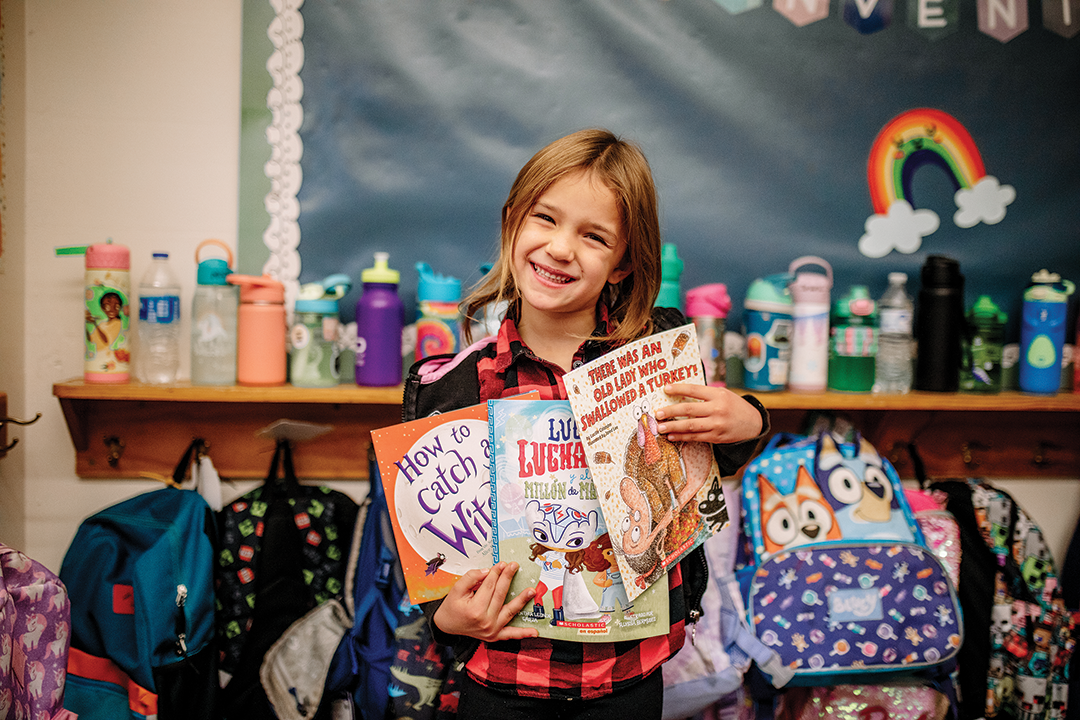
Tommi Sue Cox remembers feeling joy as a kid when the Scholastic book orders arrived. In her first year as principal at Laurel Elementary in Fort Collins, she expected a celebration on Scholastic day. Instead, she saw a lot of sadness.
Two-thirds of her students qualified for free or reduced-cost lunches, and many of their families could not afford the new books. Instead of an opportunity to read something fun, Scholastic day was a painful reminder of their realities.
That changed in her second year at Laurel, when a local nonprofit, Book Trust, began paying for those students to pick out their own books free of charge. Her students ordered what they wanted from the flyers, and on the day they arrived, the sadness turned into the joy she remembers feeling when she was their age. It changed their outlook, and her own, so much so that when Cox retired after 22 years in 2023, she joined the nonprofit’s Northern Colorado advisory board.
“The impact is generational and immeasurable,” she says. “There’s something special about having a book that you get to read over and over and over again.”
Just a few years after Book Trust began serving Laurel Elementary, Cox saw the Scholastic books everywhere, even in the backpacks of homeless students. They were treasured by kids and loved by teachers, she says, because they represented one of the few times those students could pick something they wanted to read on their own. The books aren’t tied to assignments, either: Students can buy books about Pokémon, ponies or computer programming if they’d like. Scholastic introduces them to the joys of reading for fun, not for a grade.
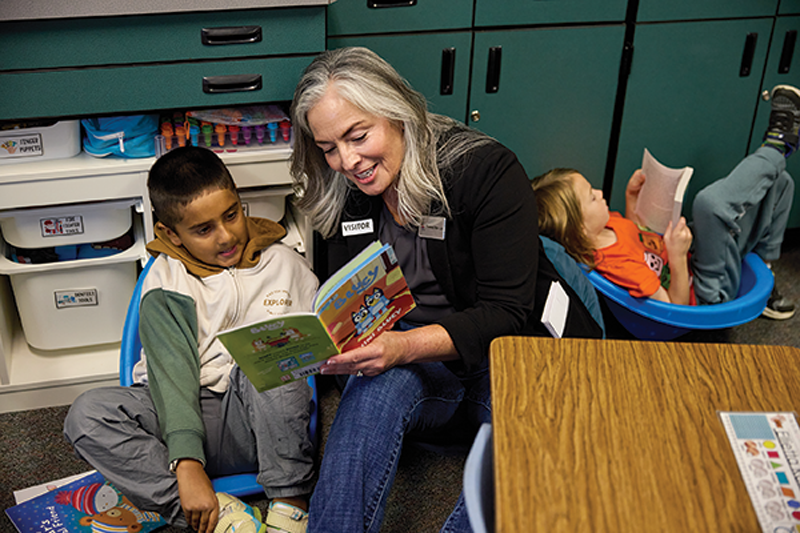
Tommi Sue Cox, former principal at Laurel Elementary School and current Book Trust Northern Colorado Regional Advisory Board member, reading with a student. Photo by John Robson.
A personal mission
Book Trust is celebrating its 25th anniversary in 2026 with an ambitious goal, but giving students in Title I schools a stipend to pay for Scholastic book orders remains central to the mission.
That’s what inspired Adrienne Schatz to launch the organization under the auspices of the Serimus Foundation. Her father, Doug Schatz, founded Serimus in 2001 with the money he earned by starting Advanced Energy in 1981, a company now worth more than $8 billion. Serimus is Latin for “We Sow Seeds,” she says.
Schatz was inspired by her first job, at a bookstore, and by her experience as a third-grade student, when the sad look on an empty-handed friend’s face as he stared at her stack of new Scholastic books stuck with her. She piloted the program in Larimer County with 170 students, partly by walking into her former elementary school, Cache La Poudre in Laporte, and asking if she could start paying for Scholastic orders for students on free and reduced lunches. Students paid their teacher with a check out of a stipend fund, so no one knew they were receiving the books from a charity. She remembers hearing cheers when the orders arrived for the first time.
“Just that process has been such a huge driver,” Schatz says. “One thing we kept hearing from teachers over and over was just how stunned students were that we respected them enough to let them choose their own interests.”
Spreading the joy
As Schatz began asking other schools if they would join the program, the response was so overwhelming that participation quickly grew across Larimer and Weld counties and then into other parts of the U.S., such as New York and Hawaii, where her parents had connections. The program took off nationwide when Scholastic became a partner, she says, right after Book Trust became a nonprofit in 2006. Schatz remembers suggesting it to Scholastic through an email, what she called a “pie in the sky thing,” and was stunned when she got a response from the company’s CEO. She flew out to make a proposal in New York.
“It was the first time I had done anything like that in my life,” she says. “I remember passing Broadway and [walking] down the streets of New York carrying my PowerPoint, and it was well received. After my presentation, it was raining, and I remember it was the most beautiful day in the world.”
Scholastic has a way for customers to donate to Book Trust when they place an order. Beyond the chance to earn extra funds, the partnership gave the nonprofit serious legitimacy, Schatz says.
“Donors wanted to make sure Scholastic had some skin in the game,” she says.
She has since presented many times at foundation conferences across the country, but she also allows the organization to breathe on its own. The nonprofit’s president and CEO, Patience Peabody, recently developed a new direction for Book Trust, not her.
The organization serves about 50,000 students a year, Peabody says, but they have a goal of serving 10 times that by 2040. They hope to achieve this by taking on what Peabody agrees is a much bigger challenge today: engaging students.
Engagement, or really the lack thereof, is what’s led to nearly half of all fourth-grade students being unable to read at their grade level, according to the organization. The obstacle isn’t just affordability; it’s also smartphones, social media and the many other distractions of the modern world.
“The literary crisis is real, and it’s not just in book-poor communities,” Peabody says. “We have communities that have access to books, but the aspect of joyful reading is not there. We need to make the act of engaging with that book fun and joyful.”
Book Trust is trying to address this by offering activities and guidance to teachers across the country in all schools, regardless of the students’ family income.
“It would be fun and plug and play,” Peabody says. “They just take the resource and focus on making reading fun and enjoyable.”
Peabody and others hope to announce the strategy in more detail this spring, but in the meantime, they still want to promote the core mission of providing books to children.
Students who received books years ago still talk about it, including a former student Cox ran into in downtown Fort Collins. Sophia Fastabend is now 19 and remains thankful for the program. She grew up in a working-class family and believes her parents wouldn’t have been able to afford Scholastic books without Book Trust’s help. She, like Cox, remembers celebrating the day the orders arrived in her class.
“I think it gave me the freedom to figure out what I wanted to learn about,” Fastabend says.
For her, that was art. She’s now pursuing a degree with a unique path: She is attending Colorado State University to learn how to be a scientific illustrator. She is the first in her family to go to college.
“Giving kids the most freedom possible is probably the best way to get them excited about learning,” she says. “Now that I’m in college, I’m having such a great time.”
Visit booktrust.org/apply to bring Book Trust to your school.