
Despite the rapid increase in light pollution nationwide, some Northern Colorado communities are guarding their night skies.
Light pollution, which the National Geographic Society defines as “the excessive or inappropriate use of outdoor artificial light,” is causing an additional seven to 10 percent of the stars to vanish from view every year in the U.S. alone. Data in the journal Science shows that the average night sky increased in brightness by 9.6 percent every year from 2011 to 2022, which is equivalent to doubling the brightness of the sky every eight years.
In Northern Colorado, however, both Jackson Lake State Park and the Town of Berthoud are doing what they can to showcase the night sky the way nature intended. And we’re already seeing the benefits as more stars emerge from the darkness.
Astronomy and stargazing
Studies published by the American Psychological Association, the journal Nature and others show that stargazing benefits our mental health and contributes to a greater interest in science.
“For me personally, it’s sort of a recognition of our place in the universe,” says Greg Halac, outreach coordinator for the Northern Colorado Astronomical Society (NoCo Astro), a nonprofit that plans activities for amateur astronomers.
Our stargazing also benefits from Northern Colorado’s dry climate, relatively high elevation and typically clear nights, leading astrophiles to search for ways to enhance the stargazing experience closer to home.
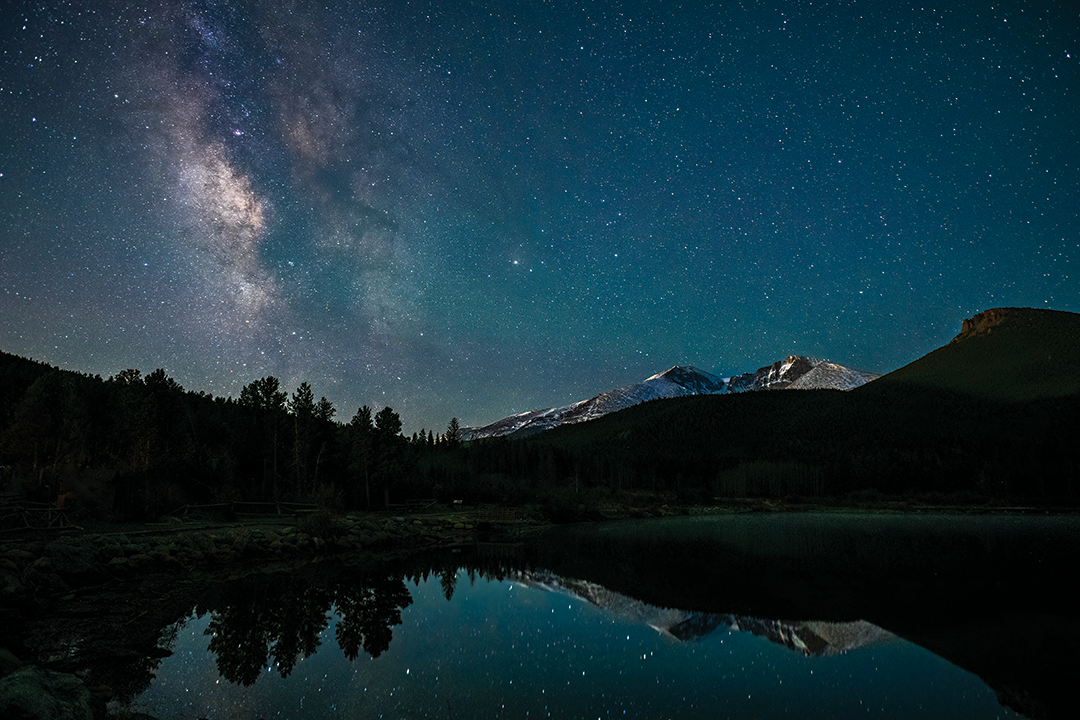
The Milky Way over Jackson Lake State Park. Photo by Jordan Neumeyer, Forever of the Stars Photography.
The Town of Berthoud is the first Northern Colorado community seeking to become a certified Dark Sky Place, an initiative being carried out under Brian Dubois, Berthoud’s economic sustainability manager. Dubois says pursuing this status is rigorous, but residents’ attitudes toward dark sky efforts have been “all positive” so far.
“A lot of people have moved to the bigger cities after being born and raised in smaller towns…now they want to come back to a smaller community like Berthoud because of the values that it has,” Dubois says. “One of those is the dark skies.”
Becoming a certified Dark Sky Place by the organization DarkSky International takes an average of three years to achieve, but Dubois hopes to shorten that timeline with the help of a steering committee of about a dozen Berthoud citizens, including some high schoolers who are part of a STEM program.
The requirements for DarkSky lighting include full cut-off shielding, which prevents light fixtures from shining horizontally beyond the property line, as well as motion sensors on some security lighting, restrictions on the light spectrum (or “color temperature”) and restrictions on outdoor lighting wattage. This generally results in cost savings and increased walkability while mitigating harmful effects of light pollution such as bird collisions with buildings.
Ecology and environmental stewardship
The American Bird Conservancy, Cornell University and other institutions have published findings on the devastating effects of light pollution on migratory birds—80 percent of which travel by night and rely on natural cycles of light and darkness to navigate—as well as sea turtle hatchlings, which need natural darkness to locate and safely reach open water. But light pollution’s effects on ecology aren’t always obvious.
“Jackson Lake has had a number of issues for decades, and one of those issues was that every couple of years, we’d just get this mass die-off of carp,” says Tyler Sewald, who was a park manager at Jackson Lake State Park when it implemented DarkSky lighting in 2020. “It didn’t include any other species, but at times it would be tens of thousands, if not hundreds of thousands, of fish.”
The cause of the stenchy, recurring nightmare was a mystery. The solution only became apparent after the park became a certified Dark Sky Place and eliminated its overnight lighting in common areas, including parking lots, bathrooms, streets and park entrances.
An obscene number of insects such as midges and mosquitos swarmed the overnight bathroom lighting nightly, which park staff mitigated using bug spray. Then they put the lights on motion sensors rather than leaving them on overnight, eliminating the insect problem and the need for spraying. Though the spray was labeled as wildlife-safe, it wasn’t safe for aquatic species, Sewald says.
“I think what would happen is we would get rain, which would drip a lot of that chemical into the shoreline of the reservoir,” he says. “I think it was killing those fish that were sucking off the surface of the reservoir.”
Turning off the bathroom lights, in other words, saved thousands of carp (all the grouchy dads out there are onto something).
“That, to me, was a real eye-opener about how much one issue could connect to multiple issues,” Sewald says. “It’s a holistic view of looking at your problems sometimes, and it just fundamentally changed how we managed and operated the park.”
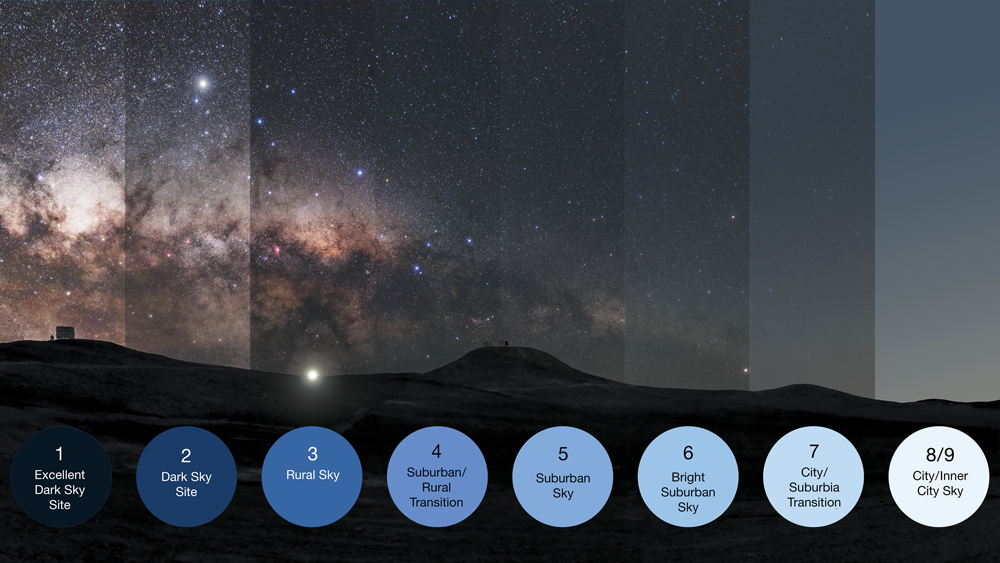
Illustration of the Bortle scale, which measures the impact of light pollution on the dark skies at a given location. Photo courtesy of Horálek, M. Wallner and Creative Commons. This illustration is a modification of an original photograph taken at the European Southern Observatory Paranal Observatory in Chile.
Human health and safety
The American Medical Association has repeatedly issued guidance on outdoor lighting practices based on scientific findings linking light pollution to increased risk of depression, heart disease, diabetes, low birth weight and several types of cancer. This is because too much artificial light at night negatively impacts our sleep, hormones, alertness and immune system.
Many lights are turned on at night to make areas safer, but dark sky advocates point out that nighttime lighting can reduce visibility and make people more vulnerable due to the effects of direct light from unshielded, bright sources—what we call glare.
Implementing DarkSky lighting standards at Jackson Lake State Park “made the ambiance darker and more natural,” says Aaron Watson, dark sky certification specialist at DarkSky Colorado. “There are way fewer complaints to law enforcement at night. They’re seeing more families coming in and a nicer, more friendly vibe.”
Watson and Sewald note that when you see light in an otherwise dark area, it’s an indication of human activity. This can help law enforcement attune to their nighttime environment.
“I think people who are committing crimes are looking for areas that are well lit because they want to see what they’re going after and how to get there,” Sewald says. “The darkness deterred people from even attempting to try to go into those areas.”
Before Jackson Lake got its dark sky certification, Sewald says people would steal money out of the coin-activated showers and break into the cash boxes where envelopes were deposited by people coming into the park.
“After we got the certification, we didn’t have any of those issues,” he says. “I think it’s because when they walked into those buildings, the lights kicked on, so they weren’t able to get away with moving around without being seen.”
Household Resources
Check out DarkSky International’s Five Principles of Responsible Outdoor Lighting at bit.ly/4mCk4XM to see how you can help reduce light pollution at home.
A list of DarkSky-approved lighting products can be found at bit.ly/453Q2Gd.
Where to Go Stargazing
Berthoud’s Little Thompson Observatory
The observatory hosts a recurring Public Star Night the third Friday of every month. Check it out at starkids.org/calendar.
NoCo Astro EVENTS
Based in Fort Collins, NoCo Astro hosts public stargazing and astronomy events most months. They are listed at nocoastro.org/calendar-events. They are also hosting the Jackson Lake Star Party Sept. 27. Guests must buy park passes, but the event is otherwise free. Halac’s personal recommendation is the Starry Sky Soirees at Eagle’s Nest Open Space near Livermore.
Jackson Lake State Park
Jackson Lake State Park, the first state park in Colorado to receive a DarkSky certification, has 247 campsites and exceptional atmospheric conditions for stargazing. Expect lots of bugs if you visit during the summer, along with eye-popping views of the Milky Way.
Ron Stewart Preserve at Rabbit Mountain open space
The Longmont Astronomical Society hosts a Friday night Public Star Party once a month with Boulder County Parks and Open Space. See details at bit.ly/3ZB01iu.
Rocky Mountain National Park
RMNP’s recurring, ranger-led Astronomy in the Park is one of its best-attended events, with upcoming dates set for July 18, July 25, Aug. 15 and Aug. 22. Sky quality is nearly pristine, and the Milky Way’s visibility is close to its peak this time of year.
Crow Valley Recreation Area
Located in Pawnee National Grassland, Crow Valley Recreation Area offers views of the Milky Way, though the campsite’s proximity to Greeley has reportedly degraded those views in recent years. For those in search of better views, dispersed camping is permitted along designated routes farther north and east.