
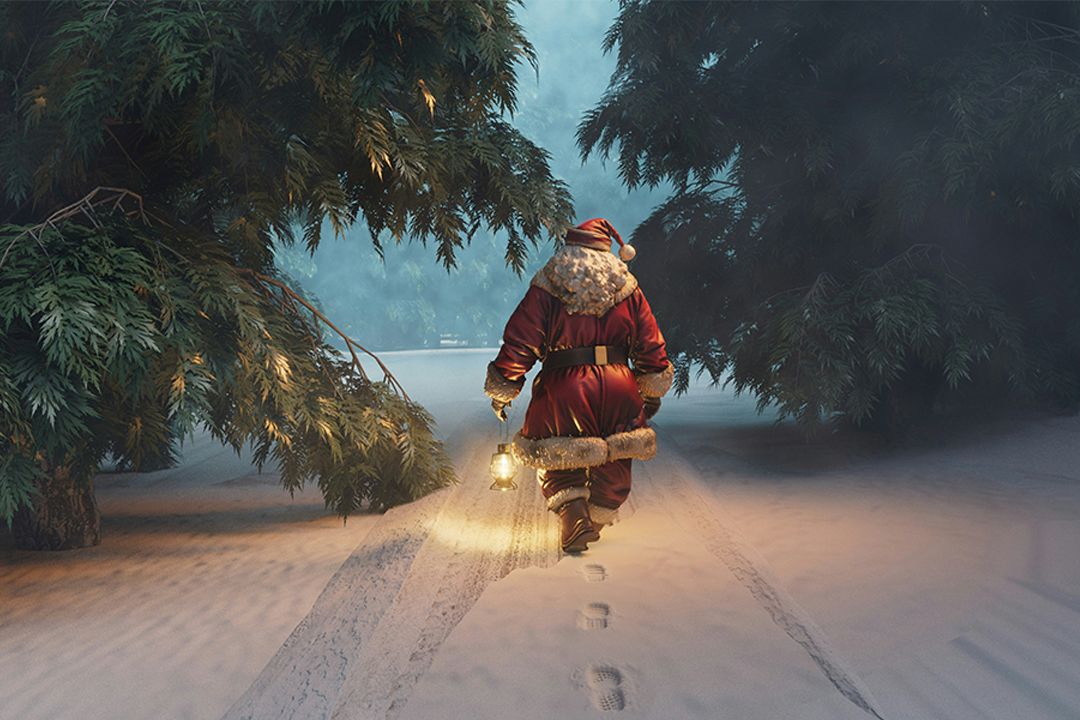
It would be hard for anyone to believe that Kelly McKenna isn’t really Santa Claus. His lush white beard comes from him, not Spirit Halloween. His laugh is right out of a claymation Christmas special. Versace couldn’t have designed a better red coat to cover his portly belly. And yet, when kids visit his workshop in Old Town Fort Collins every year, they ask him the question.
It varies, of course. Some ask if he’s really Santa. Others ask if Santa is real. The latter is the same question parents grapple with during the holiday season.
His answer differs, too, depending on the circumstance. If the workshop is full of young believers, he will tell them to yank on his beard and hope that settles it. If it’s one child who seems skeptical, he will keep them in the workshop, clue the parents in on the meeting and ask the child if they really want to know the truth. He warns them that there’s a tremendous responsibility to carry out what he asks once they have an answer.
If they agree, he says, “Yes, Santa is real.”
“When I’m in that shop,” McKenna says, “I believe in Santa. When you see that belief in children, it’s pretty magical.”
That’s not all he tells them, and it shows how tricky the answer can be.
SPOILER ALERT.
Santa, after all, is a lie. It’s a special tradition, a wonderful myth and a beloved fable passed down generations across the globe. But it’s still a lie. There is no old man who travels the world on a sleigh powered by reindeer, no matter what NORAD says. Mom and Dad, or whoever else, leave presents and eat the milk and cookies.
And it’s possible that kids will feel betrayed when they learn the truth.
Joining the world of make believe
Part of Kate Brockman’s job is to help children and parents avoid the kind of trauma that lies can create. But she also believes Santa can be “a really beautiful experience.”
“It’s one of the times when adults will join children in pretend and fantasy,” says Brockman, early childhood clinical program director at North Range Behavioral Health in Greeley. “It’s the world where they live.”
This is especially true from the time they are toddlers until a year or two into elementary school, she says.
“It’s very natural for them to live in that world,” she says. “They don’t need a lot of factual proof. They just accept it.”
That changes when kids turn 7, give or take a year, Brockman says, and logic starts to take over. They may start to question things, like how a fat guy somehow squeezes down a chimney, or how he manages to visit every house on Earth in 24 hours.
Parents don’t have to answer right away, she says. They can respond by acknowledging that it’s indeed a puzzle and encourage their kids to keep pondering it.
“The positive part is kids can come to us as parents and ask the hard questions,” Brockman says. “This gives a real opportunity for parents to practice.”
The risk, of course, is that they will likely hear that Santa isn’t real from someone else, such as their friends, or maybe they’ll see it in a magazine article (don’t leave this out if they’re old enough to read). But the way they find out might also create a positive memory.
Stephanie Bolton, who lives in Greeley and has grandchildren who talk about Santa, grew up in a working-class family in the U.K. When she was 8, she peeked out from under her sheets and saw her dad placing sacks that “Santa” left every year by her bed on Christmas Eve.
“I was so sad that it wasn’t Santa,” she says. “Then it dawned on me that the wonderful Christmas spirit came from my mom and dad. I marveled because I knew we didn’t have that kind of money, but somehow they made it the most wonderful time for us three kids. Christmas became even more special after that.”
A tough moment
Yes, there are worse things than finding out that there’s no Santa. But Brockman says it can be a significant moment in a child’s life.
“If you ask parents, they can probably tell you the exact moment they found out themselves,” she says.
Some children will feel let down, and that’s OK.
“They can be disappointed and sad and confused,” Brockman says. “That is real life. You can validate how they feel and sit with it. Sometimes as parents we just need to be with them as they feel that.”
Parents who worry about how their kids might react can start thinking about how to respond ahead of time, especially as they enter middle school. Kevin McFarling of Greeley was ready when his kids started asking questions around sixth grade. He told them that the feelings of excitement and wonder about Santa and the season were real.
“That means that I’m Santa, Mom’s Santa and their grandparents are Santa,” he says. “Now that they know, they’re Santa and keepers of the magic.”
He gave them a metal snowflake as a token of their “membership” and to remind them what it felt like to be a kid.
This is similar to what McKenna tells a child when he’s meeting with them in his workshop. Santa is real, he says, but he’s in the magic of the season, and they are now entrusted with that magic. Then he tells them one last thing before they leave.
“He’s in everyone’s heart.”
Writing Letters to Santa
If your child wants to write to Santa, here are some possible avenues.
The U.S. Postal Service accepts letters to Santa through its Operation Santa Program. The program also offers a chance for people to donate a gift to fulfill the wishes of a letter.
Learn more at uspsoperationsanta.com.
Kids can drop off letters to Santa at the North Pole Mailbox during WinterFest on Saturdays from Nov. 28 to Dec. 12 at Lincoln Park and 9th Street in downtown Greeley.
Postcards are accepted from Nov. 22 to Dec. 1 at the box near Santa’s set at the Foothills Mall in Fort Collins.
Kids can write letters to Santa while their parents take a painting class at 10 a.m. Dec. 12 at Painting with a Twist in Fort Collins. Tickets are $35 per adult. Book at paintingwithatwist.com.
The Loveland Public Library accepts letters to Santa in a special mailbox just outside the children’s section, typically appearing on Dec. 1.