

On a weekday morning at the Greeley Active Adult Center, a fitness class is doing more than counting reps. The participants are also testing their memory.
“Left hand is an apple, right hand is a bear,” recreation coordinator Sheri Lobmeyer tells the class.
As she repeats the day’s code words—“bear, six presses; apple, four presses”—Lobmeyer creates a dual physical and mental challenge for participants. To keep up, they need to remember the meaning of the commands and pair the reps with the correct side of their body.
The idea is to keep the classes fun so that seniors want to come back, but also stimulating so that they stay physically and mentally sharp. Seeing the impact of these engaging exercises for seniors is part of what motivates Lobmeyer.
“It gives them a reason to get up, get out of the house and get dressed,” she says.
The benefits she sees in participants, like improved confidence and greater social connection, are also based in science. Whether the center’s members are coming in to play mahjong or join an exercise class, their choice to stay engaged could prove beneficial for their brain health.
While there are still many things science doesn’t understand about our brains, experts agree that cognition—the mental work of thinking, learning and remembering—can benefit from many of the same healthy habits doctors already recommend. Body movement, mental stimulation, social connections and even heart health may all play a role, says Allison Bielak, an associate professor in Colorado State University’s Department of Human Development and Family Studies.
“They are all pieces of the puzzle, but we don’t know how the puzzle fits together,” she says.
Bielak has spent 15 years studying cognitive aging, which encompasses the changes in memory, attention and thinking that come with age. Unfortunately, there’s no defined formula to ensure mental acuity or prevent conditions like dementia as we age, she says, but adopting healthy habits at any stage in life can still bring benefits.
“It’s never too late,” Bielak says. “There’s definitely neuroplasticity (the brain’s ability to change and evolve) in older age.”
What the evidence points to
The Lancet Commission on dementia prevention, intervention and care identifies several habits, both good and bad, that influence cognition. They estimate that 45 percent of dementia cases are potentially preventable by addressing certain risk factors during different stages of life. These start with education in early life; factors like hypertension, smoking and obesity in midlife; and depression, social isolation and physical inactivity in later life.
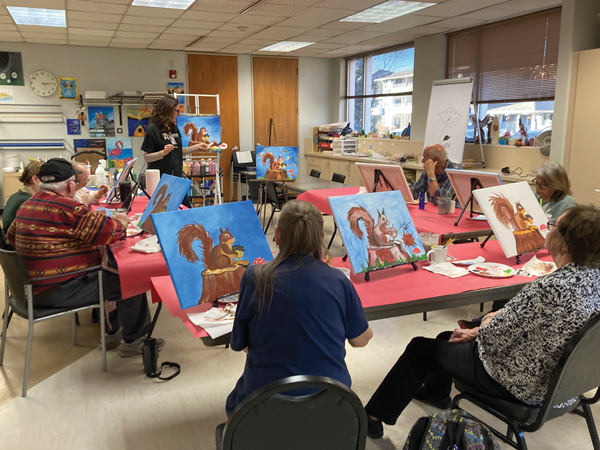
Greeley Active Adult Center
Movement
Evidence strongly suggests that physical activity has some of the most noticeable benefits. Bielak stresses that even low-impact activities can help.
“We know that people who are physically active—it doesn’t have to be that they’re doing marathons; it could just be that they walk—tend to have better cognitive ability,” she says.
A 2022 meta-analysis of 36 randomized trials published in the Communications Medicine journal concluded that aerobic exercise supported episodic memory, or the ability to remember personal experiences, in adults over 55 without dementia. The analysis highlighted aerobic exercise as an accessible, non-pharmaceutical intervention to support memory into late adulthood.
On the flip side, Bielak points to a 2005 study on television viewing that found that each daily hour of midlife TV consumption was associated with about 1.3 times the risk of developing Alzheimer’s, while more intellectual and social activity correlated with a lower risk.
Heart health
A recent NYU Langone Health study following more than 12,000 adults found that people who reached midlife without three specific vascular risk factors—high blood pressure, type 2 diabetes and smoking—enjoyed about 13 more years free of dementia than those experiencing all three. Bielak also recommends regular doctor visits to monitor vascular health as a prevention measure.
Connection
Loneliness may contribute to cognitive decline on the same level as physical inactivity or smoking. A recent study funded by the National Institute on Aging analyzed data from 600,000 participants and found that loneliness increased the risk for dementia by 31 percent, Alzheimer’s by 14 percent and cognitive impairment by 12 percent.
This is an area where we can support others, Bielak says. She recommends reaching out to grandparents or other loved ones as they age to reduce social isolation. A weekly phone call or offering a ride to the store can go a long way in helping older adults maintain social connections, she says.
Mental stimulation
Activities that challenge our brains, like reading a book or learning a new language, also support cognition. But no single one is a “magic bullet,” Bielak says. She points to research linking museum visits to better cognition, for example, but casts doubt on the specific activity being the lone driver.
“What about all the other things that they do? It’s probably not just going to the museum,” she says. “So, it’s complicated.”
Whatever the activity may be, Bielak says it should be something enjoyable, as forcing your way through stressful tasks won’t do the brain any favors. Novelty and enjoyment are key.
Bielak extends this advice to those doing any activity meant to support brain health, whether physical or mental.
“It’s about finding things in each one of those domains that fit your lifestyle, and that you enjoy, because happiness is a piece of those too,” she says.
Do what you can
Certain factors in cognitive decline, like genetics, air pollution and brain injuries, remain outside of our individual ability to control. Bielak also notes the issue of reverse causality: People with sharper cognition tend to do more to begin with, so it’s hard to say which comes first, the active, engaged lifestyle or the cognitive ability to maintain one. This also holds true when analyzing an inactive lifestyle. Retreating from our usual activities may not be the cause of mental decline, but rather an early sign of it.
What’s important, Bielak notes, is finding balance in the activities that are accessible to us and that bring us joy. Those will look different for everyone.
“We want to stay socially and cognitively engaged,” she says, “but there’s no prescription for what that needs to look like.”
Lobmeyer sees proof of this every day at the Greeley Active Adult Center. She has witnessed firsthand how community, movement and mental stimulation benefit the seniors she serves.
“The more you use your mind, the better,” she says. “We’ve seen people come out of their shells, not be depressed and take on a new interest.”