


When Brody O’Farrell told his father, Jay, about a business idea, Jay did a double take.
Brody, a 19-year-old junior at Colorado State University, wanted to make Hacky Sacks. “You mean,” Jay said, “that game with a little ball filled with sand that I used to kick around when I was your age?”
Yes, Brody said. He got the idea to make them himself after he went to purchase one and they were sold out. The Wright Life, the sporting goods store in downtown Fort Collins where Brody works, told him they hadn’t been able to keep them in stock.
“They said everyone was looking for one,” Brody says, “so I figured I needed to start my own company.”
Hacky Sack, footbag or “sacking,” as the kids call it these days, got hot in a hurry after a TikTok video of high school baseball players kicking one around went viral in April.
“The craze was just incredible,” says Bill Wright, owner of the mail division of The Wright Life, who recently sold the retail store he founded in 1981. “We sold out of everything.”
Wright said in mid-August that the store had to resort to filling orders by mail only, but that may have changed at press time.
Greyson Herdman, 33, may want to start playing the lottery. He bought the business, World Footbag (formerly the World Footbag Association), from his father-in-law, Bruce Guettich, a year ago. He now co-owns the store with his wife, Kayla, in Steamboat Springs, and business is booming.
Herdman says business was steady in his first year of ownership before things went bonkers overnight.
“It was zero to 100 pretty quick,” he says.
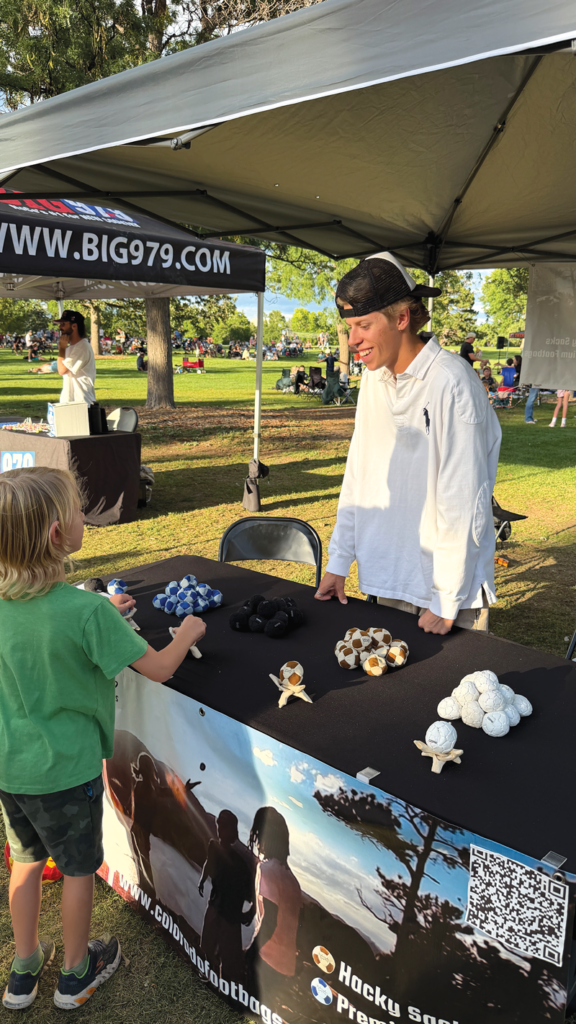
Brody O’Farrell, owner of Colorado Footbags.
Hacky Sack history
Many people call the activity Hacky Sack, though the proper term is footbag. Hacky Sack is actually a brand name of footbags, much like Frisbee is a brand name for flying discs.
The game has an interesting history. It was created in 1972 when two friends began kicking a handmade beanbag around. One of the friends, Mike Marshall, was introduced to the activity by a Native American inmate while in military prison, according to history.com. The other friend, John Stalberger, found that keeping the bag in the air by kicking it back and forth helped rehab his injured knee. Stalberger redesigned the bag several times before patenting it in 1979, according to the World Footbag Association.
The association formed in 1983 and was funded by memberships, subscriptions to the now-defunct Footbag World magazine and sponsorships, as well as retail sales. Herdman’s business relies mostly on sales now, with an online catalog of more than 130 products and a brick-and-mortar store that doubles as a footbag museum, including the sport’s Hall of Fame.
Guettich founded the company and is a member of the Footbag Hall of Fame’s first class. He is as responsible as anyone for the sport’s growth.
Herdman was a footbag player and acquaintances with Kayla when she asked him what she should bring to a white elephant party. He told her a footbag. That startled Kayla, who asked him if he knew her family history. He said no, and she told him about her father. The two formed an instant connection over footbag, Herdman says.
“I learned that her dad was, like, the footbag guy,” he says.
Guettich was a little surprised at the activity’s resurgence, Herdman says, but not as much as you might think.
“His perspective is that footbag is the American pastime,” Herdman says with a laugh.
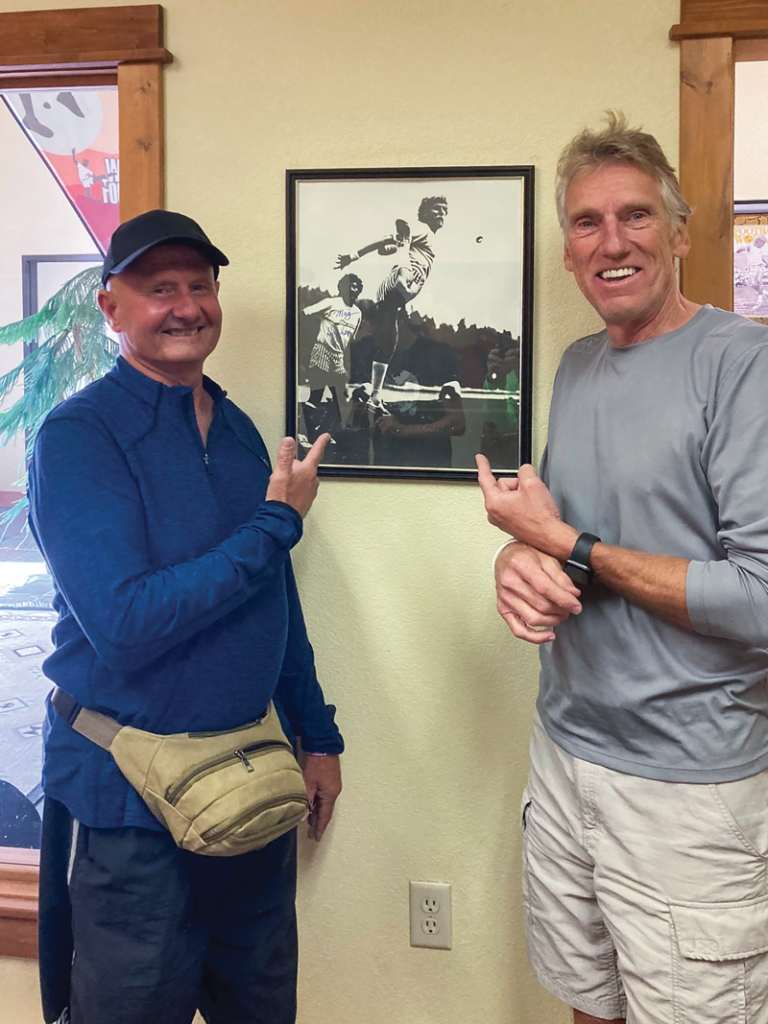
Mag Hughes and Bruce Guettich, founding members of the Footbag Hall of Fame, pointing to a photo of them playing footbag together in the ’80s.
The funny thing, he says, is that it never really died. Most people already knew what it was, even if they called it Hacky Sack, and sales were steady. But Gen Z needed to discover it for it to take off again, Herdman says. It’s funny, though not surprising, that they found it through social media.
“They discovered it in their own way,” he says.
Since then, videos have emerged of high school groups kicking footbags around, and college clubs have formed. Some rodeo cowboys even use footbags to warm up before riding a bull. Anyone who wants to play the game can likely find a circle on a college campus, downtown or in a park.
Herdman thinks of the activity as a good way for people to pass time together. There’s no scoring or rules, other than you can only use your feet, chest, legs and head to keep the bag going. Footbag requires groups to work together, so it can be a good icebreaker or bonding activity.
“The main thing we love to see is people are forming kick circles all over the place,” Herdman says. “Seeing people find this activity is really fun for us.”
A burgeoning business
Brody has a website now—coloradofootbags.com—and offers several different styles he designed himself. A manufacturing company makes the footbags for him. He also sells them at events and gatherings, like at food truck rallies. One Saturday this summer, he made $1,000 in sales in one afternoon.
“Sales have been really good,” he says. “It’s crazy to see how many people want to start.”
Brody keeps a footbag in his pocket now. The best time to play is whenever, he says with a laugh.
“Anyone can jump into the game,” he says.
When the craze first hit, Brody was hooked but couldn’t find footbags for sale anywhere. Then he realized where he could get one. He dug up his dad’s old footbag and formed a circle with his friends.
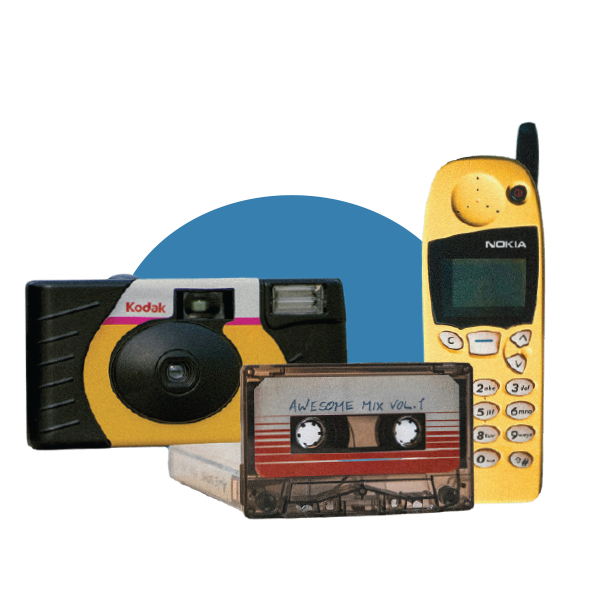
Back to Simpler Times
News outlets say Gen Zers are trading modern tech for older mediums as a way to rebel against screen addiction. Aside from footbags, here are some other retro things the younger crowd is bringing back.
“Dumb” phones. Flip phones and other basic phone sales jumped nearly 150 percent from 2021 to 2024 among 18-to-24-year-olds, according to sellcell.com.
Disposable film cameras. The disposable film camera market is worth more than $1 billion and could grow to $2.5 billion in a decade, according to amateurphotographer.com.
Vintage electronics. iPods and iPod shuffles are making a major comeback, as well as retro gaming devices, according to an article by Axios, which stated that searches on eBay for the devices rose by 25 percent in the last year.
Music players. Buyers 30 and younger are the leading consumers of vinyl records, and cassette tapes are back in vogue as well, according to BBC.