


The smoky scent and crackling sounds of a fire stir embers of nostalgia for many of us. Whether it’s memories of cozy evenings with family or late nights with friends, those subtle cues can serve as a reminder of good times.
People are often finding ways to bring those comforts into their outdoor space, says Cara Doyle, who owns Summit Outdoor Living in Fort Collins with her husband, David. The couple believes fire pits are a main way to achieve that—especially wood-burning ones.
“If we harken back to where we were as a kid…we went outside, we lit a fire, we maybe went camping with our family and got some sticks and made s’mores,” Cara says. “If you have the space to be able to do that responsibly with wood, I think that is a big draw for a lot of folks.”
A fire in the backyard can also create a sense of community and well-being. More homeowners are incorporating their fire pits into their nightly wind-downs instead of just using them on special occasions, often as a way to spend quality time with loved ones, Cara says.
An area with a fire pit naturally serves as an extension of the home’s living space, the Doyles say, which, thanks to Colorado’s beautiful weather, can be used mostly year-round. It can even be part of a biophilic design, which refers to the integration of natural elements in a built environment.
“You’ve potentially got a water feature trickling in the background, you’ve got your plant materials, you’ve got the fire pit…it’s bringing those elements together to give you that nature connection and make it feel like you’ve got a sanctuary in your backyard,” Cara says.
Wood versus gas
When deciding between a wood-burning and natural gas fire pit, think about which option you are more likely to use.
“Sometimes that may be a big one with custom masonry, but we find the one that’s used more often is a simpler gas fire pit or a smokeless, portable setup,” says Eric Van Dixhorn, owner of Archadeck of Northern Colorado.
While some folks love the sound, smell and warmth of real wood, the smoke might be too much for others. Or perhaps they’re just looking for a convenient option so that they don’t have to worry about cleaning it out, dousing it with the hose or controlling the flame.
One example is a client of the Doyles who wanted a nice gas fire pit to enjoy with his wife, who had Parkinson’s. They set it up with a remote to minimize the hassle.
“The biggie is the ease of use,” David says. “Most people don’t have time, so they want to hit the button…. Ideas are wonderful, but they’re no good if they’re not practical.”
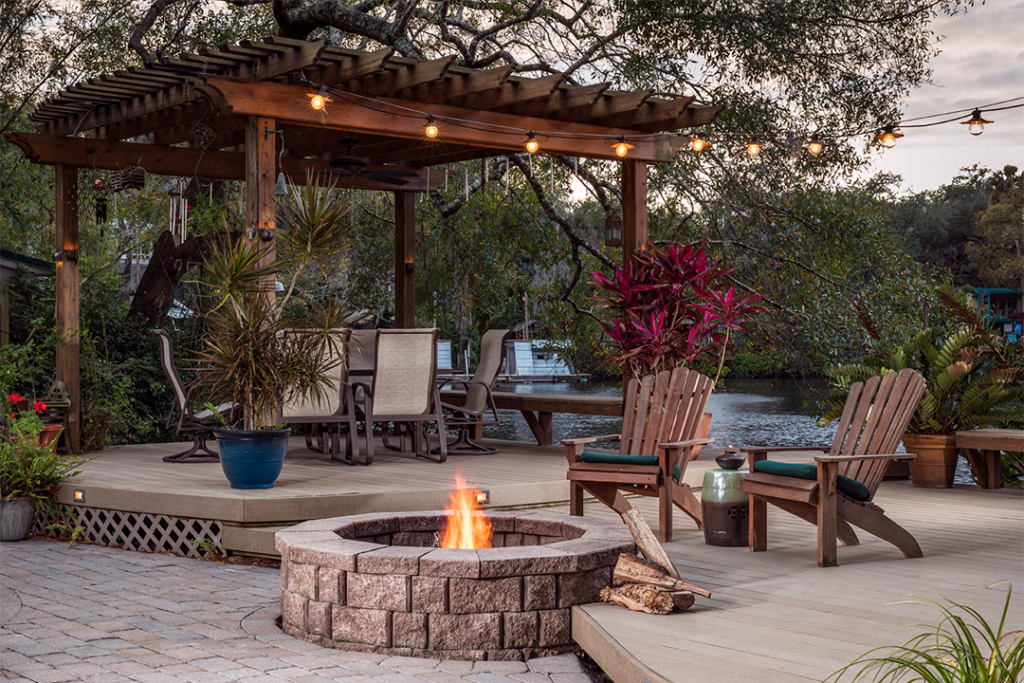
Fire pit by Archadeck.
Allocating budget and space
Those with a tight budget might consider a portable option, like a Solostove, Van Dixhorn says. The brand’s wood-burning fire pits cost a few hundred dollars and feature a design that reduces smoke. They also sell propane fire pits for under $1,000.
The next step up is a prefabricated wood-burning or natural gas fire pit, which Van Dixhorn says is the most popular option. Those are often made of steel or concrete and cost a couple thousand dollars—not including the expense of running a gas line through the yard.
From there, David says that a modest built-in fire pit can cost anywhere from $5,000 to $8,000, but once you start introducing more masonry work, the project can quickly reach $15,000 or more. Then you’re talking about matching the look of the house, whether that means bringing in a specific stone, brick or something else, Van Dixhorn says.
“And then we get into the fireplace world: If you envision a chimneyed fireplace outside, those can certainly get into the $30,000 to $50,000 range,” David says.
While discussing your budget and coming up with a design, it’s important to envision the space and location. When you consider a fire pit that’s four feet wide, you’ll need at least another four or five feet on all sides for a comfortable experience, David says.
Both Van Dixhorn and the Doyles have built benches around fire pits, but they say comfy chairs make more sense for regular use.
“People immediately go to this low seat wall that surrounds the outside of the fire pit, which is fine for a casual sit here and there…but they’re not comfortable,” David says. “Incorporate enough space for an Adirondack chair or a cushion chair so that you can scoot in and out. You’ll have fewer barriers to get outside and use it.”
Fire Pit Safety
Local jurisdictions have different rules regarding the use of residential fire pits. Here are the rules for Larimer County, according to Shawn McGaffin, division chief and fire marshal for Poudre Fire Authority.
• Fires must be completely contained and
above ground in a portable fire
appliance or fire pit.
• Fires must be at least 15 feet away from
structures and combustible materials,
both horizontally and vertically.
• Fires must have an extinguishing source,
like a hose, nearby.
• Wood in a fire pit should be stacked
no higher than two feet and no wider
than three feet.
• Fires must be attended at all times by an
unimpaired adult and be fully
extinguished when unattended.
• Only clean, dry wood can be burned
(no yard waste, trash, treated
wood, etc.).
• Fires are prohibited when the wind
is over 10 mph.
Additional rules apply during stage one and stage two fire restrictions, and fire bans are also possible. As of press time, Larimer County was under a stage one restriction through July 21.
Other resources:
1. An interactive map of Colorado county fire restrictions can be found at dfpc.colorado.gov/fireworks.
2. Larimer County fire restrictions and bans are listed at tinyurl.com/lcfireres.
3. Find Weld County outdoor burning resources at tinyurl.com/wcfireres.
4. For more information about local fire pit rules, visit tinyurl.com/firelc.