
Name: Jeremy Garrett
City/town of residence: Drake
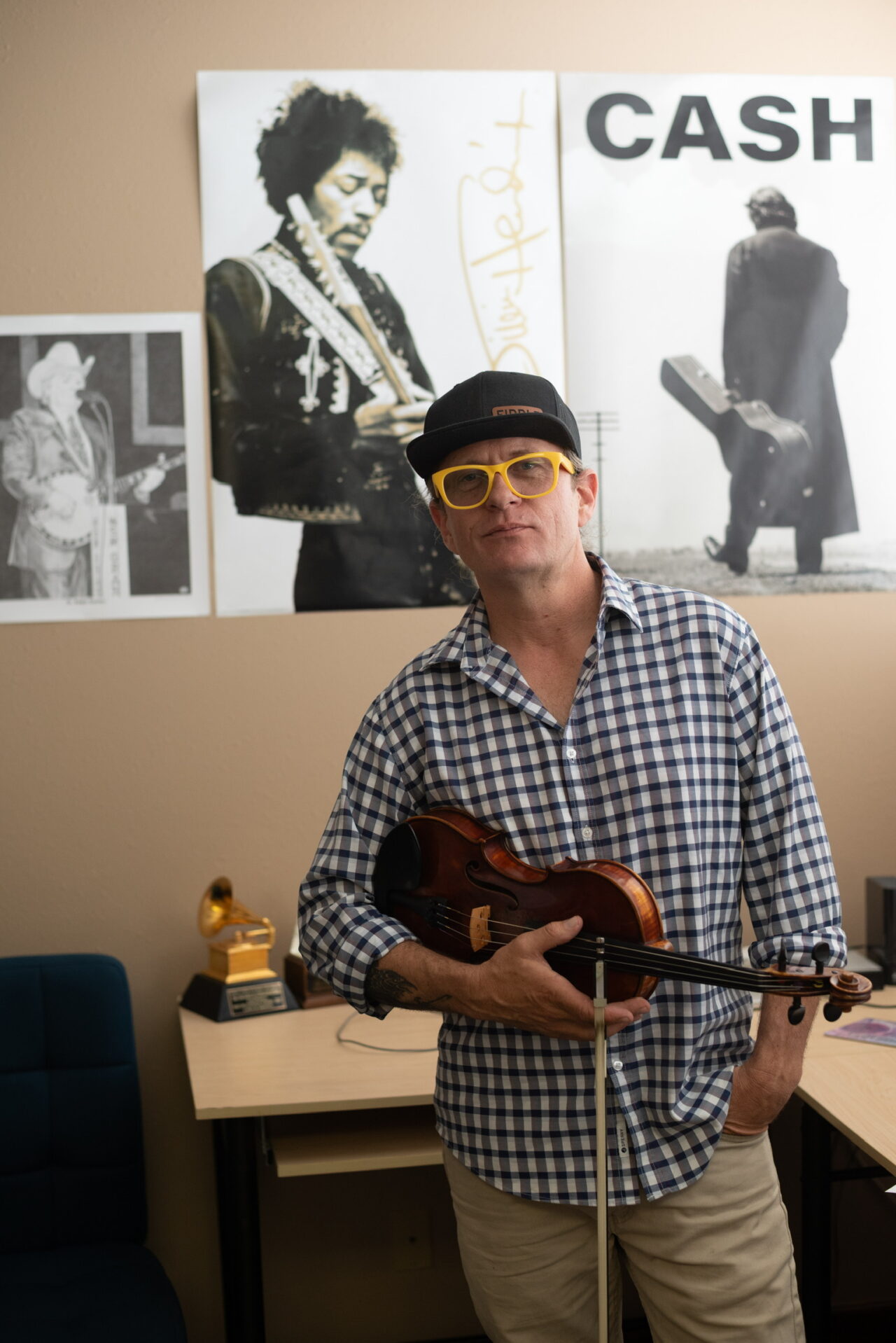
Occupation: Musician and founding member of The Infamous Stringdusters
What brought you to Northern Colorado?
I was living in Nashville for about 13 years, playing full time as a musician with the ’dusters. We were touring everywhere, but you always mark a place as you travel through it as a potential home. I’ve been through this area a lot, even pre-’dusters. I’ve been traveling and playing music my whole life, basically. We sold our house in Nashville and bought an RV, and we were traveling around the U.S., seeing the national parks, and we ended up at Riverview RV Park and found out we were having a baby. So we decided we needed to put some roots down, and since we were here, this was the spot. We found a place close to Drake to put our roots in and live off grid out there. It’s a cool spot. I do a lot of traveling into Loveland, of course, for all of my needs and business stuff.
What do you do for work?
I’ve been playing music my entire life. I started playing fiddle when I was 3 and singing in church and stuff like that. But then I went to Nashville for a long time and met The Infamous Stringdusters. We put that band together. In fact, this is our 20th year as a band. I’ve done a lot of solo stuff and played with some country musicians and stars too. You can’t help that in this business. So I do a lot of that, and we travel around full time, even 20 years in. We’ve toured around the world, but mostly in the U.S. We just released a record, “20 songs for 20 years.” We’re as pumped as ever to keep doing it. It’s a lot of fun, and I’m lucky that I’ve been able to pay my bills doing music all these years.
What style of music do The Infamous Stringdusters play?
I guess what you would call our music is some kind of progressive bluegrass music. It’s based in traditional bluegrass chops. A lot of us have played with the people who paved the way in the bluegrass world: Our dobro player has played with Earl Scruggs and even Dolly Parton, and I have played with Bobby Osborne, who is part of the Osborne Brothers, and we’ve all played with Ronnie Bowman and a bunch of bluegrass stars. That’s how we got our start.
In putting our band together, we came on strong to the jam scene in the early years for traditional bluegrass music. There were bands around, like The String Cheese Incident and Leftover Salmon, but there weren’t a lot of straight-ahead string bands that were into the jam scene. So that was how we made our mark, and we kind of paved the way for a lot of younger musicians who are doing it now.
How did you and the other members form the band?
It was a hodgepodge at first. Some of the guys knew each other from the Northeast, and I’m from Idaho, so I came out of left field. Another guy was from Colorado, our bass player, Travis. We give credit to this yearly event that bluegrass music has called the International Bluegrass Music Awards. At that time, it was in Louisville, Ky., and everybody who’s anybody in bluegrass goes to this place. It’s 24 hours a day immersion with each other, doing business, booking shows and meeting new musicians. At the time, we were pretty young, so it was just a hang for us and really a lot of fun. We met each other in a jam circle, most of us, and we met Travis coming off of an elevator. He had a backpack full of beer and was able to bring that to the jam, and he crushed bass playing. It was just one of those things where we kept in contact with each other, and we were still doing side stuff, but then it eventually all fizzled out because we wanted to make this our main thing. We pulled that trigger and took that risk 20 years ago.
It’s not been easy the whole time, but we’ve never looked back, and we’ve never regretted one second of it. We’ve really built a great business, and we won a Grammy along the way. We won three IBMA Bluegrass Music Awards right out of the shoot and have had some press. We’ve been on “The Late Show With Stephen Colbert.” So we’ve been around the scene in the music industry for a long time now, and it’s not over. We keep getting out there. Our shows are full, and people seem to still dig what we’re doing, so we’re going to keep doing it.
What led you to learn how to play the fiddle at 3 years old?
My dad is a bluegrass musician, too, and he plays guitar. He doesn’t play fiddle, but he decided that he wanted to have a fiddle player around, so he said he would grow one. So that’s basically what his motivation was. When you’re that young, you have no idea what you’re doing, and you don’t even know how to talk really yet. With the violin, I started in the Suzuki classical method, but all the while I was learning bluegrass. My dad would hum tunes to me, and melodies and stuff that I should learn on the fiddle, and I would try to pick them out. It took a little time, but I’m pretty self-taught.
I did go to college for music down in Texas at South Plains College, but getting into the early years, it was a lot of festivals and that kind of scene. There wasn’t a whole lot in the West at that time. The fiddle contest was the thing that we did every year in Weiser, Idaho, and maybe [festivals] in Grass Valley, Calif., and a couple other cool festivals. You’d get to meet some people, jam with some people and get your chops down. I also grew up in a church that was very conservative with not allowing any instrumentation at all, so it was only a cappella singing, and I learned all the singing parts while I was growing up doing that.
We merged the two, and that’s my experience growing up and getting involved in music. We used to sing this out of a song book with a style called “shape notes,” which is a different, old-school, old-time way of singing. You can check it out on online, but it’s really interesting. It’s a way to sing without necessarily having accompaniment with instruments. You can pitch the song and just sing it. It’s a fun way to learn how to sing all the parts and everything, and it’s benefited me pretty well over the years.
Do you sing with the band?
I do. We have a few dedicated lead singers, but we all sing, and everyone sort of takes part in the parts, and we’ll switch off and on, depending on who’s taking a solo or what’s needed in the song. It’s a lot of fun to incorporate those things, the part singing and the classical style. I sometimes still use that.
What do you love most about playing the fiddle?
The fiddle is the most universal instrument in the world, I’m pretty sure. I mean, it’s been around the world, probably because of the British, and they took it whenever they were going around the world, doing their thing, and every culture has adapted their own way and style of playing the instrument. Around the world, you can hear very different styles played on the same instrument.
Bluegrass is super challenging because you’ve got to have your chops down and the timing. It’s fast music. If you want to play it well and play it right, you’ve got to practice a lot to get impeccable. You can’t just slough through it; it’s not possible. You can, but it doesn’t sound great, in my opinion, and that’s just a different style. We try to be accurate in the ’dusters and have a lot of integrity when we play.
Those are some of my favorite things about the fiddle. It’s a universal sound. I can play country, or I can play jazz or bluegrass. I can even put on EDM music, and I can play with that. It makes it pretty nice. It’s a great instrument.
Tell us about your Grammys.
I think we’ve been nominated four times, and we’ve won one. I’m super stoked to even be thought of in that category or on the list. It’s a big experience to have, of course. It’s a big party, and you dress up, and there’s the fanfare and all that, if you’re into that sort of thing. When we won it, I believe we tied with Rhonda Vincent, who is technically known as the Queen of Bluegrass Music. So it was an honor to have both of us be in a position where we could both accept the award.
But it’s just a trophy. I guess it’s not really that big of a thing, but in a way, it helps other people understand that we’re legitimate. It puts you in a place where people go, “Oh, they must be good,” because you don’t really know sometimes. It’s just an accolade, but it has helped move the needle a little bit for us because people will pay attention now. We’re just stoked to be doing it.
Who are some musicians who have inspired you?
Anybody who’s good at what they do is inspiring to me, but I guess probably the main one is probably my dad, who’s a bluegrass musician too. He was very inspirational in getting me going. But there’s also a guitar player who is well known in the bluegrass world named Tony Rice, and he was probably my most influential person that I would be into because what he does with the song and his guitar playing is unmatched. He really inspired a whole vibe and cool factor with bluegrass on his own. He was bridging the gap from the old world to more of the modern world, and he made it really cool. A guy like me probably needed to see it at my age, growing up, and it was very inspirational.
Ralph Stanley is one of my favorites. Jimi Hendrix…I would do anything to have been able to see him. Johnny Cash, I got to meet him one time when I was in Nashville. I’m inspired by whoever can really last out there and stand the test of time in music, and whoever can do anything. It’s a hard world. My hat’s off to you if you can do anything in this business.
What is your new album about?
We just released our 20th album for our 20th year as a band, and it’s called “20 Songs for 20 Years.” It’s released everywhere, so you can get it now. It was inspired from being together for so many years and trying to figure out what we can do in a world that’s got such a short attention span. We thought, “Let’s do the opposite as an artist to make a statement” and to also truly give our fans a gift back because they’ve given so much to us. Instead of doing a quick, 10-song record to satisfy everyone, it was, “Let’s really get into it and do it,” and we spent a long time making that record over the course of about 18 months. It was a few sessions and a lot of pre-production to get the songs and figure out how to make a quality 20-song record and not just put a bunch of junk together.
We really put our heart into it. We feel like we went back to some of our roots in a lot of ways and harkened back to some of the more raw sounds. There’s no tricks or frills on this; there’s no ambiance sounds. Sometimes we’ll do some of those things to make a song a little bit more effective as a recording. This was all pretty raw. It was fun to do that and give that large gift of music back to the fans in a time when everyone wants something quick.
Do you have a favorite Stringdusters song?
I never have favorites. I like the variety. I like it all. I love every song on the record. I really do.
We are a true democracy. We’re a five-piece band, and we all agree or we won’t do something. Very rarely does it even come to a vote. But especially when we’re making a record, and we have our whiteboard, and we have the list of songs, and we’re sending around demos, and we’re all listening, the stuff rises to the top that should, and we know which ones [to include]. Not that the other stuff won’t maybe creep up again too, but for this record, we had over 50 songs, and that’s how we narrowed it down to 20. It was a really in-depth process, so I stand behind every song.
What do you appreciate about your fans in NOCO, and how do you hope to grow that relationship?
Now that I’ve been around the area as a local for about a decade, I’m hoping to infuse myself a little bit more into growing the music scene here, at least in the acoustic bluegrass music world where I’m connected. I’d love to see that continue thriving up and down the corridor. When I first came here, I was amazed that the fans were open-minded to the music, and it’s impressive to me because there’s no judgment about the music. If you go to the East Coast and you’re playing bluegrass, if they hear a modern bluegrass song, sometimes they’ll be like, “That’s not bluegrass.” Out here, it’s not like that at all, and it’s so much fun to play to people like that who have an open mind.
Music is obviously a mainstay for the people who live out here. It’s a sort of community; it’s a gathering. We see the same people over and over again, and I love to see the same faces. I know them by name now, and I visit with them every time I see them at a show. It’s a community.
What do you love most about living near Drake?
I have a record called “Storm Mountain,” which is basically where I live, up there above Drake. I live off grid, and I’m out far enough that I really get to enjoy nature and see the animals and hear the quiet. I don’t get a lot of noise and vibrations. But on that record, I often think about a song talking about “the river wild,” where the snow happens up there at the top, at 8,000 feet, and it starts to melt and trickle down, and you can see it. It’s just a trickle when it starts up there, and then it just works its way down into the canyon, into the Little Thompson River and the Big Thompson River, and flows out. Just to be able to experience that on a daily basis, there’s nothing else like it.
I’ve traveled all over the U.S., and there are beautiful places everywhere, and many places I could easily call home. But being out next to the Rocky Mountains, there’s something magical about this place, and especially this corridor. The Big Thompson Canyon is epic in a way that I don’t think people ever notice. It’s not necessarily on the main path to Rocky Mountain National Park if you’re coming from the airport, so it’s one of those things where I don’t think a lot of people realize what they have until they get in there and see what’s going on.
If you had a friend or a family member visiting for the weekend, what are some things you would take them to go do?
There’s always music. It seems like there’s music every night of the week around the Front Range, from Fort Collins all the way down to Denver.
Anytime I have company come over, I take them on hikes around Rocky Mountain National Park, of course, which is right there, but there’s a lot between Loveland and Estes Park, and several trails there that I love to get into. You can get on the backside of Rocky Mountain National Park on one of them and follow the Little Thompson River back all the way, and you can even go backpacking back there. So it’s cool to obviously get into the nature and that kind of stuff.
The food is good too. I like the food around home. I’m a sucker for 3 Margaritas here in Loveland, and I’ve tried other locations. I know it’s a chain, but I think this one in particular has the best staff and chef and management, and they just kill it every time I go in there. We have to eat out a lot, so we try to patron the downtown area too. We like Pourhouse and Henry’s Pub. Those spots are all good.
What fun plans do you and The Infamous Stringdusters have coming up in July and August?
Well, the ’dusters continue to tour all over the U.S. We’re going to be playing at the Mishawaka Amphitheatre on Aug. 1. We’re just doing one night, and that’ll be a fun show. It always is at the Mishawaka, of course, because it’s a beautiful place right on the river.
We’ll play at the Denver Botanic Gardens that following Tuesday, and that’ll be a fun show as well. I believe it’s sold out already. Colorado is definitely a mainstay for The Infamous Stringdusters, and we try to get back here as often as we can. This year, we hit it early on in our ski tour, so we may not be back much more than this.
Follow us on Instagram for more NOCO Locals and interview videos! @nocostylemagazine