
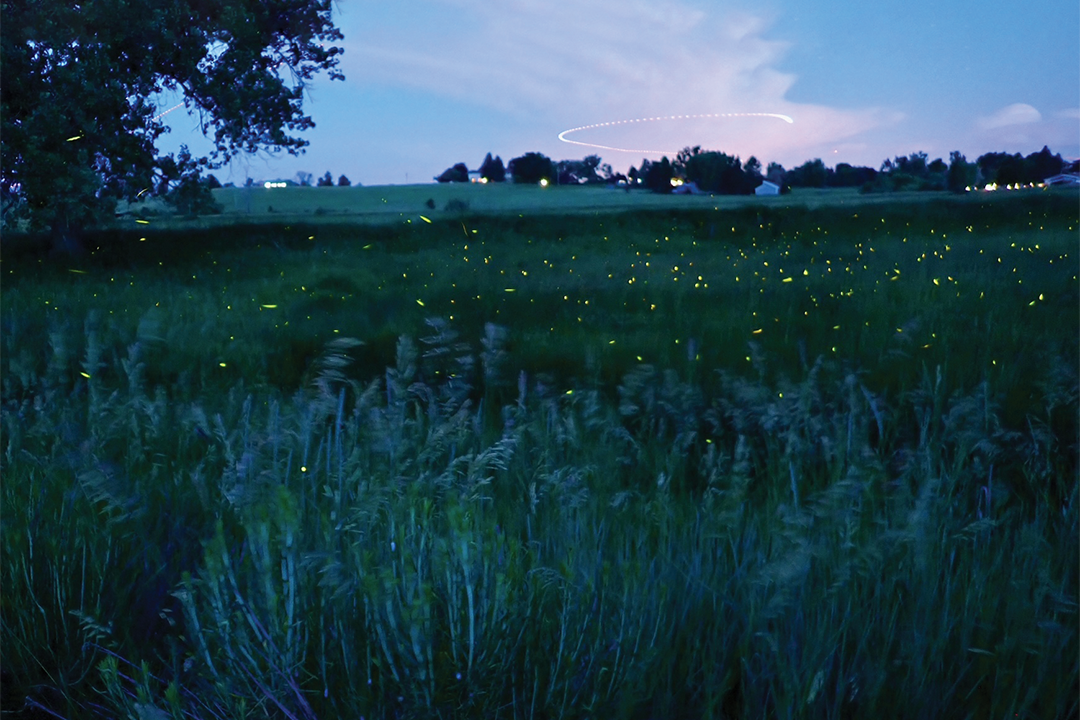
Usually in June, Diana Frances goes out to Loveland’s appropriately named Firefly Meadow to look for the little twinkles of yellow light that signal the start of summer. She’s not the only one enchanted by them.
For many, fireflies are as connected with nostalgic thoughts of our hottest months as fireworks, baseball and the neighborhood swimming pool. But Colorado is a tough place for them. The news that they are here at all would likely surprise some residents. Most of us have seen them in places that are warm, humid and moist, such as the Midwest.
And yet, there are places in Northern Colorado where fireflies have a long history. A farmer who grows and harvests hay in Firefly Meadow, located off of west U.S. 34, told the City of Loveland that he’s seen them for more than 30 years. The Butterfly Pavilion in Westminster collects fireflies in Fort Collins for its Firefly Lifecycle Project in hopes of expanding their population. There’s a trail in Greeley that was named after the fireflies when they were spotted there nearly a decade ago.
Sightings of fireflies in Loveland were first reported in 2018, or at least that’s when the city officially confirmed them. A year later, the city began offering a few guided walks in Firefly Meadow every summer to give residents a chance to see them. The city acquired the property in 2016, and it will officially open as a natural area this fall. As of now, it remains closed to the public.
Frances got involved with the fireflies in 2023, when she joined the City of Loveland as a volunteer and outreach specialist for the Open Lands & Trails division. She’s led those short firefly walks offered by the city over the last three years.
“They’re very popular walks,” Frances says. “People love fireflies.”
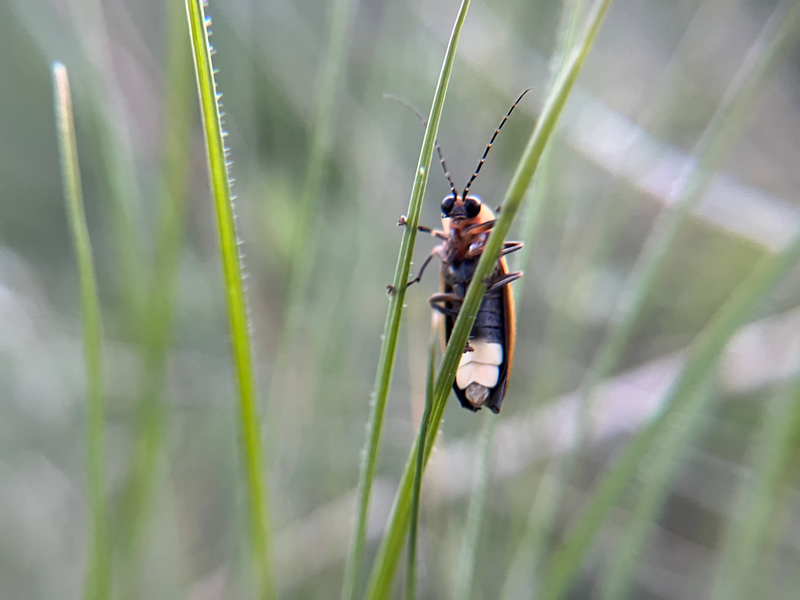
Photo courtesy of the Butterfly Pavilion.
Ahead of schedule?
Frances’ trips to Firefly Meadow aren’t just so she knows when to schedule the firefly walks. When she first sees them, she alerts the Butterfly Pavilion. This year, she started scouting in May. Fireflies usually emerge in June and can be seen through mid-to-late July, but the unusually warm and dry winter and spring confused many insects, which appear to be emerging early.
“I feel like I’m starting from scratch,” Frances says of her scouting timeline.
Many insect experts feel the same way. Tristan Kubik, entomologist with the Colorado National Heritage Program as a part of Colorado State University’s college of natural resources, doesn’t know if fireflies will emerge early as other insects have done. The program tracks the status and location of the state’s rarest and most threatened flora and fauna.
“It will be hard to predict how this warm winter will affect our beloved living lights,” Kubik says.
In 2016, Kubik made the remarkable discovery that the fireflies in this area were a specific species, perhaps even unique to Northern Colorado, instead of eastern migrants. He says the warm winter we had could be both good news and bad news for fireflies.
Fireflies struggle in Colorado because of our arid climate, something the driest year on record would seem to exacerbate, Kubik says. But fireflies also spend their winter as larvae hiding in the mud, and harsh winters can kill off wintering insects. So the warmer weather may mean more fireflies survived. That’s been the case with other insects so far.
“As our planet continues to warm and seasons get milder, we can expect some insects to rapidly adapt and likely even thrive,” Kubik says. “Fireflies are likely to benefit from milder winters, even if it means an occasional reduction in larval habitats.”
This year, Kubik plans to scout several hot spots for fireflies, including parts of Northern Colorado. At press time, he was optimistic that fireflies will emerge at the end of May.
Francisco Garcia Bulle Bueno, director of research and conservation at the Butterfly Pavilion, has monitored Northern Colorado’s firefly population since 2017 with the help of Frances and other scouts. This year, he’s as confused as anyone.
“The easy answer is we don’t know anything,” Bueno says. “We may end up with a lot, which is exciting, but we may wind up with very little.”
The Butterfly Pavilion hasn’t been able to track firefly numbers throughout Colorado, which is a common problem in entomology. There isn’t much data on insects—even charismatic species, like fireflies—that catch the public’s fascination. It’s just too hard to get.
“It’s just what we see,” Bueno says.
So, scientists don’t know how fireflies have fared in comparable years, such as 2002, a bone-dry time that held the previous record for dryness.
Loveland’s Firefly Meadow does see some flood irrigation for the hay farming operation, so it’s possible that the fireflies in the area will do alright, Frances says.
“I’m hopeful,” she says.
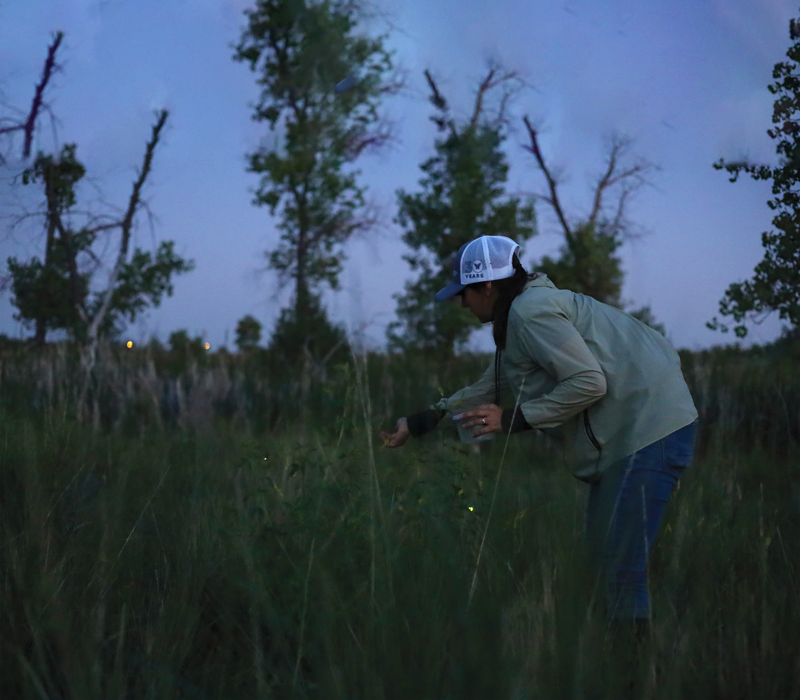
Photos courtesy of the Butterfly Pavilion.
Population growth
The Butterfly Pavilion collects about 50 fireflies from various sites in Fort Collins every spring. The collection is private (they have a special research permit), and they try to get 40 males and 10 females so that the ladies don’t have to mate with someone they think is a dork.
Conditions have to be perfect for them to mate, which can be a challenge.
“The humidity, the soil,” Bueno says. “Everything has to be a certain way.”
It’s worked. Last year they were finally able to complete a full life cycle. A female firefly born and raised under the Butterfly Pavilion’s care emerged over the summer, mated with a wild-caught male and laid viable eggs. One of those eggs hatched into a tiny larva. This feat has been accomplished by only a handful of institutions across the globe and never before in Colorado. It’s confirmation that the program could start to raise fireflies and help increase the species locally. It may even help repopulate fireflies across the country, as they are declining along with the rest of the insect population.
“This is a huge, huge step,” Bueno says. “Before that, we weren’t sure how to do it. We now have a recipe.”
While the process means there’s hope for the future, it also shows how precarious it is to be an invertebrate.
“Insects are very specific, almost like a computer program with a code,” Bueno says. “It’s why insects are facing some of the biggest population problems.”
They are the most sensitive beings to habitat fragmentation and climate change, two of the most concerning problems facing any species. In fact, insects are dying off so rapidly that scientists refer to it as an apocalypse.
“Mammals can adapt, but insects just die,” Bueno says. “There’s no room for error.”
It’s hard to say what kind of a year the fireflies will have, but Bueno and others believe there are flashes of hope here, if you know where to look.
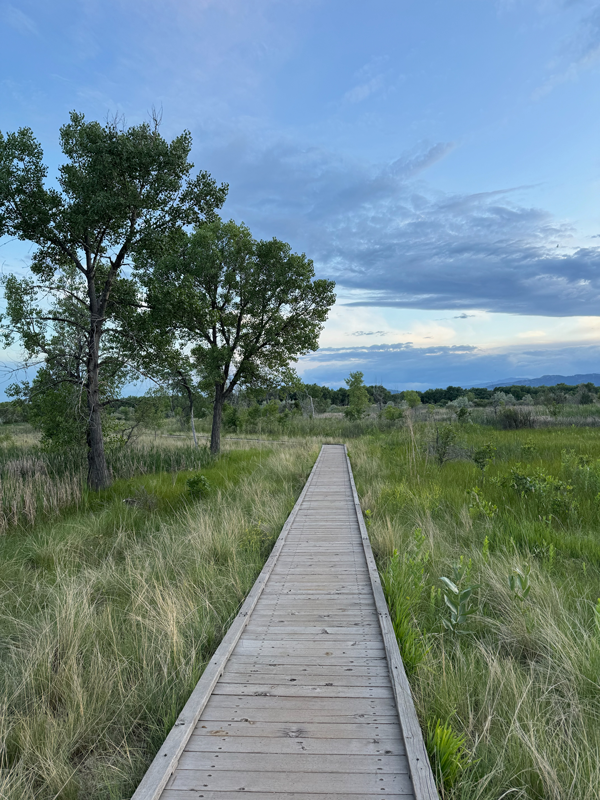
Riverbend Ponds Natural Area
Where to Look
Fireflies are usually found in wetlands, ponds and marshy open spaces. They may be out now and have appeared as late as July, but their numbers diminish as the summer goes on. Here are a few places where they’ve been spotted.
Fort Collins: Riverbend Ponds, where volunteers lead walks in June and July on the boardwalk, and Reservoir Ridge, Fossil Creek and Prospect Ponds natural areas.
Loveland: Firefly Meadow, though the area won’t be open to the public until this fall. The city will host some night walks this year. Another place to check out is the Morey Wildlife Reserve.
Greeley: McCloskey Natural Area, especially on the Firefly Trail that winds east of the entrance.
For more information or to report sightings, go to butterflies.org/colorado-firefly-watch.