
It all started in 2016 with a safari. Georgia Evans, an avid photographer and Loveland resident, had saved money to join a wildlife photography trip to Africa. Before visiting each region, she researched the local people, which is how she discovered the living conditions of the Maasai tribe in Tanzania.
“I love meeting people from different cultures,” she says. “When I started researching the Maasai people, I saw pictures of them drinking brown water from nasty-looking ponds.”
According to the World Health Organization, hundreds of thousands of people in underdeveloped countries die each year from waterborne disease. Evans has made it her mission to help change that.
Before she left for Tanzania, she decided she wasn’t going to arrive empty-handed. Determined to help, she had two community water filters—50-liter purifiers designed to protect against viruses, bacteria, parasites and microplastics—and 50 personal water straws shipped from Switzerland and hauled them to the village.
When she arrived, she used body language and gestures to overcome the language barrier and demonstrated how to use the filters.
“I spent two hours with the chief trying to teach him how to use them because we had no translators,” Evans says. “But once he understood what we’d brought him, he was so excited he wouldn’t leave my side.”
Where there’s a will, there’s a way
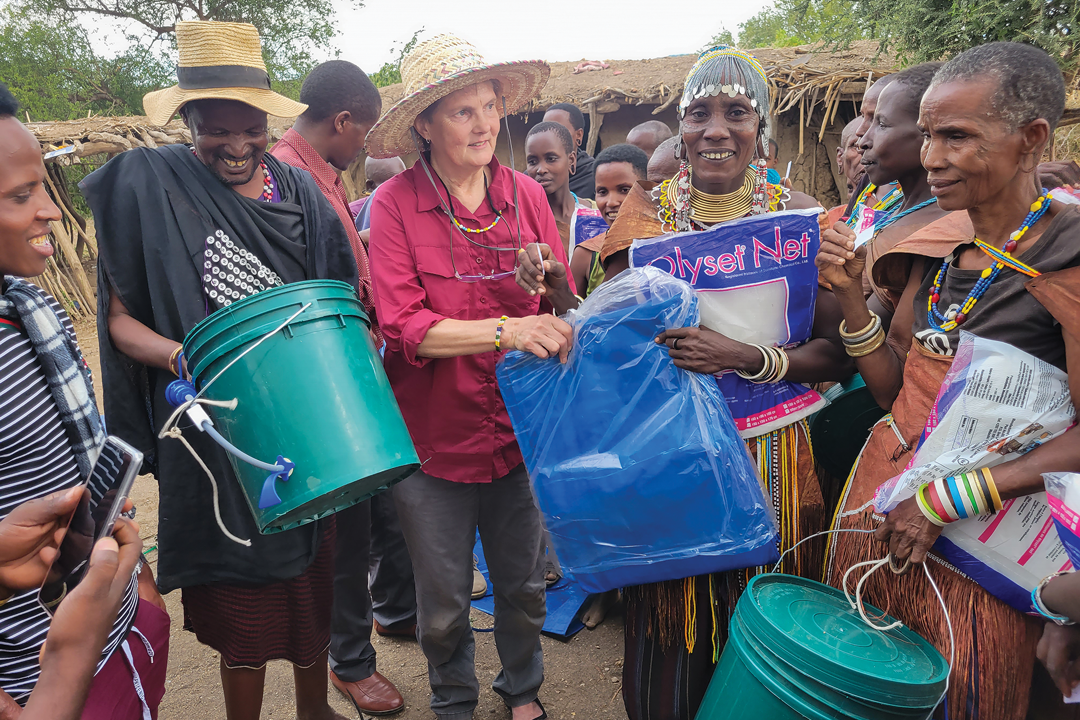
The villagers were so grateful for the supplies that Evans decided to go back the following year. That time she traveled alone and hired five Tanzanian men—two translators and three porters—to accompany her into the villages. Together they identified five communities and, camping along the way, delivered more filters along with mosquito nets to help prevent malaria.
After returning home, she was invited by an acquaintance to speak publicly about her experience. Word spread, more presentations followed and before long she’d received $35,000 in donations. It was time to turn her one-woman effort into a nonprofit: Village Care Project.
Realizing the good she could do with community support, Evans began fundraising in earnest. The trips became an annual thing, with volunteers signing up to haul suitcases of supplies over and help train the villagers on how to use them.

A Hadzabe woman gathering drinking water from a puddle in the road for her family.
As her mission gained attention, Evans appeared on local TV news stations. In 2018, she was presented with both the Woman of Vision and Woman of Inspiration awards by the Colorado Women of Influence Foundation.
Despite the recognition, Ann Clarke, who started the foundation, says Evans isn’t one to seek the spotlight.
“She’s incredibly humble,” Clarke says. “She recognizes the need to attract sponsors, but what really makes her light up is talking about her work in the villages.”
As she prepares for her 10th trip in as many years, Evans is busy coordinating volunteers, giving presentations, managing donations and ordering supplies, all while working with her guides across the ocean to nail down logistics. Her hard work will soon pay off as she returns to her happy place and is reminded of what it’s all about.
In recent years, she has found a welcoming crew of villagers waiting to greet her—some hoping for supplies, others wanting to express their thanks for her past efforts.
“There’s a woman from the Datoga tribe who dug for water with me on my first trip,” Evans says. “Every time I go back, she finds me just to give me a hug.”
The supplies she brings have evolved. She switched from large community filters to portable family bucket filters that are better suited to the lifestyle of the semi-nomadic tribes. She still distributes mosquito nets and now brings solar lanterns for villagers to see at night as well as tarps to protect their homes from rain.
Volunteer Jeannine Machon saw the impact firsthand during last year’s trip.
“We visited a tribe of baboon hunters living in round stick-and-mud dwellings,” Machon says. “Every time it rained, water poured through their roofs.”
After receiving tarps, the chief thanked them by offering to teach the Americans to use their bows and arrows. In another village, Machon bonded with the elders through smiles and laughter.
“It was eye-opening to meet people my age who had never had a clean sip of water,” says Machon, 62. “Part of what is so amazing about these trips is really reexamining what we all take for granted. You can’t help but live a more gracious life after that.”
Planting seeds
Next month, Evans and her volunteers will return to a remote area reachable only after hours on rough dirt roads. Villagers there walk for miles through waist-high grass and cross rivers just to reach a paved road.
At each stop, Evans plants seeds: seeds of hope through clean water, seeds of peace between tribes and seeds of inspiration back at home.
“She makes people believe they can make a difference too,” Clarke says. “Everyone who goes with her comes back profoundly changed.”
With each water filter accommodating a household of up to nine people, and around 125 homes receiving them each trip, it’s likely that Evans’ efforts have saved thousands of people over the years from serious illness or death thanks to the filters alone.
“A lot of nonprofits like to hold big events,” Clarke says. “Georgia’s work is quieter, but the impact is profound. It’s a small project with a huge effect.”
Evans knows she can’t lead this mission forever, but with trips planned through 2027, she isn’t slowing down yet.
“This is my calling,” she says. “We don’t speak the same language, but we communicate through smiles, hugs and holding hands. Every time I’m there, I know it’s where I’m meant to be.”
_________________________________________________________________________________
Contribute to the Cause
Visit villagecareproject.com for ways to help, including:
- Volunteering on an upcoming trip (this year’s cost is $5,000 per person)
- Donating money for supplies ($30 per family bucket water filter, $6 per mosquito net, $30 per tarp)
- Purchasing Evans’ photos (100 percent of the proceeds go toward purchasing supplies)