
A backyard on the plains presents different challenges than a property at the base of the Rocky Mountains. That’s what makes landscaping so tricky: A plant might thrive in one geographical area—or a microclimate within it—and die in another.
We asked local landscapers for tips on designing an outdoor space in the foothills, suburbs and plains. Here are the main challenges and their solutions to make your landscaping project a success.
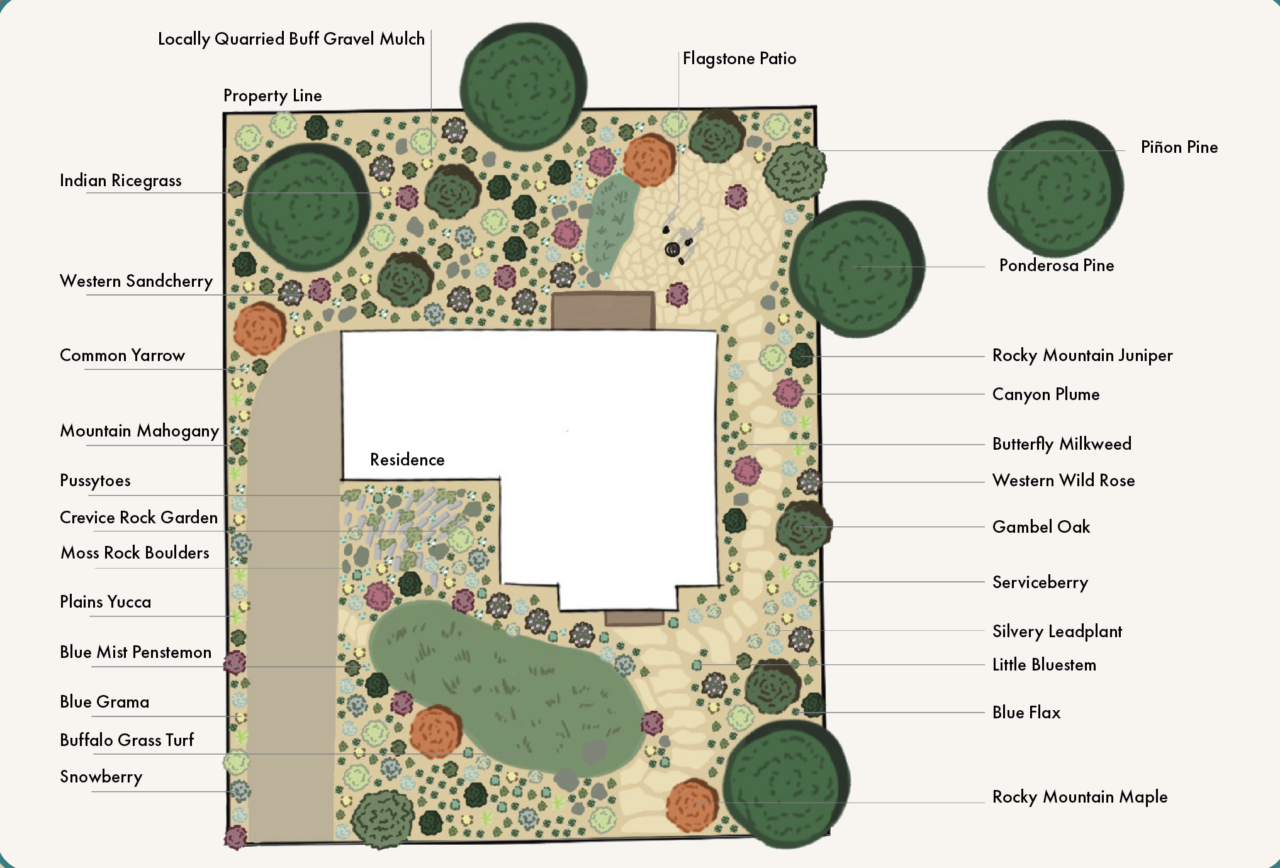
Blue Spruce Horticulture foothills landscape design. Drawn by Arden Cherry.
The foothills
Stuart Shoemaker thinks of the foothills as a “transitional zone” between our region’s grasslands and evergreen forests. Some areas around Bellvue and Masonville are densely forested and others have rocky hogbacks, so the landscape isn’t always consistent and can be difficult to plant in.
“If there is a lot of rock, just know that it’s going to be limiting in what you can plant and where,” says Shoemaker, owner of Blue Spruce Horticulture. “It’s harder to dig down deep, and if plants can’t get their roots deep into the soil, they’re not going to be as resilient.”
In more plantable areas, Shoemaker likes using some of the native trees, shrubs and perennials that grow in places like Lory State Park and Horsetooth Mountain Park, such as mountain mahogany. He also experiments with dwarf varieties, like the Blue Jazz piñon pine, which don’t take up as much space and are less of a fire risk than large evergreens.
“Wildfire risk is huge,” he says. “We’ve seen some fires in the plains, but the intensity that you see in the foothills, with these evergreen canopy forests, is quite a bit more significant.”
One thing you can do to mitigate that is install a firewise landscape. That means using little to no plant material within five to 10 feet of the house and minimal grasses and shrubs beyond that, Shoemaker says. Sedum, yucca and prairie cactus pose very little fire risk, whereas grasses are highly flammable.
Most native plants only need frequent deep watering in their first season, Shoemaker says, then you can taper off. He recommends a sprinkler hose attachment for most foothills landscapes since subsurface irrigation is difficult or impossible to install in rocky areas.
Then there’s the issue of deer. Unfortunately, there isn’t much you can do to stop them from eating your plants, Shoemaker says.
“The only way to keep deer out of your landscape is to have a large fence around your property,” he says. “Sometimes you’ll see lists of deer- and rabbit-resistant plants, but it just depends on how hungry the deer are. They’ll try anything once.”
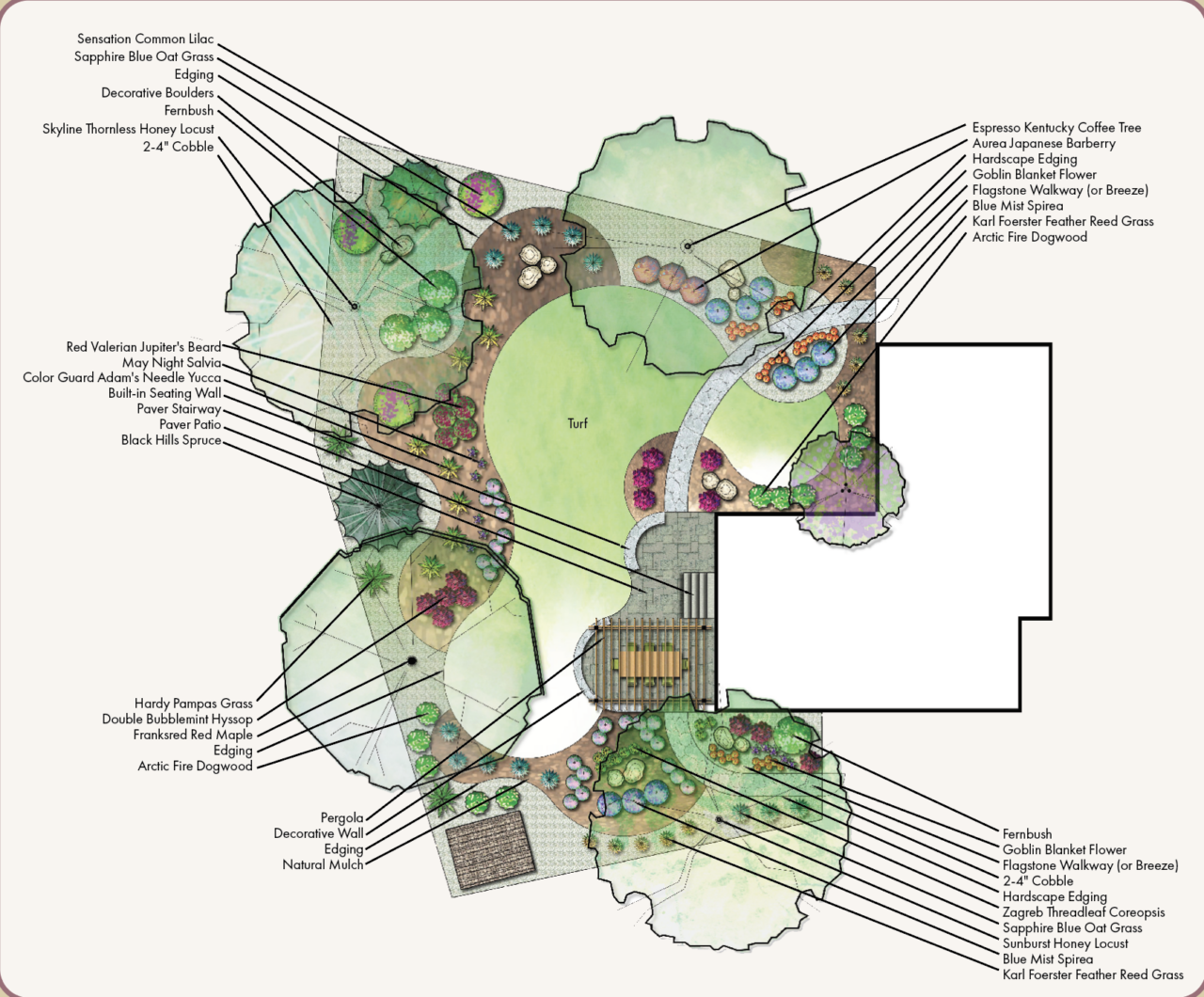
Detailed Landscape xeric backyard design. Drawn by E. Catt.
The suburbs
The suburban landscapes east of the foothills vary greatly depending on their maturity, says Clint Lucas, owner of Detailed Landscape. For example, plants that like the shade and wind protection of 100-year-old trees in Old Town Fort Collins might not survive in more exposed neighborhoods.
“We have to be very mindful of what will work and what won’t work in those unique microclimates,” he says.
Redbuds, hydrangeas and other shade-loving shrubs thrive in places with mature trees, whereas new neighborhoods require hardier shrubs, like spireas, euonymus and burning bush, he says. Exposed landscapes limit tree choices to those that can tolerate wind, like lindens.
Soil quality is another issue across the Front Range, as the heavy clay in the ground needs amending, Lucas says. That means mixing one third compost, peat moss or another humus-rich material into the backfill dirt at the time of planting, often with the addition of a root stimulator. In new construction areas, sometimes soil additives are also needed to re-enrich the land.
“It’s [soil amendment] combined with the proper plant placement,” Lucas says, “like being mindful of how a property is going to drain.”
Proper moisture levels can be achieved with smart irrigation, which is increasingly important as drought conditions continue, he says. More efficient sprinkler heads are available now, along with systems that incorporate moisture-sensing or cloud-based weather monitoring technology. Tuning up existing sprinkler systems and replacing turf with xeric plants can make a difference too.
In addition to soil quality and moisture (or lack thereof), privacy is a main concern in suburban landscapes, Lucas says. He thinks that’s because housing density has increased over the years, resulting in smaller yards that are closer together.
His solutions often involve structural privacy elements, like architectural steel panels and wood trellises for vining plants to climb on. He also likes layering tall evergreens, like columnar junipers, to create a natural wall.
“Those can be planted close to each other while still performing very well,” he says. “They create year-round screening for our clients.”
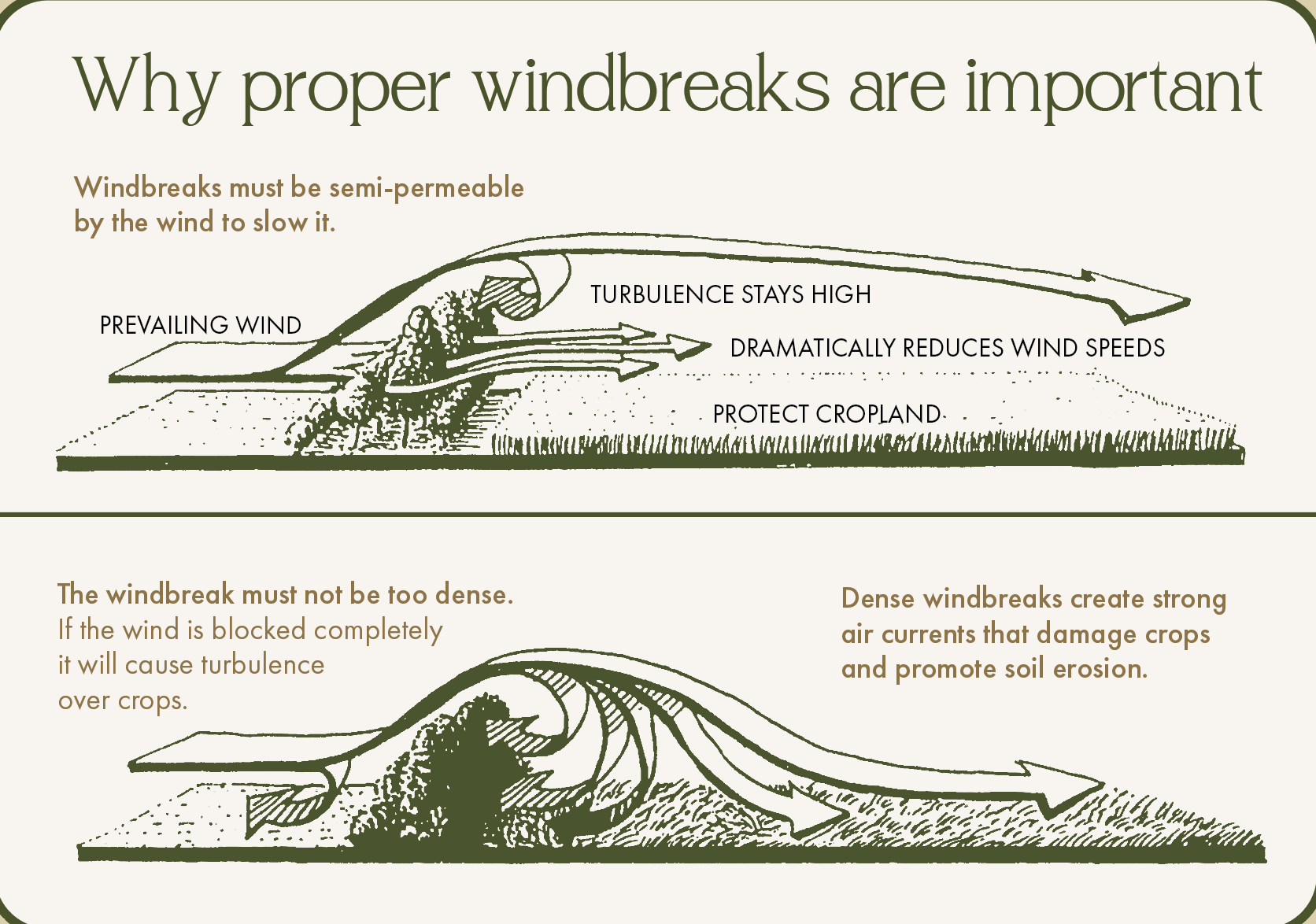
Illustration courtesy of the USDA National Agroforestry Center.
The plains
In areas that resemble the plains, such as parts of Greeley and the smaller towns around it, wind and erosion can make landscaping a challenge, says Zak George, owner of Zak George Landscaping. Both of those things limit the soil’s ability to retain moisture, which means many plants are off the table.
“People love showy plants in town, but you can’t have them out there,” he says. “If you’re in Ault, it’s probably a bigger palette because they’ve got more water, but if you’re talking about Pawnee (National Grassland), it’s going to be cottonwood, some evergreens, native elm species and some of the oaks that will withstand that wind.”
Wind dries out the landscape, which, on top of drought conditions, is hard on many plants. It’s hard on people too.
George says windbreaks can make those properties more tolerable if they are done right. Instead of planting rows of evergreen trees of the same height up against your house, he recommends placing them farther away and layering them from small to tall and then back down to small. He also suggests mixing in deciduous shrubs.
“A lot of people think, ‘I’ll just build a vertical wall,’ but it doesn’t work that way,” he says. “We don’t see how the wind moves around the plants.”
Screens, pergolas, parasoleil panels and other hardscaping materials can help slow the wind down while still letting light in, George says, especially on the east side of the home, where it’s naturally calmer. The goal isn’t to block out the wind completely.
“You ruin a landscape real fast when you build a fortress,” he says. “We typically use more of a softscape approach of trees, shrubs and screen panels to try to slow the wind down without making you feel like you live in a jail cell.”
Plants that can handle the wind might still suffer due to the erosion it causes in sandy climates, like near Pawnee National Grassland and east of Greeley, George says. Since the sand blowing around makes it harder for the soil to retain moisture, his solution is covering the ground with rock, pea gravel or a limited amount of sod. He recommends irrigation systems with low-angle nozzles to keep the landscape well-watered.
The best groundcover to use is native grass, George says, since the roots penetrate deeply into the ground and keep the water from running right through the sand.
“There’s moisture that hangs in the soil profile below grade, and it can use that because it doesn’t dry out,” he says. “The native seed stops the erosion, and it keeps the weeds down when it’s healthy.”