
Michael Simonov can ride 100 miles a week. But he needs an e-bike to do it.
“It allows me to get out and do a lot of exercise,” says Simonov, 73, of Fort Collins.
Everyone deserves a boost at 73. And for Simonov, that’s all an e-bike is: a boost for the tougher moments, such as biking against a stiff wind, or up Rist Canyon, or on the trails that wind around Lory State Park.
E-bikes, if you’re unfamiliar, provide a little juice to peddlers. Many, like Simonov, use it to go up hard hills but still prefer to pedal on their own most of the time.
Simonov discovered e-bikes five years ago, when he got his wife, Susan, one so she could keep up with him on their rides together. Then he discovered a hard truth: He had a tough time keeping up with her.
Now he cruises around daily on his e-bike, sometimes with Susan, who found a new joy in cycling because of that extra boost.
All charged up
Josh Kerson believed in the benefits of e-bikes way back in 1999, when he studied their design in college. He even built them by hand back in 2010. Now he owns a business, Precision E Bikes in Fort Collins, that services them, though he also sells a couple models, including one he designed himself.
More people seem to be catching on to e-bikes as a mode of transportation, Kerson says. A Harvard study found that e-bike sales rose from 250,000 to more than a million from 2018 to 2022.
“We’ve never seen such popularity in this industry,” he says. “It’s the best time for electric bikes right now.”
Kerson sells them to teenagers to ride to school, including college kids, but his most common customer is someone like Simonov, a retired person who wants to remain active.
“It’s an amazing life changer and an empowering tool for people who can resume their exercise years later,” he says.
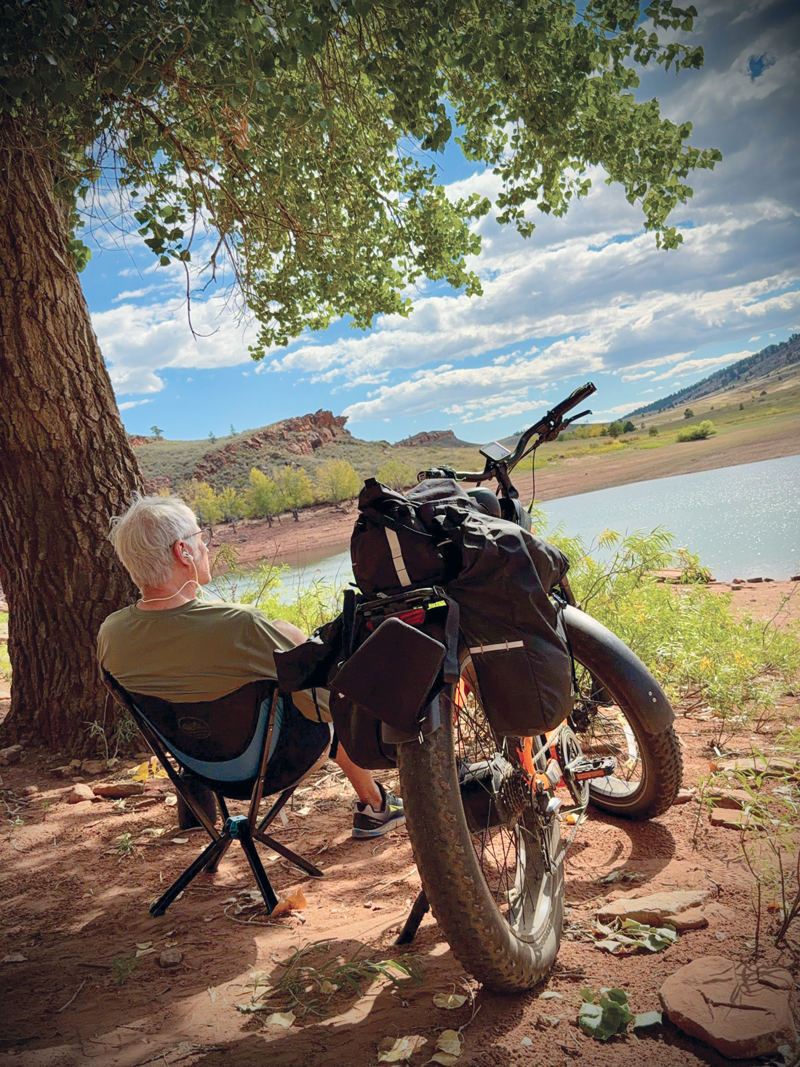
Michael Simonov at Horsetooth Reservoir.
Conflicts and injuries
When Dave Kemp gets asked about e-bikes and the problems they cause on the Poudre River Trail, he likes to refer people to an article on the People for Bikes website, a biking trade organization. It’s titled “The E-Bike Problem is an E-Moto Problem.”
E-motos are electric motorcycles and can go more than 30 mph. Many have a throttle. Those have caused issues with pedestrians, and they aren’t allowed on the Poudre River Trail. There are e-bikes that can switch between Class 1, 2 and 3, but those aren’t allowed on Fort Collins’ paved trails either.
Kemp, senior trails planner for the City of Fort Collins, says he hasn’t had issues with Class 1 or 2 e-bikes on the trails. Greeley hasn’t had issues either, according to a police spokesperson.
Kemp concedes that e-bikes can occasionally startle pedestrians when they fly by, but that’s also a problem with cyclists who don’t ride e-bikes. All cyclists are advised to keep their speed to 15 mph or under.
“We always stress slowing down around other trail users, particularly walkers,” Kemp says. “Announce yourself before passing.”
Most e-bike injuries, like broken bones and concussions, are inflicted on the users themselves. A study published in the JAMA Network Open journal found that there were about 235,500 ER trips for users of e-scooters and e-bikes from 2017-22. However, people riding conventional bikes and scooters ended up in the ER more than 10 times that amount. So, any claims that e-bikes are dangerous also apply to the bikes people have ridden for centuries.
A new way to get around
Transportation officials have yet to solve a problem when trying to get residents to leave their cars at home. They call it the “first and last mile.”
The City of Greeley found that most vehicle trips in the city were less than one mile when putting together a transportation master plan in 2023. Both Greeley and Fort Collins are now using electric bikes and scooters to provide more sustainable options for short trips that don’t require a car.
SPIN, a private company, provides a fleet of electronic bikes and scooters for people to rent across the country. Fort Collins began its partnership with SPIN in 2021, and ridership took off, says Rachel Ruhlen, transportation planner with the City of Fort Collins. Now SPIN serves a quarter-million trips in Fort Collins per year, and the city expects that number to go up, especially since they asked SPIN to double its fleet to 2,000.
Ruhlen says low-income residents and students use SPIN e-bikes and e-scooters regularly. Rates vary, but it generally costs $1 to unlock a vehicle and 40 cents per minute to ride it.
“You hear so many stories of people who rely on it,” Ruhlen says.
The City of Greeley partnered with SPIN in 2024 and now has 250 electric bikes and scooters downtown and around the University of Northern Colorado. It’s going well enough that the city hopes to expand them west to Aims Community College and areas like the Centerplace of Greeley shopping center. But the city needs to upgrade its infrastructure in the area before that happens—a project with estimated completion by 2029, says Hanna Feldmann, transportation planner with the City of Greeley.
The biggest complaint from residents about e-bike and e-scooter rentals is their location, as users sometimes leave them parked around the city—including sidewalks and front lawns—instead of on their docks. Complaints are usually addressed within 24 hours, and SPIN issues warnings to users who park them wherever they want.
“We’re trying to make a variety of transportation options easier,” Feldmann says. “This is a great way to do that.”