
At first, Kristen Johnson admits she was a little nervous to guide blind people on a cross-country skiing trip. She worried about saying the wrong thing, both at the dinner table and on the snow. She had a tendency, when giving directions, to mix up her lefts and rights. Then, on the third day, she realized something.
“You start to overthink everything,” she says, “until you understand that blind people are just like everyone else.”
Johnson, 55, of Fort Collins, is now one of Ski for Light’s veteran volunteers. The nonprofit teaches and guides visually impaired people at an annual week-long, cross-country ski camp. This year’s camp, at YMCA of the Rockies’ Snow Mountain Ranch in Granby, will be the organization’s 51st.

Johnson grew up in Minnesota and went cross-country skiing every year because so many others did it. She hated it, until one year she fell in love with it.
When she heard about Ski for Light, she was intrigued, but she didn’t want to spend close to $1,000 to volunteer for a week on her vacation time. Working for REI helped persuade her: The company offered to pay for employees to volunteer. In 2000, she decided to give it a try. She’s been back every year since, save for the year COVID-19 interrupted it.
The camp trains new volunteers in a two-day workshop before they start guiding. Part of the camp teaches guides how to direct visually impaired people of varying physical abilities, and another part allows them to hang around the skiers just to get to know them. By the end of those two days, Johnson already knew she would want to go back the next season. She looks forward to seeing some of the same skiers and guides every year as well as meeting new ones.
“I’ve made some really good friends,” she says. “You only have contact with them through Ski for Light, but when you come back, it feels like you were never apart.”
Breaking barriers
A group of Norwegian Americans founded Ski for Light in 1975 after being inspired by a similar program in Norway. They believed visually impaired people could learn how to cross-country ski, and they thought experienced skiers would enjoy sharing the sport. Johnson is proof of the second belief. As for the first, many visually impaired campgoers describe the freedom of skiing down a hill as life changing.
“Once you start flying, it’s exhilarating,” says Talia Woodard, 26, who lost most of her sight when she had surgery for a brain tumor at age 7 and attended the Ski for Light camp last year. “After my first day in the snow, I didn’t want to stop.”
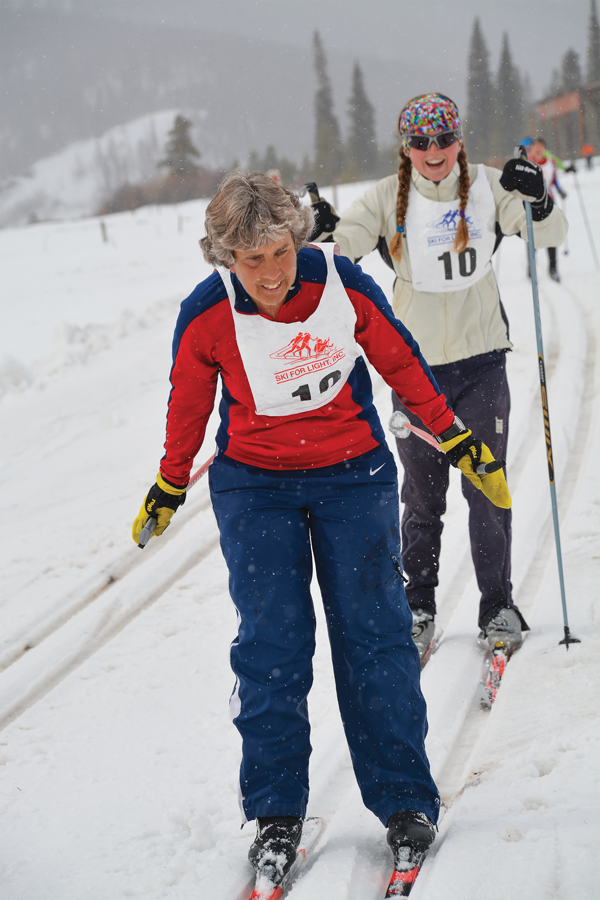
Bringing that freedom to the visually impaired, and a small group of folks with limited mobility as well, is why the organization exists, says Julie Coppens, president of the executive committee. Visually impaired people tend to become protective of their bodies and navigate the world as if it’s full of danger, she says, which can prevent them from going on adventures or even participating in any kind of physical activity. The organization helps them overcome those fears with groomed tracks that allow the skiers to feel where to go as well as reassurance that it’s OK to fail.
“We practice falling right away,” Coppens says. “It’s a soft landing because it’s on snow. You likely won’t hurt yourself.”
Part of the instruction, she says, is teaching visually impaired skiers to feel the outdoors—like how Yoda taught Luke Skywalker how to feel the Force, the life magic that emanates from the world. They will even blindfold skiers with limited sight so they aren’t trying to see. The skiers don’t emerge as Jedi Knights, but they learn how to be less afraid of their environment.
“We show them that they can do absolutely anything,” Coppens says. “That is a lesson we all take away from Ski for Light, whatever your ability.”
The organization is made up of volunteers, and Coppens started as a guide, like other members of the committee. Guides are tougher to recruit than willing skiers (they still have to pay for the trip), but Coppens can’t think of anywhere she would rather be.
“It’s a week skiing with dozens of other people who become your friends,” she says. “Where else can you have that experience?”
Testing their skills
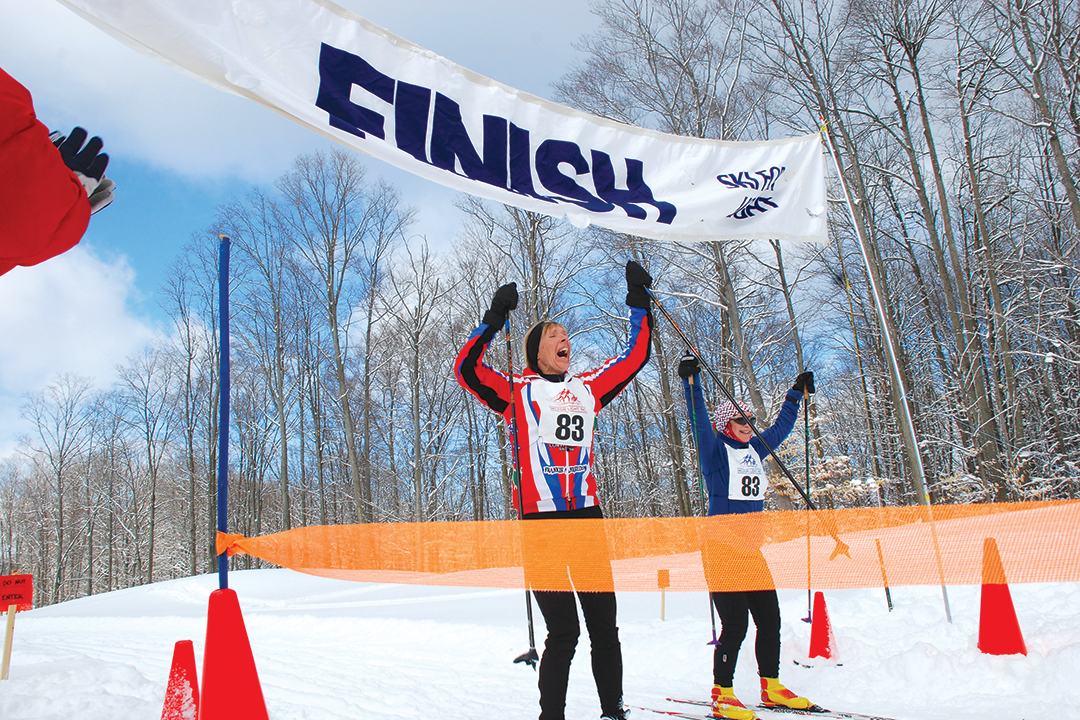
The week ends with races that reflect varying degrees of skill. Some skiers do a 10K and not only want to win but are capable of it, while others join a 5K and try to predict their time. The final group tries to complete a kilometer. There are people of all body types, Coppens says, and some of the beginners have never even walked on snow.
Woodard had some experience with sports before she attended the camp. She’d done horseback riding, cheerleading, swimming and track and field, all at a school for the blind in Texas. But skiing was new to her.
“Downhill was scary,” she says. “It took me a while to get comfortable.”
The camp inspired her to continue to work on her fitness. She recently moved to Summit County and works at the Keystone Lodge & Spa. The resort offers free ski lessons for employees.
“I’m looking forward to that,” she says.