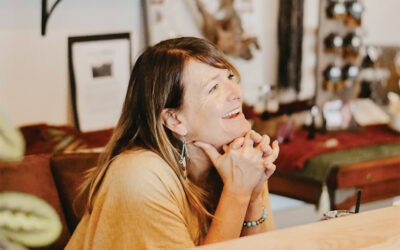

Aubrie Hendryx was born with pectus excavatum, a condition where the sternum grows inward, compressing the heart. She finally decided, at age 36, to have titanium bars inserted through her ribcage to hold everything in place. As she recovered at the end of last year, one thought kept popping into her mind: “I’m so grateful for Jazzercise.”
A friend brought Hendryx to her first Jazzercise class 10 years ago, knowing how much she would love it as a lifelong dancer. After her surgery, she was able to get in and out of bed without using her arms, and she could pick things up off the floor without bending her waist. All those years in class gave her autonomy through the excruciating and limiting recovery.
“Jazzercise is specifically formatted to make sure we have the muscles to be able to do those things,” she says. “I want to write a love letter to Jazzercise because it’s why I’ve been able to recover really well.”
Now Hendryx is not only an instructor at Jazzercise Greeley; she is a living endorsement of the benefits. She’s trying to dispel the myth that Jazzercise is just a bunch of middle-aged ladies in leotards sweating to the oldies. It’s one of many dance fitness methods, like Zumba and hip-hop, that have evolved with the times.
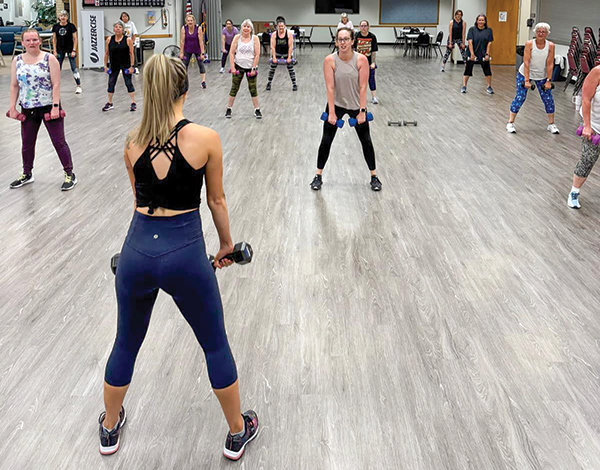
Aubrie Hendryx, instructor at Jazzercise Greeley, teaching a class.
A classic method reinvented
Founded in 1969 by Judi Sheppard Missett, Jazzercise became the first widely recognized form of dance as a way to work out. Classes sprung up across the country in the late ’70s and ’80s. Yes, there were leotards, sweat bands and plenty of songs by Madonna and Olivia Newton-John. That’s what was cool at the time, Hendryx says, but it’s not like that anymore.
Today’s classes blend dance with elements of cardio and strength training for a more well-rounded workout. Instructors choreograph their classes using mostly songs that have been released in the last year, so you might find yourself dancing to Lady Gaga or Bad Bunny.
Jazzercise classes come in different formats, and weights are a part of every one. Some classes include planks, lunges and burpees, while others feature more hip-hop moves or resemble a ballet barre workout.
“I feel like I get a great workout every time,” Hendryx says.
She believes anyone can do Jazzercise, regardless of whether they have a dance background. Her classes have people of all ages, including 70-year-olds who have been doing it for decades. The instructors give cues to keep everyone on track, which is especially helpful for people who aren’t familiar with terms like relevé, chassé or grapevine.
“It’s very beginner friendly, and it’s always different,” Hendryx says. “You may find that you really like one instructor’s style, or you might like to mix it up. The best workout is the one you’re going to do, whatever that is.”

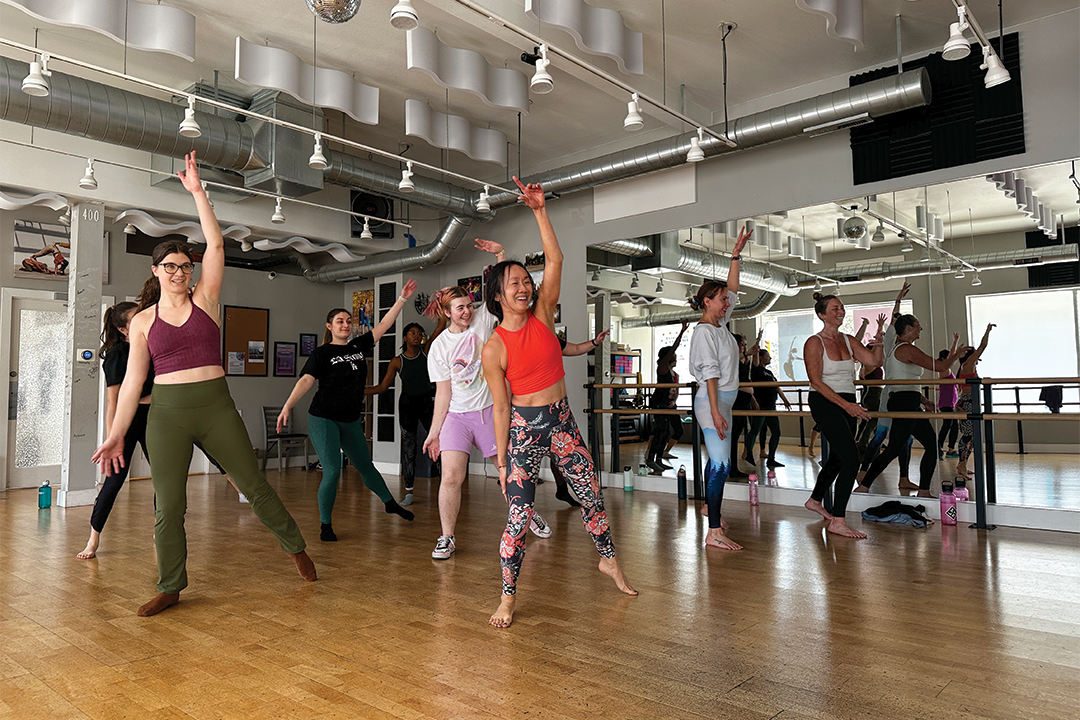
Cecilia Parent (second from right), Zumba instructor at Genesis Health Clubs.
Latin dance with a twist
You’d be hard pressed to find a 61-year-old in better shape than Cecilia Parent, a personal trainer and Zumba instructor at Genesis Health Clubs in Fort Collins. The Ecuadorian dancer fell in love with Zumba 18 years ago.
“It was so neat to find something where you’re moving your hips, your ribs and just different body parts,” she says. “It looks cool. It feels cool.”
Zumba was accidentally created in the ’80s when aerobics instructor Alberto Perez forgot to bring his music to a class. He had a mixtape of Latin songs in his car, so he showed the class how to dance to them. So many people loved the class that it evolved into a fitness method that is still popular today.
Parent attributes Zumba’s popularity to the fact that dance in general has gotten bigger in American culture. People also love it because it’s a visual, intuitive experience, she says.
“[Perez] wanted you to appreciate the rhythms and feel the music,” Parent says. “It doesn’t have to be exact. As long as you’re going in the same direction, you’re good.”
Parent’s one-hour classes are made up of about 18 songs, ranging from heavier reggaeton beats with slower, deeper moves to quicker salsa and mambo rhythms and Afrobeats. She likes the cultural aspect of Zumba because it incorporates dance moves with different origins.
“You get all that variety in one class,” she says. “I never want people to get bored.”
Zumba has become a little more technical in recent years, Parent says, though she hopes that doesn’t scare away beginners. Over time, people get more familiar with the movements and patterns.
“They come out of [the class], and even if they didn’t get all the moves, it doesn’t matter,” she says. “They’re like, ‘Oh my God, that was fun.’”
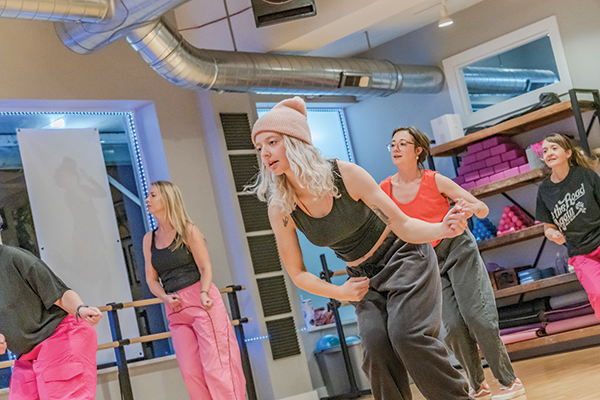
Hip-hop dance fitness class at Impulse Dance and Fitness.
Photo by Andrew Sutcliffe.
Connection over competition
Nadia Duncan grew up dancing competitively and realized, as an adult, that there weren’t many places to dance for fun in Fort Collins. She wanted to create a community where people like her could feel safe and supported and find joy in dancing without the pressure to perform.
“I look at it as social connection,” she says. “That’s what brings me joy: the communication that happens with dance. Now more than ever, we need those positive social interactions with real people.”
In 2018, Duncan opened Impulse Dance and Fitness, a space for adults of all ages, backgrounds and abilities to learn ballet, hip-hop, modern, jazz, contemporary and tap as well as several types of dance fitness. Her goal is to remove the fear of judgment or embarrassment adults often feel when trying something new or doing something that feels vulnerable.
“The window on our building has the mantras our instructors say, like ‘Don’t take yourself too seriously,’ and ‘Dance is play,’” Duncan says. “We’re basically having a play date when we’re dancing together.”
Duncan teaches a variety of hip-hop dance fitness classes, including MixxedFit, which blends simple hip-hop dance moves with bodyweight toning exercises.
“It’s kind of clubby,” she says. “It’s a cardio focus while working on your endurance, agility, coordination and memorization. The whole point is to get your heart rate up and have fun with it.”
Members can also take barre and contemporary dance fitness classes at Impulse. Taught by Kristina Wood, a dance fitness instructor of 20 years, those classes offer their own spin on ballet and contemporary dance.
Barre was created in the late 1950s by Lotte Berk, a European ballerina who used rehabilitative exercises with elements of ballet, Pilates and yoga to help heal a back injury. Today, the workout incorporates strength-based balletic movements performed at the barre. Weights are also used to the beat of pop, dance and electronic music.
“In barre, we like music that’s a little more upbeat because we’re working pretty hard,” Wood says. “It’s nice to have that musical support behind you to feel like, ‘I’ll keep going because the music is pushing me to go.’”
Contemporary dance fitness focuses on cardio more than strength training, but the movements are more flowy, with bigger extensions and longer reaches, Wood says. She sprinkles in songs that are emotive or even angsty, giving dancers a cathartic outlet.
“If you’re really mad, that can come out, or if you’re heartbroken, that can come out in your movement too,” Wood says. “It’s tapping into something deeper inside that opens and releases as you’re moving.”
__________________________________________________
BEATSPACE Fitness
Bounce to the Beat
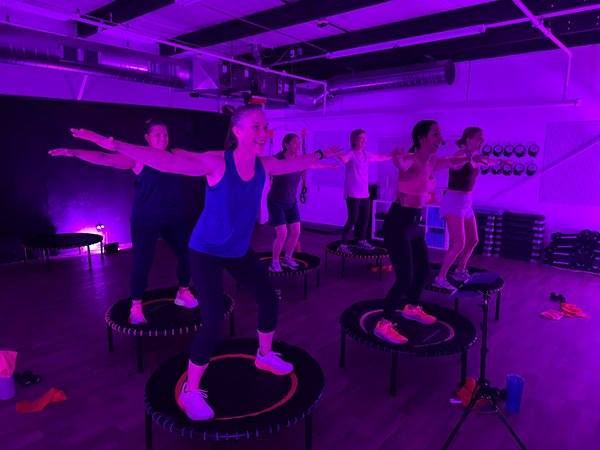
Maybe you’ve seen the viral videos of people bouncing on miniature trampolines, called “rebounders,” to club music. Now you can try it in Fort Collins.
At BEATSPACE Fitness, instructors teach choreographed routines on rebounders using moves such as “skiers” and “twists.” Their PowerBOUNCE class includes intermittent strength training, such as planks and free weight exercises, performed on solid ground.
“When people are focusing on the rhythm and music, it makes them forget how hard they’re working because it’s just really fun,” says founder and co-owner Jessica O’Keefe.
BEATSPACE also offers a Bounce 30 class with progressive choreography. By the end of the class, you’ll perform a 64-count dance combo on the rebounder. Benefits include a stronger brain-body connection and increased bone density, lymphatic flow and immune system function, according to co-owners Michelle Quinn and Hannah Crenwelge. It’s low impact, so it’s easy on the joints.
“My mom is 66 and hasn’t worked out in decades, and she’s been doing it and thinks it’s the coolest thing ever,” Crenwelge says. “It’s very accessible for everybody.”