

Landon Schmidt
Firefighter, Poudre Fire Authority
Landon Schmidt became a firefighter in 2022, shortly after graduating from Colorado State University. A former football player, Schmidt says that firefighting and college athletics had so much in common that he felt at home almost immediately in his new career.
“That athlete mindset—teamwork, trying to accomplish something together—I love that aspect,” he says. “It’s something new every day.”
Like athletes, firefighters also work out a lot. Schmidt’s shifts include four-hour blocks set aside to train, either in the gym or in equipment drills to practice emergency situations such as a car crash or rope rescue.
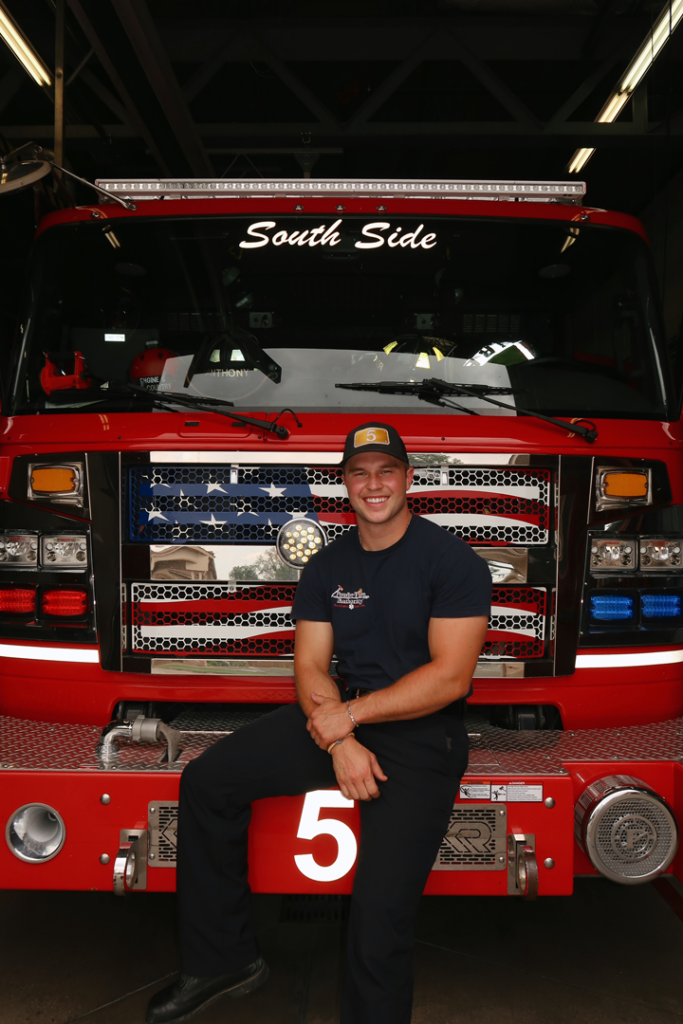
Landon Schmidt
About 80 percent of the emergency situations Schmidt responds to are medical calls that his team attends alongside UCHealth paramedics. The sheer number of them can make the job redundant, he says, but those situations have also given him a new way to look at the Fort Collins community. Medical calls focus his attention on people battling health problems, drug addiction or domestic disturbances, among other issues.
“Part of me feels like maybe I was sheltered a little bit,” he says. “I didn’t know a lot of this stuff existed or that these people struggled.”
Schmidt appreciates the medical calls because they require him to stay versed in a variety of skills outside of responding to structure fires. But it’s the other 20 percent of emergency calls that he and his team spend most of their time preparing for at the station.
“When that one call comes that you haven’t run in three years, five years or maybe it’s the first time in your career, you’ve got to be ready for it at all times,” he says.
Such a moment came for Schmidt when his team responded to a climbing accident in the Poudre Canyon. A climber was stuck at a high elevation, and they spent about six hours getting the person back to safety.
“I was so thankful the crew I was with was very dialed in,” he says. “They were ready for that type of call.”
For Schmidt, the hardest part of firefighting is balancing the adrenaline-pumping scenarios like that rescue with the repetition of medical calls. When he feels discouraged, he focuses on compassion.
“I understand that when someone calls 911, it’s a bad day for them,” he says.
When the day is over, Schmidt hopes to leave the impression that Poudre Fire was a major support to anyone and everyone who called.
“That’s what keeps me going,” he says.
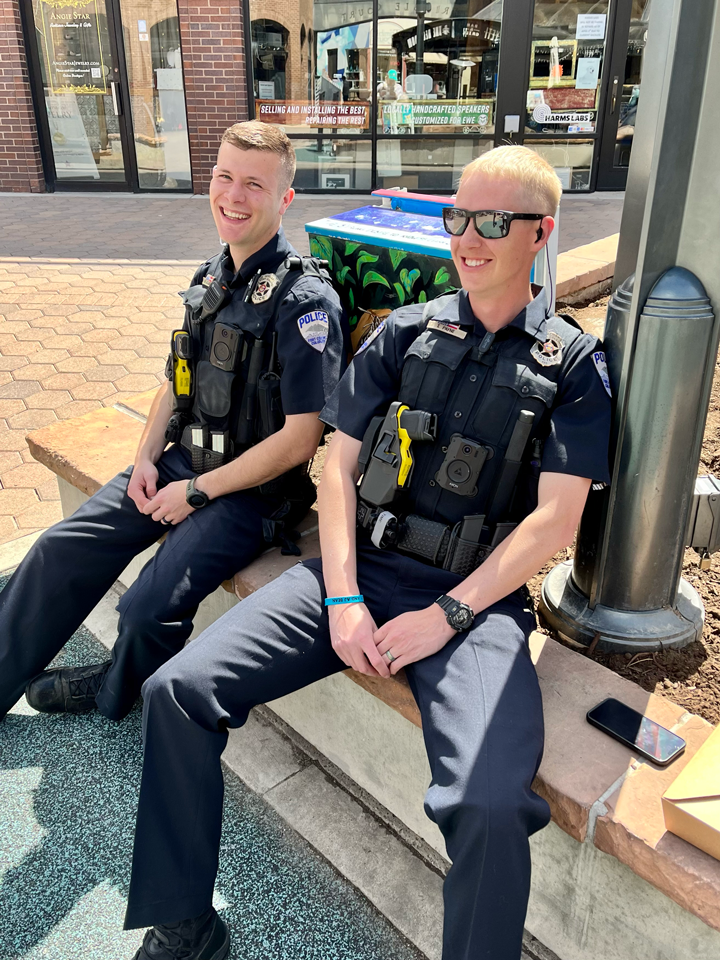
Tyler Payne (right)
Tyler Payne
Patrol officer, Fort Collins Police Services
Tyler Payne decided he wanted to be a police officer during a difficult time for law enforcement. It was 2020, and Americans were expressing their distrust of police in protests across the nation that sometimes turned violent.
Payne, whose brother was also a police officer, had been leaning toward the decision for some time. He wanted to get out from behind a desk and help people in a more direct way. The protests were all the more reason to get involved, he says.
“I want to change the outlook on police and make as many changes, or make the biggest difference, I can by helping others,” he says.
Today Payne, 36, primarily works as a patrol officer responding to between eight and 12 emergency calls per day. One of his top goals is to create a sense of mutual respect with those he interacts with—including people who he must arrest and bring to jail. Many times, he ends up shaking the hand of the person he brought in once they are discharged.
“As long as you’re respectful, most people will work with you,” he says.
Still, Payne says he has been on the receiving end of plenty of name-calling and threats. More often than not, he feels supported by the public. But those other moments can be frustrating and challenging.
“You definitely have those people…they’re yelling and screaming at you in the back of your car, banging their head, whatever it may be,” he says. “You’re like, ‘Why am I doing this to myself?’…. I’m not just a cop; I’m a person too, and I have my opinions and my thoughts on things. They might be the same as yours.”
Those challenges are balanced by moments when Payne feels like he makes a positive contribution to his community. He says helping people who are addicted to opioids is particularly meaningful to him after working for 10 years in public health.
“Sometimes it is necessary to arrest,” he says. “It gets them into the court system where they can have drug treatment help them based on court order.”
Payne is also on call for crime scene investigation and crisis negotiation, though both of those gigs are relatively rare. Between the two, he estimates being called to a scene fewer than 10 times since he assumed the role after graduating from the police academy in 2022.
When Payne does respond to crime scenes, he says it’s a far cry from what a viewer might see on TV. Fort Collins has very few homicides, so more often than not, he’s investigating a burglary or something like a natural death with one strange component.
His role has also meant missing out on some family moments with his wife and three kids, who range from 9 months to 8 years old, because sometimes he patrols on holidays. He’s expected to be on call at times, which could mean that he returns home or leaves for work when his family is asleep.
But those are parts of the job Payne is willing to accept.
“I wouldn’t change it at this point,” he says. “I like what I’m doing.”
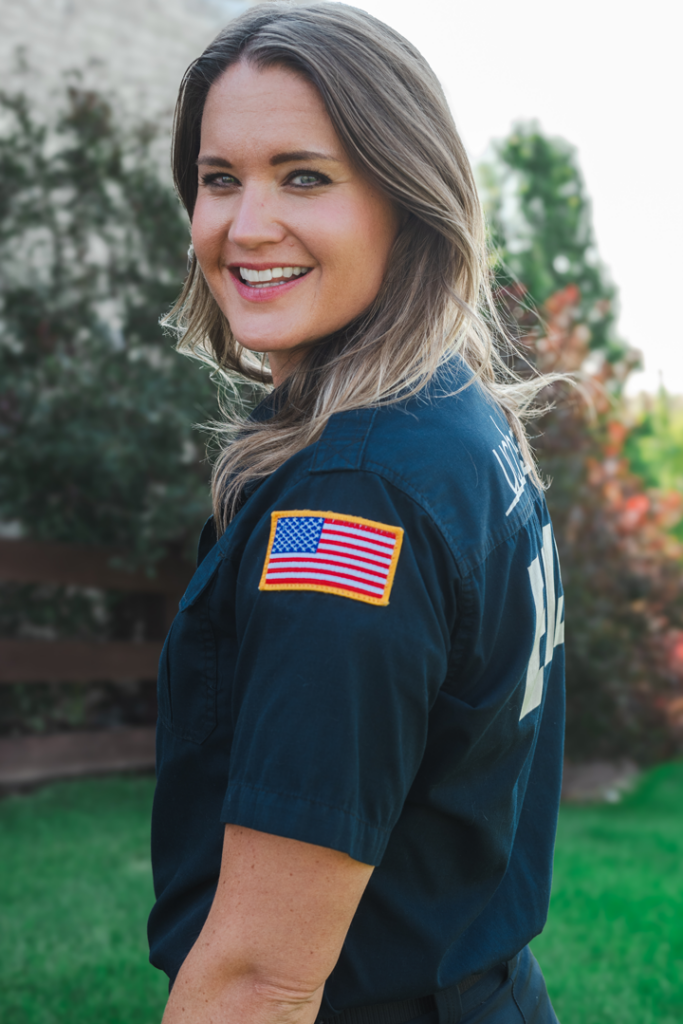
Katie Siman. Photo by Jordan Secher.
Katie Siman
Paramedic and physician assistant, UCHealth
For Katie Siman, each day brings a certain degree of excitement and mystery. A day in her life as a paramedic can go from relatively slow to adrenaline pumping in an instant.
“It’s really fun to run calls and be out in the community and never quite know what your day is going to look like,” she says.
When Siman responds to a medical scene, she must quickly piece together what happened to the patient so that she can present a clear picture of their situation to emergency department physicians. The communities she serves depends on what part of the district she is assigned to: UCHealth’s emergency services stretch from Fort Collins and Wellington east to Greeley, Windsor and Kersey.
Sometimes Siman helps transport patients from one hospital to another. Other times, she’s checking the vital signs of firefighters working a structure fire, helping someone having a seizure or heart attack or delivering a baby whose mom didn’t have enough time to get to the hospital.
Over the course of her 20-year career as an emergency medical responder, Siman says she has tended to the community in traumatic moments, such as the devastating floods that struck Northern Colorado in 2013. In 2018, she was part of the emergency team that responded to the Windsor Harvest Festival parade, where an 8-year-old boy died following injuries he sustained from one of the parade floats.
“That one deeply affected me for years and really tested my ability to deal with those types of traumatic situations in a healthy way,” she says, noting that many emergency medical professionals have similar experiences. “I’ve had colleagues who have said there were particular calls that were the reason they left. They’re not super frequent, but when they happen, they’re terrible.”
Siman recalls how emergency responders were treated after the Windsor Harvest Festival. Her family was called to the station, and she and her coworkers were encouraged to talk with each other and take off a few shifts. Counselors and other resources were made available to her team as well.
There were times before that when she didn’t think she had the emotional space to process tough calls and had to keep going. The response she got after the parade showed her that others recognize how hard her job can be.
“It was like, ‘We need to take care of you so that you can help take care of other people,’” she says.
Siman’s job has widened her perspective on her community in ways that are both flattering and, at times, a bit sobering.
“I think it’s given me a very real look at people,” she says. “Just understanding we all have our moments of weakness, and we all have our moments of bad choices, and not to judge anybody in their darkest moments.”