
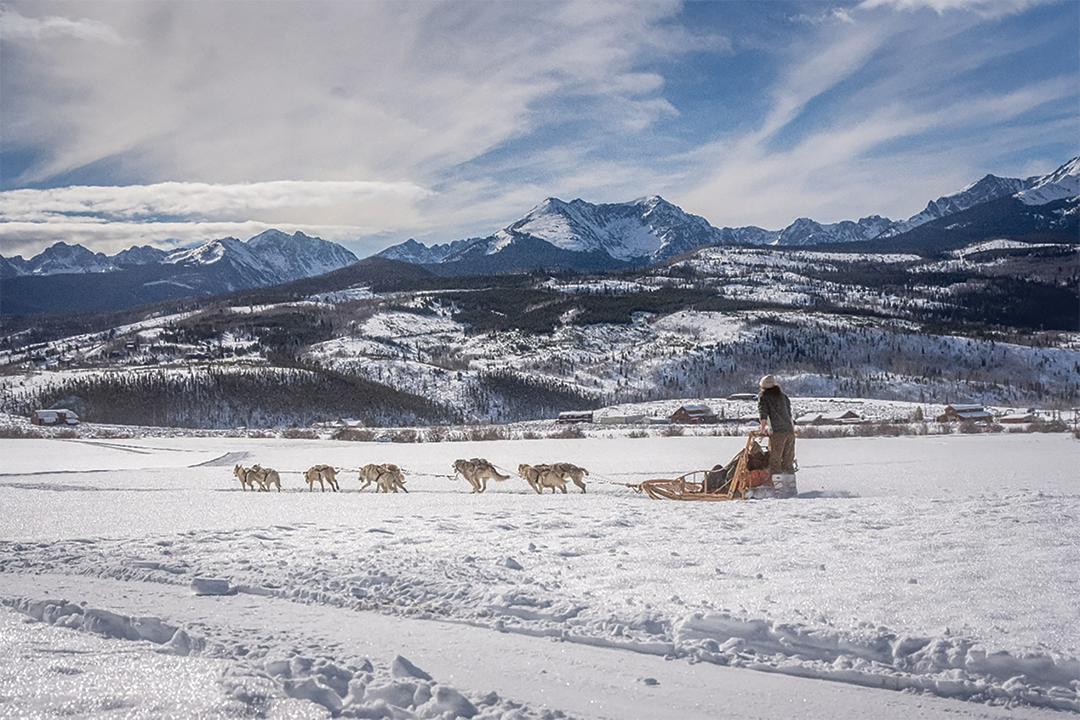
Dog sledding companies in Colorado may have different objectives, but they all agree on one thing: Yes, you can pet that dog.
“We want all the guests to give them love and hugs,” says Sara Hoffman, who owns Grizzle-T Dog & Sled Works in Steamboat with her husband, Kris. “Many times they will ask for it. They’re saying, ‘I just took you for a ride, now pet me.’”
Grizzle-T is one of many dog sledding businesses in the state that offers rides powered by husky paws. Those huskies are dogs, first and foremost, even though they’re used to working.
“People are blown away by that,” says Ben Vaughan, who manages Colorado Dog Sledding in Summit County, about 10 miles north of Silverthorne. “From the moment they’re born, they’re socialized with guests. The Alaskan husky loves human affection as much as it loves to eat and run.”
Petting the pups, of course, is only part of the fun. Both companies offer tours that generally last half a day on a trail. Grizzle-T teaches guests how to “mush,” or drive the dogs, while Colorado Dog Sledding does the mushing for you. Both give you the chance to feel as if you’re competing in the Iditarod, the world’s most prestigious sled dog race in Alaska that spans more than 1,000 miles. In fact, one company is owned by perhaps the best musher of all time.
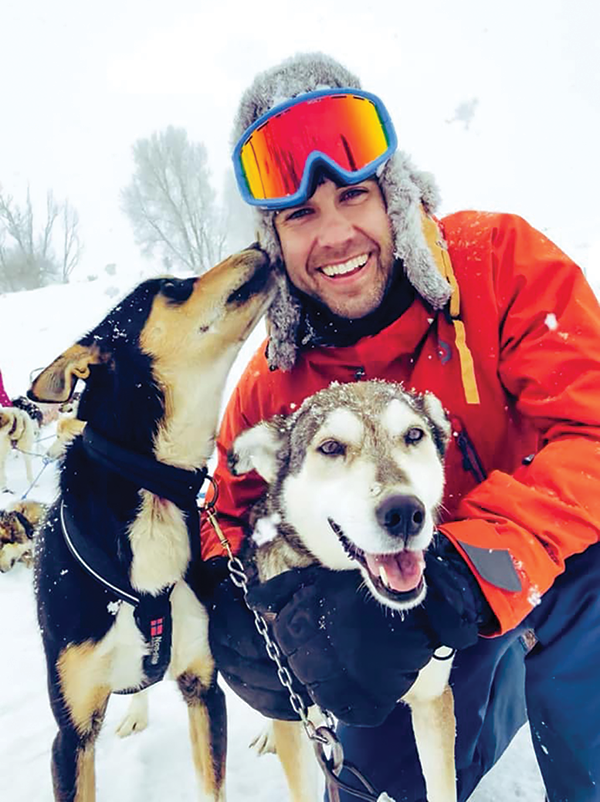
Grizzle-T Dog & Sled Works.
A chance to mush
Grizzle-T operates on a private, 12-acre ranch, which practically vaporizes your chances of crashing into someone else or flying off a cliff. They groom the trail on the property with a Snowcat, so it’s not too rough. That not only eliminates any major problems, but it also eliminates excuses when taking the reins yourself. But don’t worry: They cover the basics of mushing in a 15-minute lesson before you head out.
“Ninety-nine percent of what we do is teaching our guests how to mush,” Hoffman says. “We find that’s the fun part, and that’s what people really enjoy doing.”
The couple trails along in case there’s an emergency, but the dogs have traveled the route so often that it’s like a walk to the mailbox for them.
“You’re kinda just holding on for the ride,” Hoffman says. “They know the trail like the back of their paw. Some people prefer us to follow closer, but we try to be hands-off since it’s such a peaceful experience.”
Her husband bought the dog-sledding business in the early 2000s after working as a musher for five years. He competed in the Iditarod, though he doesn’t any longer because it’s expensive, dangerous and takes a good chunk away from their season, which lasts as long as they have snow, generally from December to April.
Hoffman “got suckered” into it, she says, when she began dating him a year after he bought the business. But she knew what she was getting into from the moment she met him.
“The dog sled was our second date,” she says. “I drove it the whole way.”
Their daughter, Hadley, 11, and son, Hunter, 9, learned how to mush at age 2, which is why Hoffman believes nearly anyone can learn how to do it. The real job of any amateur musher is to ensure the dogs don’t go crazy, she says, because they love it almost too much.
“When we are gearing up for a ride, the dogs are swarming around, saying ‘Pick me, pick me,’” she says. “The ones left behind give this sad, mournful Husky howl.”
An ideal pace reaches a top speed of 15 mph.
“If they have their way, they will go full throttle the whole way,” Hoffman says. “But this is a marathon, not a sprint.”
Verbal commands aren’t necessary or ideal, she says, as the dogs prefer to enjoy the run. The musher applies their body weight to one of the two braking devices to slow the dogs.
“Giving verbal commands to them would be like you having a different boss every day,” Hoffman says. “You wouldn’t respond to that well either.”
Grizzle-T rarely cancels because of the weather, though they won’t go out in blizzards or extremely cold temperatures.
“The dogs actually like typical winter weather,” Hoffman says. “They’ll be like,
‘What do you mean it’s snowing? I don’t care.’”
They also leave plenty of time to hang out with the dogs once the ride is over.
“My kids are in the kennels when the babies are born,” Hoffman says. “They are born, bred and live out here until they meet Father Time.”
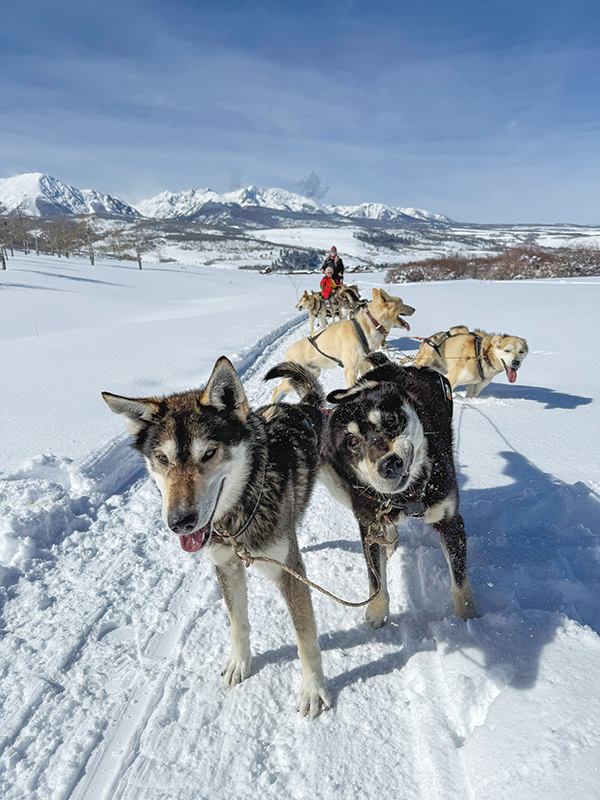
Colorado Dog Sledding.
Riding with champions
Guests who ride with Colorado Dog Sledding might feel as if they’ve traveled back in time as they gear up for a morning or afternoon trip, Vaughan says. It makes sense: Dog sledding has a history of more than 10,000 years, when the Inuit used dogs for transportation and hunting. The first formal race occurred in the mid-1850s, and many trappers used sleds to get around. The activity mostly remains popular in Alaska.
“We want our guests to feel as if they’re in Alaska in the early 1900s,” Vaughan says. “Our boots are made from moose hide. It’s not touristy looking. It’s very authentic.”
The owner, Dallas Seavey, would know, given that he’s a six-time champion of the Iditarod and has the most victories of anyone. His last win was in 2024, and his first was in 2012. His father, Mitch, won it three times, the last in 2017.
The dogs have their own accomplishments as well, Vaughan says.
“Some have run it four times with two wins,” he says. “These aren’t tour dogs. They are champion race dogs. That sets us apart. People like to be around greatness.”
Colorado Dog Sledding operates on Acorn Creek Ranch in Silverthorne, a homestead more than 140 years old, through a contract that allows them to run all winter. It’s a beautiful area, Vaughan says.
“The Gore mountain range is right there,” he says.
The five-mile tour takes nearly an hour and a half, including 45 minutes on a sled and 15 minutes with the dogs. There’s also a short talk about the history of the race, Seavey’s accomplishments and the achievements of the dogs on the ride as well as others on the property.
“There are 47 dogs and 47 personalities,” Vaughan says. “Many times the dog you see will pick you. Some are like, ‘You’re my guy. You’re my girl.’ You came for a ride, but you will leave talking about how awesome the dogs are.”
____________________________________________________________________________________________________________
Book a Trip
The dog sledding season generally runs from December to April, or until the snow melts. Trips can run from $175-500 or more, depending on the day. The median rate is about $300. Reservations are usually required, and some places will put your name on a list and call if another party cancels. Here are some places you can book a dog sledding adventure with this winter.
Colorado Dog Sledding
Summit County
970.610.6880
Grizzle-T Dog & Sled Works
Steamboat
970.870.1782
Good Times Adventures Breckenridge
970.453.7604
goodtimesadventures.com/dogsledding.html
Alpine Adventures Dogsledding
Leadville
Call 719.486.9899
alpineadventuresdogsledding.com
Mountain Musher
Wolcott (10 miles west of
Beaver Creek)
970.291-5154
YMCA of the Rockies/Snow Mountain Ranch
Granby
970.586.3341