
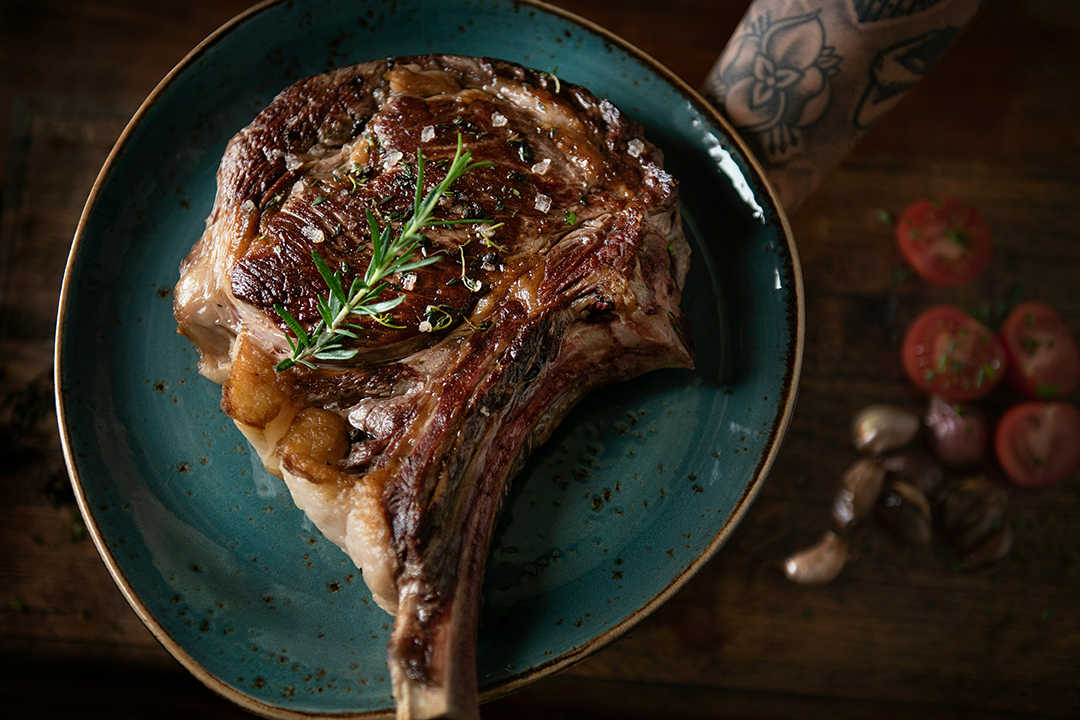
For many, cooking a prime rib on Christmas is like roasting a turkey on Thanksgiving. It’s another tradition that combines comfort food and celebration, but instead of white meat slathered in gravy, it centers on what is widely considered the best cut of steak.
“This is the dessert of meats,” says Cecil Velazquez, co-owner of Pinocchios Prime, a prime rib house in downtown Greeley that serves the dish every day of the week. “It’s a treat because of its quality and tenderness.”
Known for its flavorful fat, or “marbling,” prime rib comes from the same part of the cow as a ribeye steak. The main difference is that it’s cooked as a whole roast rather than sliced and grilled. The process takes about four hours, which is another reason it’s often saved for special occasions.
“We cook it on high for a short period of time to caramelize it, then we turn it way down and cook it for a long time at a low temperature,” says Annie Velazquez, who owns Pinocchios Prime with Cecil. “When it’s cooked like that, it becomes almost like butter. It takes time and effort, but it’s worth it.”
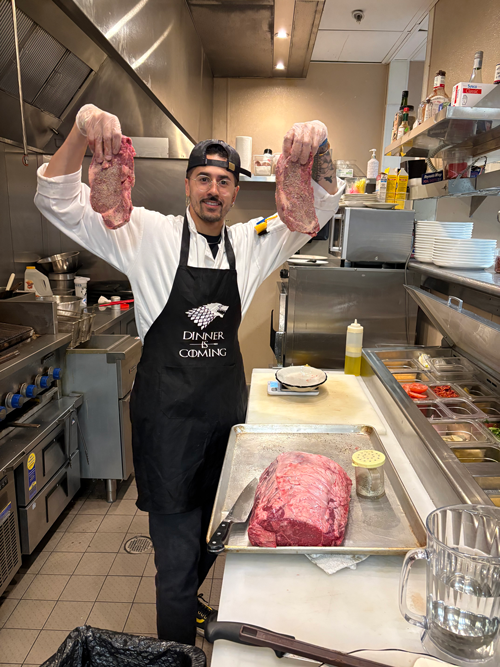
Forrest Lee, Annie Velazquez’s son and chef at Pinocchios Prime.
Temper, cook, rest
Before cooking any cut of meat, it’s important to let it “temper,” or come to room temperature, says Jason Shaeffer, owner of Chimney Park in Windsor, which is set to reopen this month and will serve prime rib for the holidays. Allowing a raw prime rib to temper for about an hour will help it cook more evenly, he says, though the exact time depends on how thick the meat is.
Shaeffer prepares his prime rib by slicing off the spinalis—known as the “cap” on top of the central eye of the meat—and setting it aside to cook separately. As a result, his prime rib and ribeye steaks are center cut, which makes them thicker and evenly cooked to medium rare.
“The spinalis on the ribeye of the cow is well marbled, so if you were to roast it, it would be overcooked,” Shaeffer says. “We offer [the spinalis] at a different time, and it’s amazing. I think it’s the best cut from the animal.”
Once the meat is tempered, the seasoning adheres to it better, Cecil says. He uses a special, house-made seasoning that only he has the recipe for. He even makes it at night so that no one can see how he does it.
“It’s got just the right flavor when it caramelizes,” he says. “People say, ‘There’s something different about this, but I can’t tell what it is. It’s not just salt and pepper.’”
Shaeffer keeps it simple, using only coarse kosher salt and fresh cracked black pepper. At home, he cooks a half prime rib in his Kamado grill by searing it for no more than 10 minutes at 500 degrees on the bottom rack. He removes the roast while the grill cools to 300 degrees, then he inserts an indirect heat stone and puts the roast on the top rack to cook for an hour-and-a-half, or until it reaches 131 degrees. Then he removes it from the grill, wraps it in a cloth and lets it rest for a minimum of a half-hour to finish cooking.
“The larger the piece of meat, the more time you need to let it rest,” he says. “You don’t want to let it get cold, but the more you let it rest, the more evenly it’ll finish cooking and keep the juices locked inside.”
You can also cook prime rib on a sheet pan with a lip in the oven, Annie says. She recommends heating it to 450 degrees and cooking the meat for 10 to 20 minutes, or once the fat on the top begins to darken and sizzle. Then she removes the meat and turns the heat down to between 175 and 200 degrees, depending on the size of the roast, and cooks it for a couple of hours, or until a meat thermometer reads about 120 degrees. Then she lets it rest.
“The key is using a thermometer and keeping your eye on it so that it doesn’t overcook,” she says. “You can always cook something more, but you can’t uncook it.”
If one of your holiday guests prefers their prime rib more well done, Annie suggests dipping their slice in hot au jus to bring it up in temperature. That way, you don’t have to cook the entire roast to a temperature that no one else wants.
Accoutrements
Prime rib is traditionally served with au jus and horseradish. Rather than serving the au jus on the side, Cecil and Annie pour it on the plate and serve their prime rib on top of it.
“We found that the meat just tastes better with the au jus,” Annie says. “People don’t realize how much that adds to the flavor and tenderness of the meat.”
The couple makes their au jus from a beef base, using a paste instead of a liquid or powder because the flavor is easier to control, Annie says. She suggests adding garlic, onions, mushrooms and a little bit of red wine to deepen the flavor.
“Check it because if it cooks down, it becomes more concentrated, and it’ll get too salty,” she says.
They also like to serve prime rib with a side salad and a baked potato. Other popular sides are au gratin potatoes, sweet potatoes, Brussels sprouts, asparagus and green beans, Annie says.
Shaeffer recently made his half prime rib at home with a side of small red potatoes. He rendered some of the soft fat from the prime rib by cooking it low and slow in a pan. Then he took the potatoes—already cooked in water and salt—and gently smashed them on a cutting board, keeping them in one piece. He then added them to the pan with the fat and a little salt and pepper to crisp them up.
“Some herbs in that are wonderful,” he says. “You can do some woodsy herbs (think thyme and rosemary) with parsley, chives and things like that. Roasted meat and roasted potatoes go really well together.”
Since prime rib has a higher fat content, Shaeffer recommends pairing it with a wine that has some “biting, gripping tannins,” like a California cabernet, to cut through the buttery mouthfeel. An old fashioned is another popular pairing.
“We do it a little differently,” Cecil says of the cocktail. “We do a Bordeaux cherry with the sliver of orange and muddle that with a little bit of simple syrup. That goes fantastic with prime rib.”
________________________________________________________________________________________________________________________________
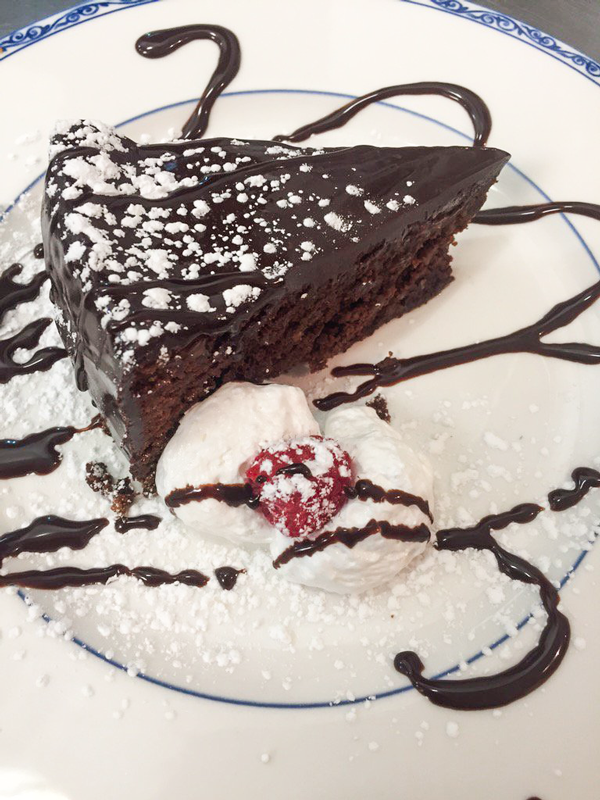
For Dessert
Chocolate Walnut Torte
Courtesy of Pinocchios Prime
Serves 10-14
INGREDIENTS
8 eggs, separated
1 cup confectioners’ sugar
1 cup melted butter
2 cups ground walnuts
1 tablespoon vanilla extract
1 1/2 tablespoons cornstarch
1 cup chocolate chips, melted
STEPS
Whip the egg whites in a bowl until they form soft peaks. In a separate bowl, mix the egg yolks, confectioners’ sugar, melted butter, ground walnuts, vanilla, cornstarch and melted chocolate chips. Gently add the whipped egg whites to the chocolate mixture with a spatula. Pour the batter into a greased 8″ springform pan and bake at 350° F for
40-50 minutes. Allow to cool.
Chocolate Ganache (frosting for torte)
INGREDIENTS
1 cup semisweet chocolate chips
1 cup heavy cream
STEPS
Microwave the chocolate chips in 30-second intervals until melted, about 90 seconds. The chocolate can also be melted in a double boiler over boiling water if preferred. Add heavy cream, stirring until blended with the chocolate. Remove from heat and allow the ganache to thicken (about 30 minutes), then spread over the cooled cake. Serve alone or with ice cream or whipped cream.