
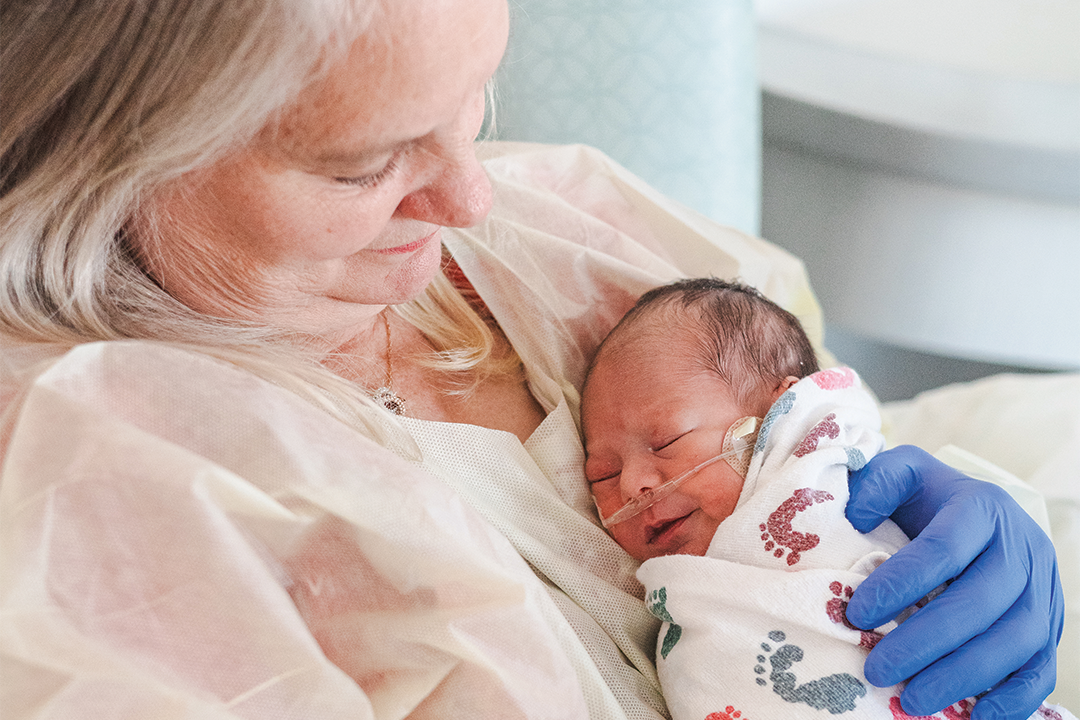
Tonya Motley still thinks about her own babies fighting to live as she cuddles the tiny ones who need her love at Poudre Valley Hospital in Fort Collins.
Motley has her own history with PVH’s Neonatal Intensive Care Unit, what she and other medical professionals call the NICU. She was born two months early and became the first baby at PVH to be placed in an isolette, a clear plastic crib that provides a warm environment free from germs. When she had her own babies, twin girls, in 1996, they spent a week in the NICU as well. They’re half the reason why she volunteers her time with other preemies in the NICU: She wishes the cuddling program existed when she had her own.
“I was exhausted,” says Motley, who lives in Timnath. “Getting here for two feedings a day was all I could do.”
She worked at PVH as a nurse when a dear friend adopted the baby of a mother who used drugs while she was pregnant. The friend told her there were volunteers who would hold her baby in the NICU when she couldn’t, and the results were extraordinary.
Tonya Motley. Photos by Jordan Secher.
“When her baby was held, she cried less and needed less morphine,” Motley says. “I was sold on it then.”
Indeed, there is now a wealth of research that shows how human contact for preemies is nearly as vital as their mother’s milk. Cuddled babies develop faster and, therefore, don’t spend as many days in the NICU. Not only do their brains grow faster, but their bodies do too.
This is true of all babies, but it’s especially crucial for preemies because of the nature of their treatment: Many are placed in the same isolettes that Motley spent her first days in. This keeps them safe but away from the stimulating environments that help babies thrive.
Cuddling reassures the preemies that they are loved. Motley puts it another way: She and the other volunteers take away their tears so they can focus on growing.
Volunteer cuddlers, many of whom remember how punishing it can be to have a newborn, aren’t judgmental of the parents who aren’t there 24 hours a day. Many parents who have NICU babies at PVH don’t live in Fort Collins or even in Colorado. More than a few live in Wyoming or Nebraska, and even those who live an hour away may have other kids or simply need to go home once in a while.
“I have sat there and cried with them,” says Coleen Waite, a longtime cuddler from Loveland.
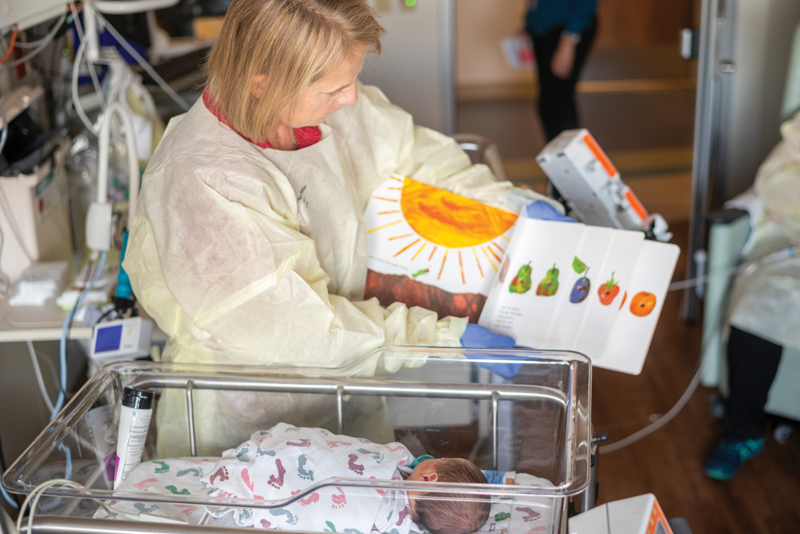
Nurses already have their hands full caring for all the babies in a NICU (there are more than you might think). NICUs have some babies who are clinging to life, of course, but many of them just need a little help. This is why the cuddlers are crucial: They can spend time giving the babies the attention they need to thrive, whether that’s reading them a book, singing to them or just sitting and holding them.
The birth of the cuddling program
As more evidence emerged of just how much preemies require that attention, hospitals began volunteer programs to cover the need. A longtime PVH nurse, Donette Blansit, pushed for the program, and after two years of work, in 2018, PVH adopted one of their own. Blansit, after retiring, came back as a cuddler herself.
Waite was one of two cuddlers in the pilot program. As a mother of eight kids, she was already an expert. She practically ran to the hospital when she heard about the program.
“I absolutely love babies,” she says. “When I hold a baby, it blocks out everything else in the world.”
The start was “bumpy,” Waite says. Cuddlers were contacted when they were needed, which was so often that they were essentially on call. They didn’t have to go, of course, but no one could hold Waite back from a baby who needed help. Now the cuddlers are given two-hour shifts at a time, sometimes several days a week, and Waite says it’s a lot smoother. There’s a reason why cuddlers are cut off after two hours: It’s a cozy job.
“It’s easy to get sleepy,” says Lori Dykstra, who coordinates more than 400 volunteers for a couple of hospitals in the UCHealth system, including PVH.
It’s not hard to sell volunteers on baby cuddling, Dykstra says, but it takes a special person to learn how to handle a preemie, even with the nurses’ coaching. Motley calls it a “whole different ballgame.” This is why UCHealth requires candidates to pass a background check and then volunteer for six months in other departments just to make the extensive waiting list.
Once the cuddlers are selected, they spend hours training and shadowing experts such as Waite before they’re signed on. The program loses some volunteers when it’s time for them to hold their first preemie because they can’t handle the tubes and beeping machines keeping them alive.
Trusting the process
Kiara and De’Angelo Gonzalez of Greeley had twin boys, Zakai and Enzo, who seemed OK for their first two days until Zakai stopped breathing during a feeding and Enzo got too cold. They were moved to the NICU.
“It was heart-wrenching at first,” Kiara says, “because all of a sudden they weren’t there.”
The couple wanted to stay with their babies at all times, and they did, until their time in the NICU stretched to two weeks and they had to go home for a bit. Kiara admits she was a little hesitant about allowing others to hold their boys. Many parents express that concern, and a few opt out of the program, though that’s rare.
“At the end of the day, it’s affection that’s given to them,” Kiara says. “That’s really refreshing.”
Motley enjoys talking to parents of twins the most. She likes telling them about her twins’ first year, when time blurred, and reassuring them that they will survive it too. And when they need a break, she’s there, whispering that same reassurance to their babies.