

Scott Rashid, 61, dedicated his life to birds after he fell in love with their grace and agility. Most of that love stemmed from the fact that he didn’t have either.
His father once tried out for the Yankees and played basketball on a team that faced the Harlem Globetrotters, and his brothers were equally athletic. Rashid was a gangly high school kid with long legs that tangled together every time he tried to run.
But Rashid, like the most successful wild creatures, was terrific at adapting to whatever the world required of him. He found drumming and played for years in bands. He also found art: His photography and drawings adorn the pages of the seven books he’s written. And he found birds. It’s doubtful he would’ve been fascinated by them if he could dart through the wind like they do.
“I was so awed by how agile the birds were, compared to how clumsy I was,” he says.
If Rashid hadn’t found birds, he wouldn’t have passed his love for them on to the tens of thousands of people who have listened to his lectures in Arizona, Texas and Estes Park, where he lives now. He also wouldn’t have shared it with the birds themselves, including the raptors who’ve lived in the many nest boxes he has built and erected all over Northern Colorado. Most of all, he wouldn’t have it for himself. His love for the winged creatures would have died in the nest, like an unhatched egg.
“The thing about Scott,” says Jennifer Redmond, who volunteers for the Colorado Avian Research and Rehabilitation Institute (CARRI), a nonprofit Rashid founded and runs out of his home, “is that he has a passion that does not quit. He could talk about birds 24/7.”
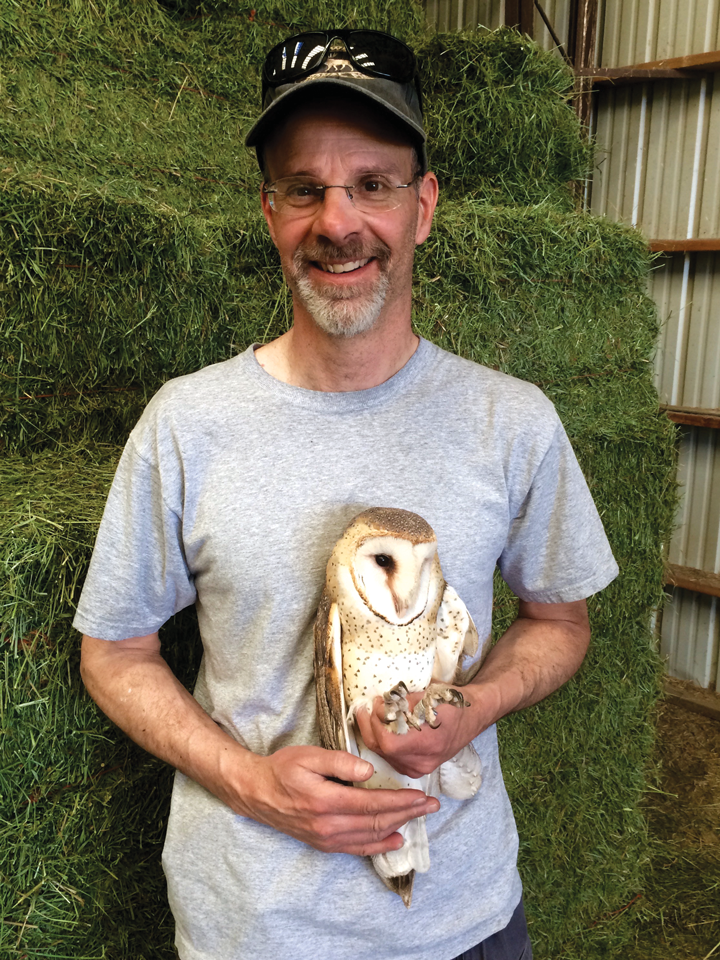
Scott Rashid holding a barn owl after banding.
Finding his way
Rashid has a degree in art, not biology, and it was art that led him to birds. An avian professor gave him some photos to draw and connected him with a scientist who studied hawks.
That winter, Rashid spent hours with the scientist, “banding” hawks by placing a small metal ring with a unique number around one of their legs, making them easier to track. In the summer, the two banded ospreys and eagles.
Rashid’s artwork soared when he had actual subjects to observe and draw. He was good enough that he had his work shown in a North Carolina gallery after he graduated from college in the late ’80s. Then he visited Estes Park in 1989 to show his work at a Western art show at The Stanley Hotel. He thought Estes was gorgeous and, possibly, a good place to observe birds, so he migrated there for good that summer.
Banding as a science
When Rashid moved to Estes Park, he worked with a professor at Colorado State University to get a bird banding license. He banded for more than a decade before people recognized that all his time in the field made him an expert, even if he lacked any formal academic training. The first of his hundreds of lectures was a presentation on birds in the Estes valley for Rocky Mountain National Park.
Those presentations led Rashid to believe that what he’d learned about owls could make a good book. He called it “Small Mountain Owls,” and it was first published in 2009, featuring more than 160 of his graceful illustrations and photographs. The book has since been updated and is available on the Schiffer Publishing website, along with two of Rashid’s other books on the great horned owl and the northern goshawk.
Much of Rashid’s banding happens at the YMCA of the Rockies, where, since 1998, he has given banding demonstrations for guests three times a week. He has caught and banded more than 15,000 birds there.
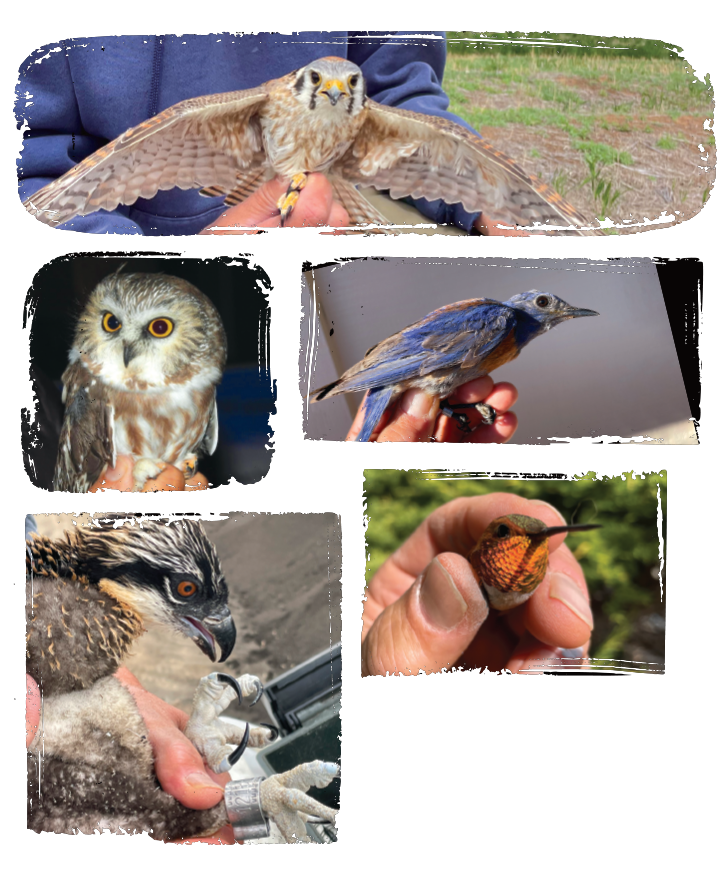
Some of the many birds Rashid has banded: American kestrel (top), northern saw-whet owl (middle left), western bluebird (middle right), osprey (bottom left) and rufous hummingbird (bottom right).
Banding birds is important to Rashid for reasons other than the opportunities it has afforded him. It informs him, and others based on the data he collects and shares, of species’ migration patterns, population counts and, perhaps most importantly, the health of their habitat, a key point in the face of climate change.
It has also informed him on where to put up the bird boxes—essentially bird houses for raptors and other large birds—he’s built through the years and placed all over Northern Colorado and Texas. Rashid has installed more than 180 nesting boxes for American kestrels and more than 100 for owls, and he has learned a lot from the cameras he puts inside them (more than 300 kestrels hatched in them this year). The boxes are all he does for the birds: He wants them to stay wild.
The birding population has decreased to the point where CARRI, Rashid’s nonprofit, is a little quiet. He founded the organization in 2011 to raise money to help pay for bird rehabilitation, and for a while, he did quite a bit of it. But now he says the need isn’t there. He used to care for 40-50 birds a year, mostly by giving injured birds medical treatment, a safe space to heal and, eventually, a chance to work up their hunting skills before being released. Now he gets a couple.
He thinks the decline comes from habitat loss and a drastic decline in insects as well as pollution and climate change.
“That’s why I’m putting up these boxes and giving them a place to live,” he says.
A unique career path
Out in the field, Rashid takes detailed notes on how the birds act, even if it means staying out all night. He calls himself a wildlife observer, not a traditional scientist, but he believes in his methods.
Redmond, one of his volunteers, works as an eye doctor in Aurora and got her master’s degree in biology just so she could pursue environmental conservation as a hobby. Rashid has had an unusual path, she says, and she doesn’t know anyone else like him, both in that he works alone, save for a few volunteers, and in the way he became an expert.
“He’s a very good naturalist,” Redmond says. “Scientists can get tunnel vision, but he just observes birds in the field.”
Rashid’s wife died of cancer in 2018, and he has a girlfriend now. But most of his time is spent outside. It’s not the call of the wild, per se. He’s just following the call of the birds.